
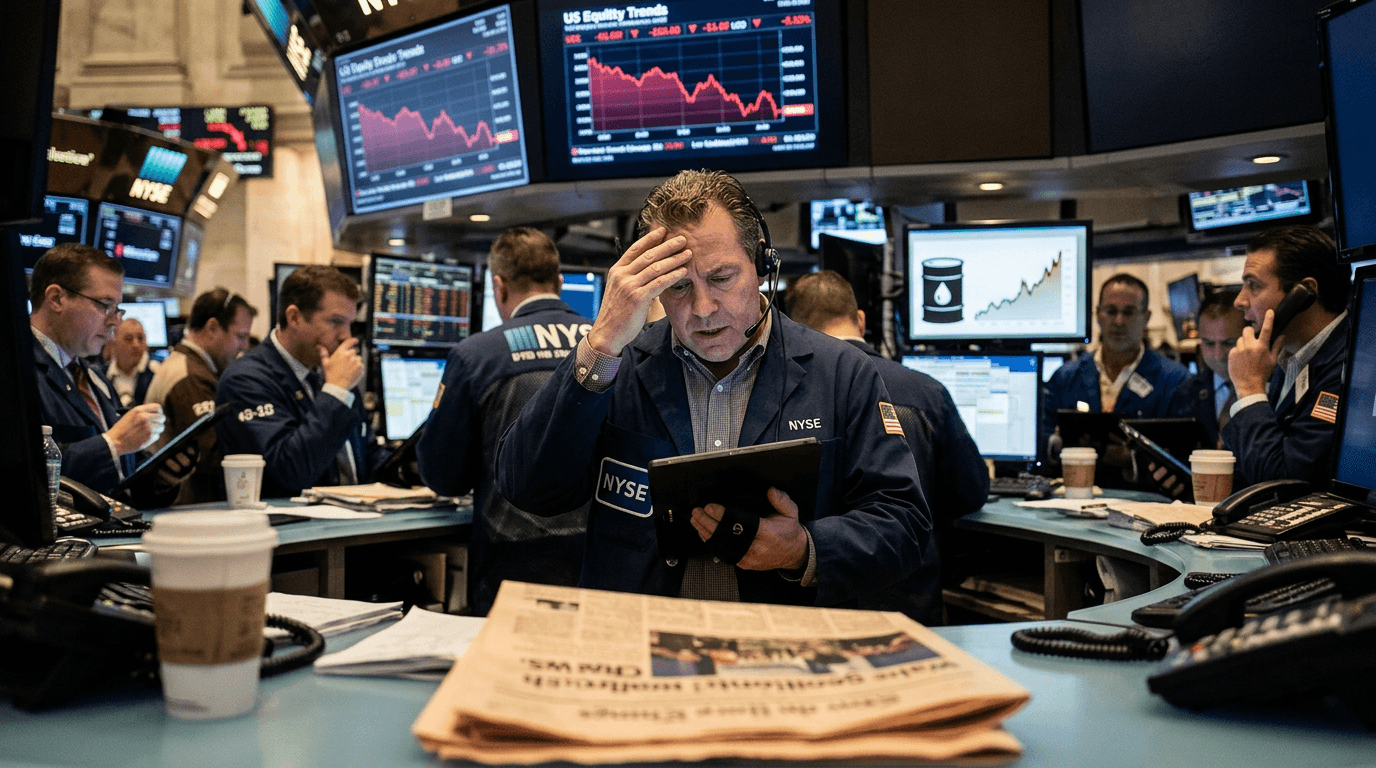
Global financial markets are facing considerable turmoil as rising tensions between the United States and Iran ripple through equity markets and energy prices. The ongoing geopolitical crisis has interrupted a record-setting rally in US stocks, causing major indices to pull back sharply while crude oil prices have surged beyond $100 per barrel. For traders and investors watching these developments, grasping the interconnected dynamics of these market movements is crucial for navigating the current volatility and strategically positioning portfolios.
The Stock Market Selloff
This week's abrupt halt in the record-breaking rally of US equities is attributed to stalled diplomatic efforts and escalating military tensions. The S&P 500 and Nasdaq, buoyed by robust corporate earnings and stellar chipmaker performance, saw their winning streaks end amid growing investor uncertainty. Futures for the S&P 500 dropped 0.4% as traders shifted away from risk assets, seeking safer positions due to the ongoing impasse in US-Iran peace talks. The Nasdaq, in particular, ended an impressive 13-session winning streak, underscoring that even the most resilient sectors were not immune to the wider market anxiety. With market volatility on the rise, investors are grappling with geopolitical uncertainty and the tangible risk of further military confrontation. This reversal is especially notable given that the US benchmark had recently achieved an all-time high, with April gains surpassing 9% following strong corporate earnings reports.
Oil Prices Surge On Supply Disruption Fears
At the heart of market volatility lies the critical situation in the Strait of Hormuz, a key energy chokepoint globally. Brent crude has soared past $100 per barrel, reaching approximately $102.60, driven by genuine concerns over potential supply disruptions. The blockade has introduced substantial risk premiums, with traders factoring in possible interruptions to global oil supplies. Recent escalations, including Iranian forces targeting commercial ships in the vital waterway, with cargo and container vessels under direct threat, have intensified tensions. The US has responded by intercepting Iranian oil tankers and providing military escorts for additional vessels in the Indian Ocean. This tense standoff has led to legitimate supply concerns that go beyond mere speculation, significantly impacting global energy markets.
Sector Rotation And Market Winners
The market turmoil has prompted a classic risk-off sector rotation, highlighting how geopolitical events can reshape portfolio performance. Energy companies and defense stocks have emerged as market leaders, as investors direct capital toward beneficiaries of high oil prices and increased defense spending. The Dow Jones U.S. Defense Index recorded gains as military tensions fueled demand for defense-related equities. In contrast, travel and airline stocks have suffered considerably, strained by flight cancellations, increased jet fuel costs, and widespread closures of Middle Eastern airspace. Interest-sensitive sectors have also experienced challenges as investors worry about prolonged geopolitical uncertainty and oil price spikes potentially affecting inflation and central bank policy responses. Several oil and gas facilities across the Middle East have suspended production, further constraining supply and supporting energy prices.
Global Contagion And International Markets
The ramifications of US-Iran tensions have extended beyond American equity markets, posing significant challenges to global financial systems. European stock markets dropped over 1%, with both French and German indexes pressured by rising oil prices and conflict-driven uncertainty. Asian markets saw even sharper declines, with Japan's Nikkei 225 falling 1.73% after initially dropping 2% at the open. These international declines reflect genuine economic concerns about how prolonged geopolitical conflict could hamper global growth, particularly for energy-dependent economies. The rerouting of oil tankers around the Strait of Hormuz is generating logistics costs that reverberate through global supply chains, adding inflationary pressures to an already complex economic landscape.
Implications For Traders And Investors
The current market environment presents both challenges and opportunities for traders navigating heightened volatility. The breakdown in diplomatic talks and uncertain ceasefire timelines suggest that near-term uncertainty will likely persist, maintaining elevated volatility across asset classes. Traders should closely monitor key developments, including diplomatic progress, military escalation risks, and actual supply disruptions from Middle Eastern production facilities. Effective risk management is vital when geopolitical factors lead to price gaps and rapid directional movements. The strong correlation between energy prices and equity market weakness suggests that crude oil price fluctuations will likely continue to influence broader market sentiment. Strategies such as portfolio diversification across defensive sectors, careful position sizing, and dynamic rebalancing aligned with changing risk conditions are essential for capital preservation during periods of geopolitical stress.
Looking Ahead
While record-high stock valuations and strong economic fundamentals provided a bullish foundation before this crisis, geopolitical events can swiftly override technical factors. Investors must recognize that even the strongest market rallies are vulnerable to external shocks. Market participants will closely observe peace talks, military developments, and actual supply disruptions as key indicators determining whether recent volatility signals a temporary pullback or the onset of a more significant correction. The coming days and weeks will be pivotal in determining whether markets can regain confidence or if escalating tensions will continue to pressure risk assets.