
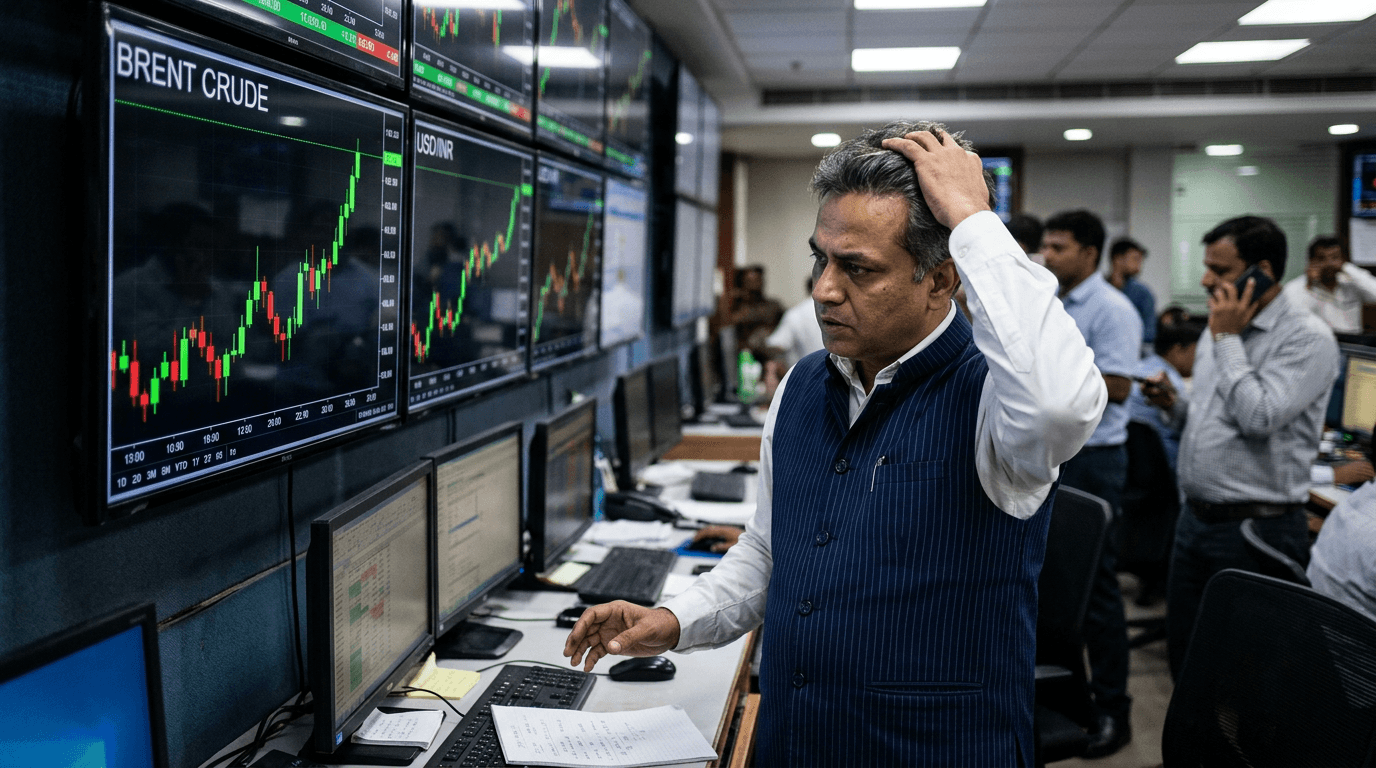
Oil prices have surged back into the spotlight, and this time the rally is radiating stress across emerging-market currencies, with the Indian rupee squarely in the firing line.[3][9] For a country that imports the bulk of its crude, elevated Brent prices are not just a market story—they are a macro shock that touches inflation, the trade balance, and expectations for the Reserve Bank of India (RBI).
Oil Rally And Emerging-market Fx Stress
When Brent crude spikes, the first casualties are often oil-importing emerging markets whose economic fortunes are tightly linked to energy costs.[3][13] Higher oil prices worsen their terms of trade, force more dollar outflows, and raise fears about inflation and slower growth—all of which feed directly into currency weakness.[2][3]
Reuters and other market observers have highlighted that as Brent remains elevated and traders price in the risk of further supply disruption, the rupee is expected to come under renewed pressure alongside other emerging-market FX.[3][9][10] The stress is not simply about one commodity contract; it reflects a broader repricing of geopolitical risk and macro vulnerability.
India is a prime example of this dynamic. As global energy costs rise, foreign investors tend to reassess exposure to riskier assets and currencies, often reducing positions in emerging markets and rotating toward safe-haven or dollar assets.[2][3] That shift in capital flows amplifies the impact on EM FX beyond the direct trade and energy channels.
Why High Oil Hits The Indian Rupee
The oil–rupee relationship is both structural and statistically strong. India imports over 85% of its crude oil requirements and pays for those imports primarily in US dollars.[2][13] That means every sustained move higher in Brent mechanically increases India’s dollar demand.
A recent empirical study finds an “extremely strong positive correlation” between Brent crude prices and the USD/INR exchange rate, with oil prices explaining more than 80% of the variance in the rupee over a decade.[1] The paper’s central rule of thumb: a one‑dollar increase in Brent is associated, on average, with a depreciation of roughly 28 paise in the rupee.[1] Put differently, a $10 per barrel rise in Brent tends to be linked to about ₹2.82 of rupee weakness, all else equal.[1]
In practical terms
- When oil rises, Indian refiners and importers must buy more dollars to purchase the same volume of crude.[2]
- That additional dollar demand, without a matching rise in dollar inflows, pushes the rupee lower against the US currency.[2]
- The more abrupt and persistent the oil shock, the sharper and more sustained the pressure on INR.[1][3]
Historical episodes bear this out. Past jumps in crude prices have coincided with rupee declines, often accompanied by equity market drawdowns as higher energy costs and risk aversion hit broader sentiment.[6][10][13] Conversely, periods of lower oil prices have helped support the rupee by easing both the import bill and inflation concerns.[11]
Macro Transmission: Inflation, Trade Gap, And The Rbi
Oil’s impact on the rupee is not just a simple import bill story; it ripples through several macroeconomic channels that markets watch closely.
First, higher oil prices widen India’s trade deficit. Costlier crude means more dollars leave the country to pay for imports without an offsetting rise in export revenues, structurally weakening the rupee.[2][3] If the trade gap remains large for long, it can raise concerns about external balances and increase vulnerability to sudden stops in capital flows.
Second, oil is a major input into the domestic inflation picture. Rising fuel costs feed into transportation, manufacturing, and household budgets, driving headline inflation higher.[2][13] A sustained oil rally raises the risk that inflation could overshoot central-bank comfort zones, prompting expectations of tighter monetary policy.
Third, the RBI must manage the trade‑off between growth and price stability while trying to keep financial markets orderly. When oil shocks hit, the central bank often responds with a mix of tools:
- Managing FX volatility through intervention in the currency market.[1][8]
- Adjusting liquidity conditions to smooth the impact on money markets and bond yields.[8]
- Communicating its inflation outlook and reaction function to anchor expectations.[8]
Research suggests that while RBI interventions can slow and smooth the rupee’s adjustment to higher oil prices, they cannot fully prevent it over a 12‑month horizon; over time, the exchange rate tends to realign with the underlying oil‑driven fundamentals.[1] For traders, that implies that short‑term rebounds in INR during intervention-heavy periods may be tactical rather than structural.
How Traders Are Positioning In Em Fx
In an environment of elevated Brent and geopolitical tension, FX traders typically reassess their stance across the emerging‑market complex.[3][13] Several patterns are common:
- Relative differentiation between oil importers (like India) and oil exporters (such as some Middle Eastern or Latin American economies). Importers tend to see more pressure on their currencies when crude spikes.[3]
- Preference for currencies with strong external positions, sizable reserves, or credible central‑bank frameworks as defensive EM plays.
- Increased use of hedging strategies—via options, forwards, or cross‑currency trades—to manage exposure to oil‑linked FX volatility.
For the rupee specifically, market commentary has noted that a negative bias can pile pressure on the currency when high oil prices coincide with broader risk‑off sentiment toward India.[9][10] Traders watch several indicators:
- Brent price levels and volatility.
- India’s trade deficit and current account data.
- RBI communication and intervention patterns.
- Portfolio flows into and out of Indian equities and bonds.[10][13]
When oil shocks are driven by geopolitics—such as tensions in the Middle East—headline risk can dominate, making intraday FX moves sharper and sometimes less anchored to traditional valuation metrics.[6][10][13] That can create both opportunity and risk for active traders, particularly in leveraged or derivatives-based strategies.
Practical Takeaways For Market Participants
For investors, traders, and risk managers, the current oil rally and its impact on the rupee offer several practical lessons:
- Treat Brent as a key macro indicator for INR: Given the strong long‑run link, tracking crude alongside conventional FX drivers (rates, growth, flows) is essential.[1][2][3]
- Focus on sustainability, not just spikes: Short‑lived price jumps can be absorbed, but prolonged elevated oil tends to have more durable effects on inflation, the trade balance, and currency levels.[3][13]
- Watch policy and positioning: RBI responses, fiscal measures (such as fuel tax tweaks or subsidies), and foreign‑investor flows can either amplify or mitigate oil’s impact.[8][10][13]
- Use scenarios and stress tests: Simulated environments and scenario analysis can help gauge how portfolios might behave under different combinations of oil prices, rupee levels, and policy paths.
For those trading or investing around India and broader emerging markets, connecting the dots between geopolitics, commodities, and currency dynamics is no longer optional—it is central to understanding risk. The latest oil rally is a reminder that in EM FX, energy prices can act as a powerful transmission channel, turning distant geopolitical tensions into immediate moves on the trading screen.