
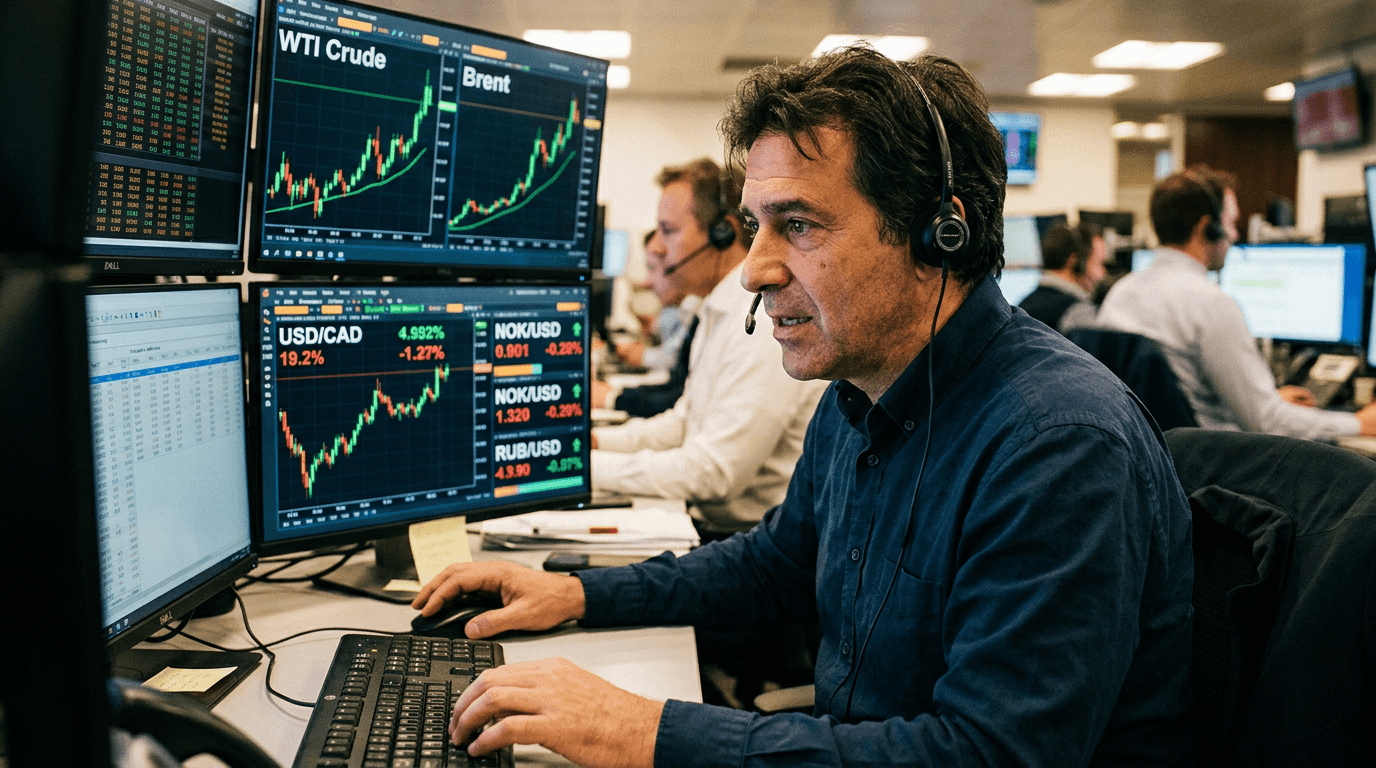
Oil’s latest rebound above key price levels is reminding traders that crude is still one of the most important macro drivers for global FX, particularly for the Canadian dollar and other petrocurrencies. As the Middle East conflict intensifies and energy flows are disrupted, oil-linked currencies are catching a bid, while volatility in energy futures creates both opportunity and risk for active market participants[1][2][4][9].
Market Backdrop: Oil Rebounds On Geopolitical Tensions
Brent and WTI crude have pushed back above key psychological thresholds, with prices trading in the mid‑90s to above $100 per barrel as the conflict widens across the Middle East[1][2][10]. This rebound comes after a period of consolidation and pullbacks from earlier war‑driven highs, highlighting how quickly geopolitics can reprice the energy complex[1][5][9]. For traders, the message is clear: when supply routes and infrastructure are at risk, the market will pay up for barrels.
Shipping and production disruptions have been central to this move. The Strait of Hormuz, a corridor that carries roughly a fifth of global oil and LNG flows, has seen repeated closures and interruptions as hostilities escalate[3][4]. Attacks on energy facilities and tankers have forced rerouting and raised insurance costs, further tightening effective supply even before formal embargoes or sanctions are considered[4][6][9]. These physical constraints underpin the latest leg higher in prices and justify the market’s sensitivity to headlines.
How Higher Oil Prices Feed Into Cad And Petrocurrencies
The Canadian dollar tends to appreciate when oil prices rise because crude exports are a major source of national income and a key driver of Canada’s terms of trade. Higher oil receipts can support government revenues, corporate profits, and investment, all of which feed into stronger growth expectations and, potentially, higher interest rate trajectories. In FX markets, that often translates into a firmer CAD against currencies less exposed to energy.
Other petrocurrencies, including NOK (Norwegian krone), MXN (Mexican peso), and certain emerging‑market producers, can see similar dynamics. When oil moves higher on supply shocks rather than demand strength, the effects can be uneven: producers benefit from improved fiscal and external balances, while net importers face deteriorating trade positions and higher inflation. This divergence is one reason why oil rallies during crises tend to amplify currency differentiation rather than lift all boats.
For traders, the key is understanding correlation regimes. In “normal” times, CAD and NOK may respond moderately to day‑to‑day crude fluctuations. During geopolitical stress, however, short‑term correlations can spike as oil becomes the primary narrative. That means moves in front‑month futures, spreads, and volatility indices can quickly spill into FX, especially when markets are thin and headline risk is elevated[9]. Position sizing and hedging need to reflect that regime shift.
Volatility, Risk Sentiment And Cross-asset Flows
Energy markets have seen some of their largest daily and monthly swings in decades as the Middle East war disrupts flows and damages critical infrastructure[6][7][9]. Traders report that the tape is driven by headlines, with sudden price gaps following news of strikes, escalations, or tentative ceasefire talks[9]. Options markets are pricing elevated implied volatility in crude, and intraday ranges in futures have expanded accordingly[9]. This backdrop increases the probability of sharp squeezes and forced liquidations.
Higher oil prices also intersect with broader risk sentiment. Rising energy costs can fan inflationary pressures, complicate central bank decisions, and weigh on real income and growth expectations[6][8]. Equity markets often react negatively to prolonged oil spikes, especially in energy‑intensive sectors, while bond markets reassess the path of real yields and inflation premia. For FX, the mix of stronger petrocurrencies and weaker importers can create complex cross‑currents that reward traders who understand the macro linkages.
In practical terms, this environment tends to favor tactical, event‑driven strategies over static positioning. Short‑dated trades around scheduled events (OPEC meetings, geopolitical summits, major data releases) can be more effective than long‑horizon directional bets when the news cycle dominates price action. Risk management tools—such as staggered entry, tighter stops, and options hedges—become essential rather than optional.
Trading Implications In A Simulated Finance Environment
Simulated finance (SimFi) platforms like E8 Markets offer a valuable sandbox for navigating this kind of complex macro backdrop. Traders can test how CAD pairs react to sudden $5–10 intraday moves in WTI, or how cross‑asset correlations change when oil gaps higher on geopolitical news rather than on demand surprises. Because the capital is simulated, participants can focus on skill development—strategy design, execution, and risk discipline—without the psychological burden of real drawdowns.
One powerful use case is scenario analysis. Traders can build playbooks for different paths of the conflict: prolonged disruption with oil grinding higher; rapid de‑escalation leading to a sharp reversal; or partial resolution where prices stabilize but volatility remains elevated. In each scenario, they can map potential outcomes for CAD, NOK, MXN, and key equity indices, then test entries, exits, and hedges in a realistic environment.
SimFi also helps traders refine their response to “headline markets.” When price is driven by news rather than data releases or scheduled events, timing and information flow become critical. Practicing how to react—rather than overreact—to breaking news, how to avoid chasing exhausted moves, and how to distinguish signal from noise is a core edge in energy‑linked trading. The ability to replay and review trades in a simulated environment accelerates that learning curve.
Key Takeaways For Traders
The current rebound in oil prices, driven by intensified conflict and disruptions across the Middle East, is a reminder that energy remains a core macro driver[1][2][4][9]. For FX traders, CAD and other petrocurrencies are obvious beneficiaries, but the story extends across asset classes—from equities and rates to commodities and volatility.
To navigate this environment effectively
1. Track both price and narrative: follow crude benchmarks, spreads, and volatility indicators alongside credible geopolitical news sources[1][2][6][9]. 2. Respect regime changes: assume correlations and volatility can shift quickly when supply routes or infrastructure are threatened[4][6][9]. 3. Focus on risk‑adjusted returns: adapt position sizing, leverage, and hedging to match the higher volatility regime. 4. Use simulation to refine your edge: test strategies and stress‑test portfolios in a SimFi setting before committing real capital.
Conclusion
Oil’s break back above key levels as the Middle East conflict escalates underscores how geopolitics, energy flows, and currencies are tightly intertwined[1][2][4][9]. The Canadian dollar and other petrocurrencies are benefiting from the improved terms of trade, but the broader macro picture is more nuanced, with higher volatility and increased tail risks. Traders who invest in understanding these linkages—and who use simulated environments to sharpen their strategies—will be better placed to turn turbulent energy markets into disciplined opportunities rather than uncontrolled risk.