
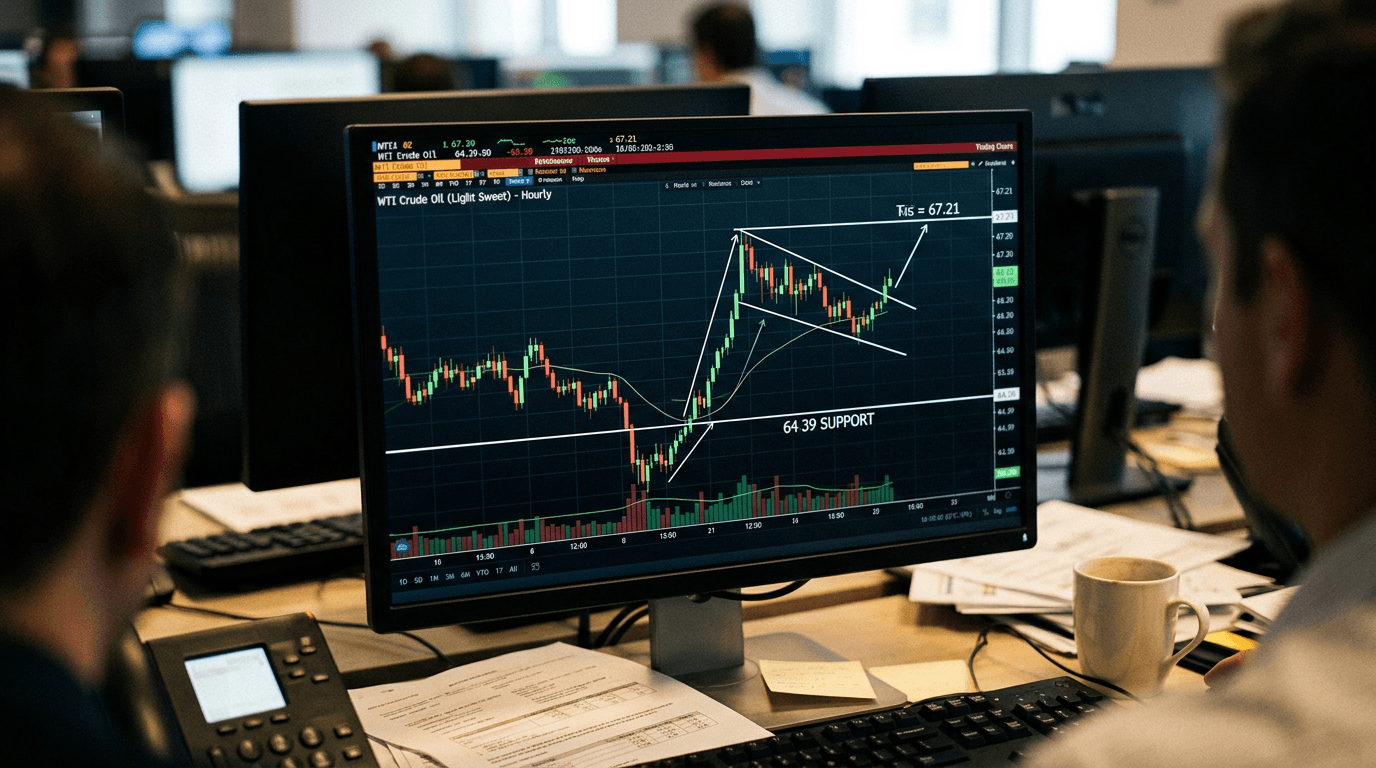
West Texas Intermediate crude has staged a compelling recovery this week, bouncing from critical support levels to retest bullish territory amid a backdrop of geopolitical uncertainty and technical strength. After dipping to $64.39 on February 26 following a surprise surge in US crude inventories, WTI has climbed back toward the $66 level, signaling renewed investor confidence in energy markets. This rebound validates key support zones and sets the stage for a potential push toward the $67.21 resistance level—a critical milestone that could extend the year's impressive rally further north.
Understanding The Support And Resistance Framework
The recent price action has crystallized important technical levels that traders must respect. The support zone between $64.02 and $63.70 proved decisive this week, preventing a deeper correction despite headwinds from inventory data. When WTI touched $64.39 on Thursday, it found sufficient buying interest to spark a reversal, demonstrating that institutional players view this zone as a meaningful floor. This is significant because holding support in a strong uptrend often precedes the next wave of bullish momentum.
The first target of $65.46 has already been reached, representing a critical confirmation point for bullish traders. This level acts as a psychological waypoint before the market attempts its primary objective: reclaiming the $67.21 resistance, which corresponds closely to the February 23 high and the six-month peak established on February 19. Breaking above this zone would not only invalidate the recent correction but also open the door to further upside expansion. For energy traders and portfolio managers, watching how price action unfolds around these levels will be essential for positioning decisions.
The Technical Case: Bullish Flag In Formation
From a technical perspective, crude oil has developed a textbook bullish flag pattern, one of the most reliable continuation formations in technical analysis. Since the six-month high near $67, followed by the pullback, the market has been consolidating in a tight range—precisely the behavior expected during flag construction. This consolidation phase, supported by the 20-day moving average, represents a period of accumulation where buyers are gathering strength for the next directional move.
Bullish flags typically resolve in the direction of the preceding trend, and in this case, that direction is unmistakably upward. WTI crude has delivered a year-to-date gain of 14.2%, making it one of 2026's top-performing assets across all major markets. The technical structure suggests that this outperformance may have more room to run. When the flag breaks above its upper boundary, breakout targets often extend 40 to 50 percent of the flagpole height above the resistance level, indicating potential for significant additional upside if the pattern completes as expected.
Geopolitical Risk Premium: The Undercurrent Driving Prices Higher
Beneath the technical landscape lies a powerful fundamental dynamic that continues to underpin oil prices: Middle East geopolitical tension and the ongoing US-Iran nuclear negotiations. The third round of nuclear talks held in Geneva on February 26 kept markets on edge, and the potential for escalation remains real. US military forces have amassed in the Red Sea region, and Washington has intensified sanctions pressure on Iranian entities involved in oil and weapons exports, creating an environment where every headline can influence price action.
This geopolitical risk premium is not merely a temporary phenomenon. It reflects genuine concerns about potential supply disruptions and the possibility of military confrontation. Should a large-scale military operation occur that blocks the Strait of Hormuz—through which roughly one-third of the world's seaborne crude passes—prices could spike substantially. Industry analysts note that such a scenario could push WTI toward $80 per barrel, a level that would have profound implications for global energy markets and inflation pressures.
Inventory Data And Market Dynamics
The surprise 16-million-barrel build in US crude inventories last week did trigger the recent pullback, as it suggested softer-than-expected demand despite strong prices. However, this inventory surge must be contextualized. Global oil production continues to exceed demand in many analysts' forecasts, yet the geopolitical risk premium has proven more than sufficient to offset bearish supply dynamics. The Energy Information Administration projects Brent crude will average $58 per barrel for 2026, yet forward-looking traders are pricing in the possibility of higher volatility and prices as long as Middle East tensions persist.
Trading Strategy And Outlook
For active traders, the current setup offers a favorable risk-reward framework. The bounce from support at $64.39 with a defined target at $67.21 provides a clear profit objective while keeping stops relatively tight below the support zone. Position traders should consider building or maintaining long exposure on dips into the $65-$65.50 range, where support from the first rebound target provides an ideal entry point for scaling into moves toward the secondary target.
The broader trend remains constructive despite short-term noise. The bullish flag pattern, combined with geopolitical underpinnings and technical recovery from support, suggests that the path of least resistance for crude oil remains higher. Breaking above $67.21 would signal a decisive move toward testing February's six-month highs and potentially establishing new legs higher in the medium term.
Key Takeaways For Traders And Investors
The rebound to $65.46 represents a successful defense of critical support and a validation of the ongoing uptrend. The bullish flag formation offers a technical framework for anticipating higher prices, with $67.21 serving as the immediate target. Geopolitical risk premium continues to provide upside support, and only a significant de-escalation in Middle East tensions or a major demand shock could derail this constructive structure. Monitor price action around resistance zones closely, and remain positioned for potential continuation higher.