
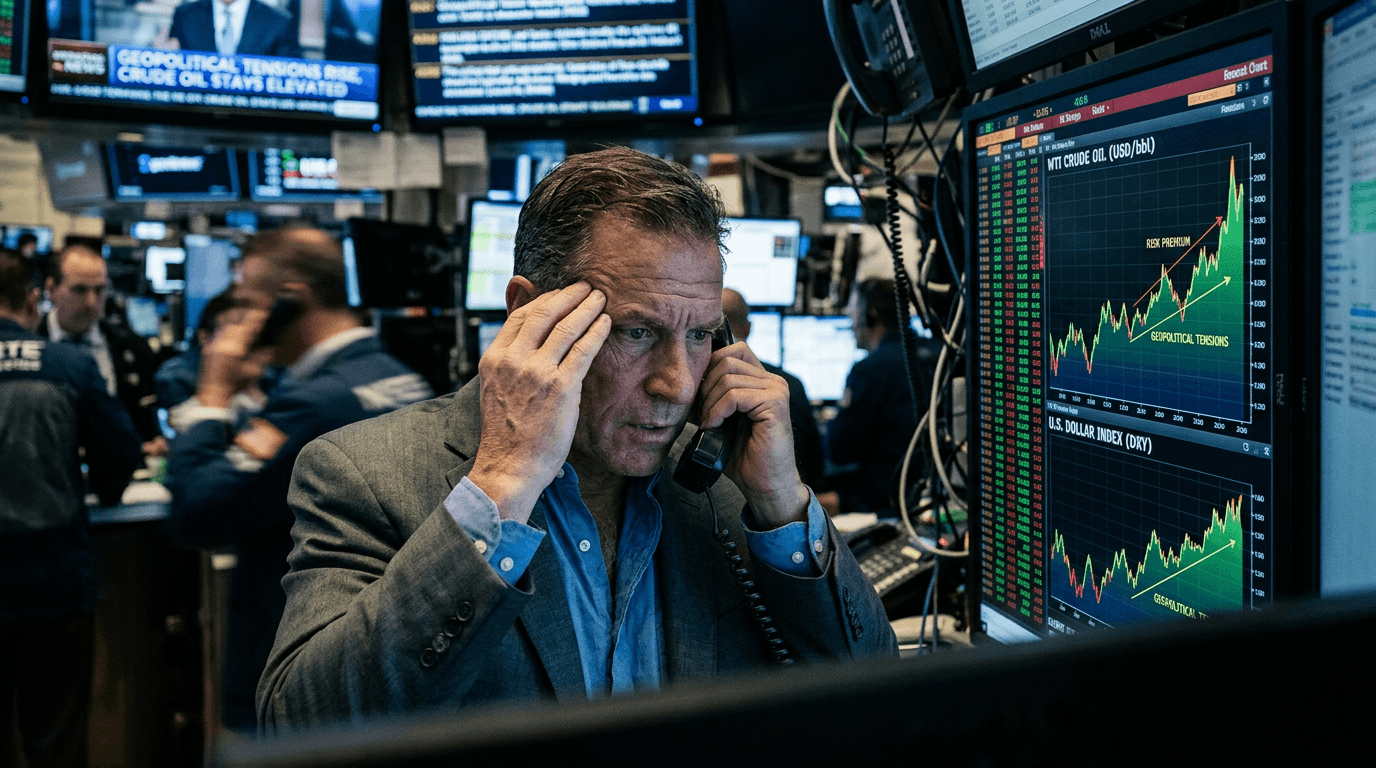
Geopolitical tensions have pushed West Texas Intermediate (WTI) crude into a regime where prices reflect not just supply and demand, but a sizable geopolitical risk premium layered on top of fundamentals[6][9]. This elevated and unstable oil backdrop is reinforcing demand for the U.S. dollar and other safe-haven assets, encouraging traders to adopt more defensive foreign exchange (FX) positioning as they navigate headline-driven volatility[5][17].
Geopolitical Risk Premium Back In Wti
A geopolitical risk premium is the extra cost baked into oil prices to reflect the probability of future supply disruption rather than any confirmed loss of barrels[6]. In recent months, WTI has traded well above levels implied by underlying demand and inventory data, as markets price the risk of conflict-related outages and shipping disruptions around key chokepoints such as the Strait of Hormuz[4][6].
Evidence of this premium is visible in repeated sharp rallies driven primarily by geopolitics. WTI has posted double-digit percentage gains over short periods, including an 11% weekly surge as traders rapidly rebuilt a geopolitical risk premium into prices[2] and a 17% move higher as supply-disruption fears overtook fundamental data[5]. Analysts have estimated specific “Iran premiums” in the range of $3–$4 per barrel for WTI and Brent, while Persian Gulf shipping risks have added a much larger $10–$20 per barrel premium to Brent in some episodes[1][4][9][14]. These are sizeable numbers relative to normal daily price moves and represent a clearly identifiable risk surcharge.
At the same time, there has been no large-scale, sustained physical supply outage in many of these episodes[6]. Instead, traders are pricing probabilities: potential sanctions tightening, tanker incidents, or temporary closures of strategic straits. When tensions ease, the premium can fade quickly, sending prices back toward pre-conflict levels, as seen when resumed flows through Hormuz pushed WTI down toward the high-$60s[7][12]. The result is an oil market where geopolitics sets the ceiling while fundamentals define the floor[1][10].
Key takeaway: WTI is not just an oil-demand story; it is a risk-pricing instrument where conflict probabilities and shipping risks materially elevate prices above equilibrium levels.
Why Elevated Oil Supports Defensive Fx Positioning
When crude trades on geopolitical risk rather than pure macro fundamentals, broader markets often shift into a “risk-off” stance. Investors rotate toward safe-haven assets to hedge against the potential for disorderly energy price spikes, disruptions to trade routes, and knock-on effects to global growth[5][6]. This shift tends to support the U.S. dollar and other perceived safe havens in FX markets[17].
The U.S. dollar benefits in several ways. First, oil is predominantly priced and traded in dollars, so higher crude prices mechanically increase global dollar transaction needs[9]. Second, during periods of heightened geopolitical uncertainty, global investors tend to park capital in deep, liquid dollar assets, including U.S. Treasuries and high-grade credit, reinforcing defensive dollar demand. The broader safe-haven complex—traditionally including currencies like the Japanese yen and Swiss franc—also attracts flows as investors seek to reduce exposure to high-beta, higher-yielding or commodity-linked currencies[17].
Meanwhile, currencies of oil-importing economies can come under pressure as higher energy costs worsen their terms of trade and inflate import bills. Even some oil exporters may not fully benefit if the risk-off mood leads investors to trim exposure to emerging markets more broadly, offsetting the positive impact of higher spot crude prices. The net effect is a preference for strong, stable, and liquid currencies, with traders favoring defensive FX baskets over growth-sensitive or carry-driven strategies.
Key takeaway: Elevated, geopolitics-driven crude prices are amplifying risk-off behavior, underpinning demand for the U.S. dollar and other safe-haven currencies while discouraging aggressive positioning in high-yield or emerging-market FX.
Volatility In Energy Futures And Cross-asset Flows
As geopolitical risk premium becomes a key driver of WTI, energy futures markets have shifted into a highly headline-sensitive, news-driven phase[5][8]. Price swings are often triggered not by weekly inventory data or demand revisions, but by diplomatic statements, military incidents, and shipping news. Futures curves can reprice rapidly as traders adjust expectations about the probability and duration of potential disruptions[6][11].
For example, CME commentary has highlighted how WTI futures remained firm as tensions escalated in the Middle East, even as U.S. inventories fell modestly, underscoring that geopolitical factors were dominating price action over conventional supply data[11]. Other analyses note that crude is now trading more as a geopolitical premium instrument than a straightforward macro demand gauge, with WTI and Brent prices explicitly reflecting risk surcharges for Iranian exports, Black Sea tanker safety, and war-risk insurance costs[9][4].
These dynamics spill over into other asset classes. Higher, risk-premium-driven oil prices can lift near-term inflation expectations and complicate bond markets’ assessment of central bank trajectories, even when core demand indicators remain soft[6]. Equity sectors tied to energy, transportation, and manufacturing become more volatile as their input costs and profit outlooks swing with every geopolitical headline. FX markets, in turn, respond to changes in risk appetite and growth expectations, reinforcing the defensive positioning originally triggered by oil.
Key takeaway: Energy futures are in a regime where geopolitical headlines drive volatility and cross-asset correlations, making crude a central variable in the broader risk environment.
Practical Takeaways For Traders And Simulated Strategists
For traders—and for those practicing strategies in simulated finance environments—the current backdrop demands a structured approach to risk premium and defensive positioning. One effective framework is to separate crude’s price into two conceptual components: a fundamental base (driven by demand, supply, and inventories) and a geopolitical overlay (the risk premium)[6][9][10]. Scenario analysis can then focus on how each component might evolve under different news outcomes.
In FX, this translates into clear positioning rules. During periods of elevated oil-related risk, a bias toward the U.S. dollar and other safe-haven currencies can help cushion portfolios against sudden spikes in volatility[17]. Traders might reduce exposure to currencies of vulnerable oil importers or to high-yield carry trades that tend to underperform when risk sentiment deteriorates. At the same time, they should recognize that a sharp de-escalation—such as credible diplomatic progress or sustained normalization of shipping flows—could compress the risk premium, reverse some of the oil rally, and weaken defensive FX trades as risk-on sentiment returns[7][12][15].
Simulated trading platforms offer an ideal environment to test these relationships. Users can design strategies that link WTI futures and FX baskets, exploring how hypothetical changes in geopolitical conditions affect portfolio performance without real capital at risk. This helps build intuition about the speed and magnitude of cross-asset moves when geopolitics overtakes fundamentals.
Key takeaway: Treat crude as a dual-component price (fundamentals plus risk premium), align FX positioning with the prevailing risk regime, and use simulated environments to stress-test cross-asset strategies.
What To Watch Next
The path of WTI and defensive FX positioning will hinge on whether geopolitical tensions escalate or ease. On the upside for oil, further military incidents or credible threats to close strategic shipping routes could deepen the risk premium, pushing WTI into higher ranges and reinforcing demand for safe-haven currencies[4][10][16]. Analysts have noted that an outright closure of Hormuz could propel crude well above recent levels, with WTI potentially spiking beyond $80 even in markets already supported by a war premium[10][4].
On the downside, diplomatic progress—such as sustained agreements to keep key straits open, verifiable de-escalation in conflict zones, or durable U.S.–Iran arrangements—could compress the premium and shift focus back to oversupply and tepid demand[7][12][15]. In such scenarios, crude prices could retreat toward levels more consistent with structural fundamentals, and FX markets might rotate out of defensive postures and back into growth- and carry-oriented trades.
For active traders, this means monitoring not only traditional energy data but also the quality of geopolitical news. Markets differentiate between temporary ceasefires and durable frameworks; between rhetorical threats and verifiable policy changes. The durability of any risk premium—and the resilience of defensive FX positioning—depends on which type of headlines dominate.
Key takeaway: The sustainability of elevated WTI and defensive FX strategies will be determined by whether geopolitics delivers lasting de-escalation or renewed escalation.
Conclusion
Geopolitical tensions have re-established a meaningful risk premium in WTI crude, turning oil into a barometer of conflict probabilities and shipping risks rather than a pure reflection of supply-demand balance[1][6][9]. This elevated and unstable crude backdrop is feeding volatility in energy futures and reinforcing a global tilt toward defensive FX positioning, notably in the U.S. dollar and other safe-haven currencies[5][17]. For traders and SimFi participants alike, understanding how and why this premium arises—and how it interacts with FX and broader risk sentiment—is essential to navigating markets where geopolitics can suddenly overtake fundamentals.