
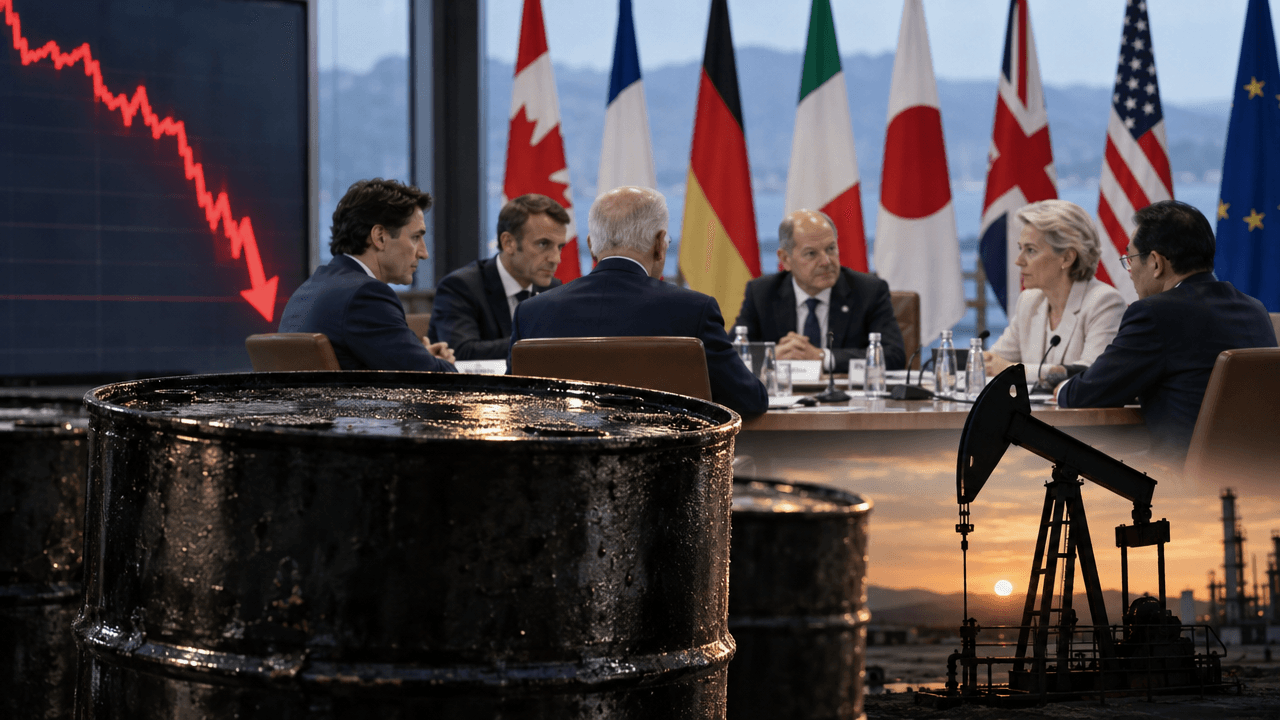
Oil markets reacted swiftly to fresh headlines from the Group of Seven (G7), with benchmark crude reportedly dropping about 4.19% to roughly $91.42 per barrel after leaders signaled plans to release up to 100 million barrels of strategic diesel and crude reserves.[1] For traders, this is more than a one-day move: it is a signal that policymakers are willing to lean on emergency stockpiles to counter high fuel costs and inflation pressures, reshaping expectations for energy prices over the coming months.[1][3]
Market Reaction: Why Prices Fell
The immediate selloff in crude reflects a classic supply shock in reverse: when markets anticipate additional barrels hitting the market, prices tend to adjust lower as future scarcity risk declines.[1][3] A coordinated G7 release of up to 100 million barrels over four months implies an average of roughly 830,000 barrels per day if spread evenly, a meaningful addition relative to recent demand growth.[3] Even if actual flows are uneven across the period, the headline number alone is enough to prompt algorithmic and discretionary selling in oil futures as traders reprice the balance of risks.
The focus on diesel is particularly important. G7 leaders have indicated that a substantial volume of diesel will be “frontloaded” within the first 20 days of the release window, targeting one of the tightest parts of the refined product market.[3][12][13] Diesel is critical for freight, agriculture, and industrial activity, so any relief in diesel prices can ripple through broader input costs for businesses and, ultimately, consumer prices.[11][12] That anticipated easing in fuel costs contributes to the downward pressure on crude benchmarks, even though diesel stocks themselves are a refined product rather than crude supply.
Equity markets in the energy space often mirror moves in the underlying commodity, and a sudden 4%+ drop in crude typically weighs on oil majors, refiners, and energy-related indices, at least in the short term.[1] For futures traders, that creates a dynamic environment where cross-asset correlations—between crude, diesel, inflation expectations, and cyclical equities—can shift quickly as markets digest both the size and timing of the G7 action.[3][11]
Inside The G7 Strategic Release
Strategic reserves exist precisely for moments of significant market stress, and G7 countries are now leaning more heavily on this tool.[1][11] Under the plan discussed by leaders, the seven advanced economies—United States, United Kingdom, Canada, France, Germany, Italy, and Japan—would release 100 million barrels of diesel, gasoline, and crude oil from emergency stockpiles over about four months.[11][12][13] The release is designed as a coordinated effort rather than a series of unilateral moves, which helps amplify its signaling effect to markets.
The International Energy Agency (IEA), based in Paris, is coordinating the release, building on an earlier, record-sized decision to deploy 400 million barrels of strategic reserves in response to prior supply shocks and price spikes.[3][5][10] According to recent data, IEA members have already drawn down around 325 million barrels of that earlier commitment, leaving limited room before the initial plan is fully executed.[5] The new G7 initiative therefore represents an additional layer of intervention, aimed specifically at refined products like diesel, which have remained stubbornly tight despite previous crude releases.[3][5][12]
Importantly, the 100 million barrels figure encompasses both crude and oil derivatives, not exclusively crude oil.[1][3][10] This matters for timing: refined product releases can have a more immediate influence on end-user prices, while crude releases depend on refinery capacity, logistics, and the specific grade of oil involved before they translate into extra fuel at the pump.[3] Traders must therefore distinguish between headline barrel numbers and the actual, deliverable volumes of diesel and gasoline that reach consumers in the short term.
Inflation, Policy, And Energy Futures
The G7 move is explicitly tied to concerns over high fuel prices and their impact on inflation, growth, and political stability.[1][3][11] Elevated diesel and gasoline costs feed directly into consumer price indices, freight rates, and the cost structure of key sectors, making energy a central driver of headline inflation. By signaling a willingness to release strategic reserves, G7 leaders are effectively trying to cap near-term price spikes and soften inflation expectations.[1][11] If successful, this could give central banks slightly more room to maneuver and reduce pressure for more aggressive rate hikes.
In futures markets, expectations around inflation and interest rates play a crucial role in positioning across commodities, bonds, and equities. A credible plan to add supply from strategic reserves can encourage traders to scale back long positions in crude and refined products that were predicated on persistent scarcity.[1][3] It may also prompt selling in inflation-linked instruments if investors believe headline energy prices will moderate over the next quarter.[3][11] For macro-focused traders, the link between G7 energy policy and central bank reaction functions is a key narrative to monitor.
However, strategic releases are not a permanent solution. Once emergency reserves are drawn down, they must eventually be rebuilt, which can mean future periods of net buying by governments and agencies.[5][10] If underlying geopolitical risks or supply disruptions persist, markets may start to look past the temporary relief and price in the eventual need to restock reserves, potentially supporting prices again in the medium term.[3][5] That cyclical dynamic between release and replenishment is central to understanding the longer-term implications for energy futures curves and volatility.
How Traders Can Position In A Simulated Environment
For traders using a SimFi platform like E8 Markets, this episode offers a rich case study in how policy-driven supply shocks can reshape market behavior without the pressure of real capital at risk. The first takeaway is the importance of headline awareness: a single coordinated announcement from G7 leaders triggered a multi-percent move in crude within a session, reinforcing how political decisions can rival traditional fundamentals in driving price action.[1][3]
Second, simulated traders can use this event to practice scenario analysis across the energy complex. For example, one scenario might assume an evenly distributed release over four months, creating a modest but sustained flow of additional barrels.[3] Another could model a more aggressive front-loaded release, especially in diesel, leading to sharper short-term price declines followed by stabilization.[3][12] By backtesting strategies across these scenarios—such as spread trades between crude and diesel, or relative value trades involving energy equities—traders can develop a deeper intuition for how different parts of the market respond.
Third, the event underscores the value of risk management rules. A 4.19% move in crude in response to policy news can trigger margin calls for overleveraged positions in a live environment.[1] In simulation, traders can test stop-loss placement, position sizing, and hedging tactics around major policy meetings and announcements, learning how to protect capital during periods of sudden volatility. This experience is invaluable when transitioning from simulated to live markets, where similar events can and do occur with little warning.
Risks And Scenarios To Watch
Despite the immediate bearish reaction in oil, several risks could limit the impact of the G7 release or even reverse the move over time. One key variable is execution: if countries release less than the full 100 million barrels, or if logistical bottlenecks slow the delivery of diesel and crude to end markets, the actual supply relief could fall short of expectations.[3][9][12] Another is demand resilience; if global growth remains stronger than anticipated, additional barrels may be absorbed without a significant sustained impact on prices.[3][11]
Geopolitical developments remain a wildcard. Previous strategic releases have been linked to conflicts and disruptions in key producing regions, and any escalation in those areas could overshadow the effect of the G7 plan.[5][9] Similarly, decisions by major oil producers regarding output levels, quotas, or export policies can either reinforce or counteract the impact of strategic stockpile releases.[10][13] For traders, this means maintaining a flexible framework that incorporates both policy announcements and evolving geopolitical and producer dynamics.
Conclusion
The sharp drop in oil prices following the G7’s consideration of a 100 million-barrel strategic reserve release highlights how quickly energy markets can respond to coordinated policy action.[1][3] While the planned release offers potential short-term relief for fuel prices and inflation, it also raises important questions about the sustainability of relying on emergency reserves and the need for longer-term supply and demand adjustments.[5][10][11] For traders—whether in live markets or simulated environments—this episode is an opportunity to study the interplay between policy, macroeconomics, and energy fundamentals, and to refine strategies that can adapt as conditions evolve.