
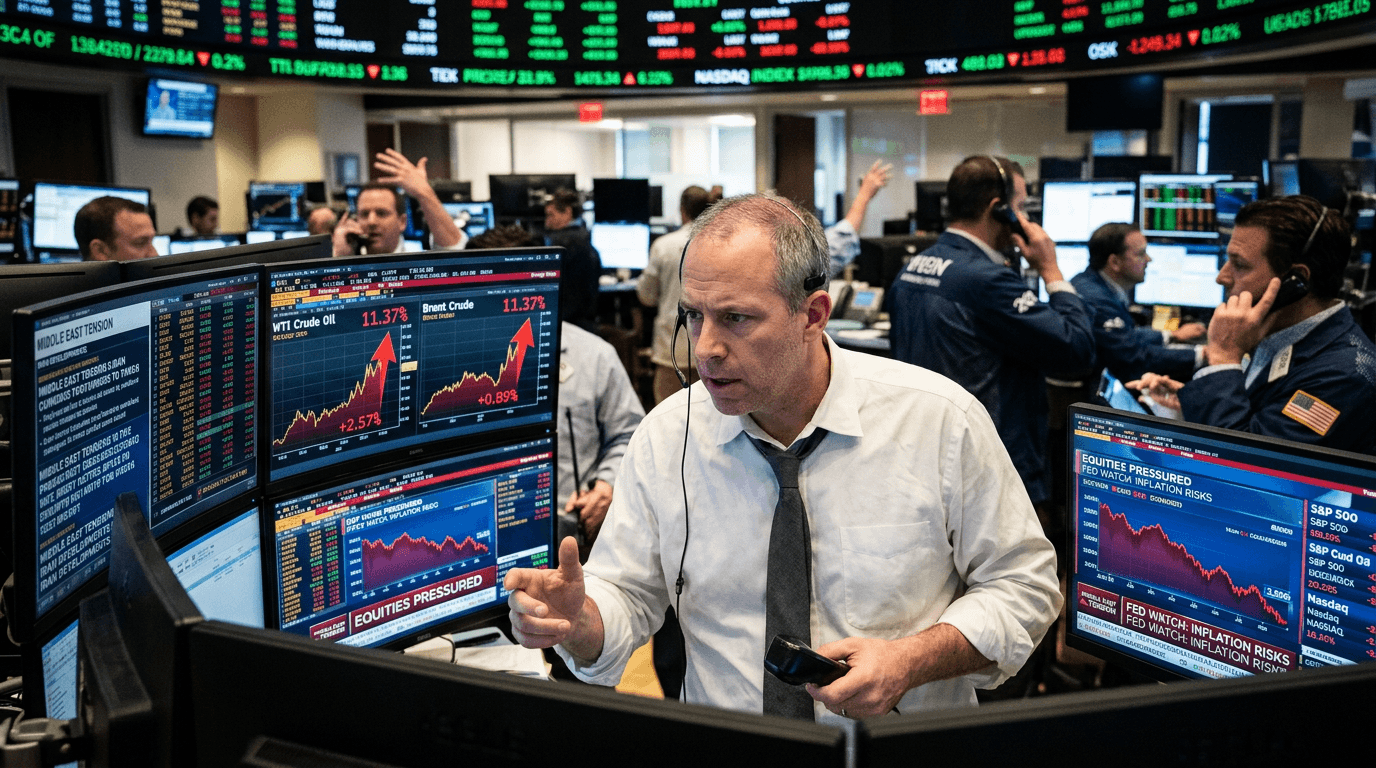
Oil’s latest surge is a stark reminder that geopolitics can reprice global markets in a single session. Crude jumped roughly 9%, pushing U.S. benchmark prices above $81 and Brent near $86 as the war with Iran escalated, while U.S. equities and index futures slid further as traders reassessed inflation, Federal Reserve policy, and global growth risks. In one move, energy, rates, and risk assets were all forced back under the same spotlight.
Market Shock: Oil Spikes On Iran War
The war involving the U.S., Israel, and Iran has turned the oil market into a barometer of geopolitical stress. Earlier in the conflict, Brent crude had already been pushed above $90 a barrel, logging the largest weekly gain since the early pandemic period as supply fears intensified.[3] Prices later broke above $100 for the first time since 2022 as disruptions removed millions of barrels per day from global supply.[4] More recently, Brent has neared $120, approaching levels last seen during prior major shocks to the energy system.[1][7][9][14]
This backdrop is important because today’s 9% jump is not an isolated spike; it comes on top of months of extraordinary gains. In March, Brent was on track for a record monthly surge of around 51%, surpassing even the Gulf War-era rally of 1990.[7] West Texas Intermediate (WTI), the U.S. benchmark, has seen similarly outsized moves, with single-day increases north of 20% at points during the conflict.[2][7] That kind of volatility fundamentally changes how traders think about risk.
One of the core drivers is the Strait of Hormuz, the narrow shipping lane off Iran’s coast that handles roughly one-fifth of the world’s oil and gas trade.[7][11] Attacks, blockades, or threats to shipping through this chokepoint translate almost immediately into higher prices, even if actual physical flows are only partially disrupted. For traders, that means oil is trading not just on fundamentals like demand, but on scenario analysis: What happens if Hormuz is shut for a week? A month? Longer?
Inflation, Fed Policy, And Bond Markets
An oil shock is never just about energy—it is about inflation. Higher crude prices feed directly into gasoline and diesel, and those costs ripple through transport, manufacturing, and consumer prices. In the U.S., motorists are already paying the highest prices at the pump in nearly two and a half years, with average regular gasoline rising from about $2.98 to $3.79 per gallon since the start of the conflict.[12] Overall fuel costs have climbed more than 40% since hostilities began.[11][12]
Central banks cannot ignore that kind of price pressure. Analysts have warned that the Iran war’s oil and gas shock is unlikely to fade quickly, raising the risk of a more persistent inflation overshoot.[14] For the Federal Reserve, that complicates any plan to cut rates: a renewed rise in headline inflation driven by energy makes policymakers more cautious about easing, and could even reopen discussions about additional tightening if inflation expectations drift higher.
In bond markets, this translates into higher yields and steeper volatility. Traders watch inflation breakevens, Fed funds futures, and the shape of the yield curve for clues to how monetary policy will respond. If oil remains elevated or spikes again, markets may price fewer rate cuts, higher real yields, and a wider risk premium across credit. That, in turn, feeds back into equity valuations, particularly for longer-duration, growth-oriented assets that are most sensitive to discount rates.
IMPACT ON U.S. STOCKS AND FUTURES
The latest oil spike has weighed on U.S. stocks and index futures, extending recent declines as investors rotate away from cyclicals and high-beta names. This pattern has already been visible globally: during prior flare-ups in the conflict, European indices such as the Stoxx 600 have dipped, and S&P 500 futures have traded lower as the market digested overnight headlines from the Persian Gulf.[11]
Rising energy costs squeeze both consumers and corporates. Households facing higher fuel bills may cut discretionary spending, pressuring sectors like retail, travel, and leisure. At the same time, companies with significant transport or energy inputs—manufacturers, logistics firms, airlines—see margins compressed unless they can pass costs on. Experts have already noted that demand is being “crushed” in some regions, with airlines flagged as particularly vulnerable as jet fuel prices rise and passengers grow more cautious.[13]
Not all sectors suffer equally. Energy producers, refiners, and some commodity-linked names can benefit from higher prices, providing a partial hedge within diversified portfolios. But for broad-based equity indices, the net effect of a rapid oil shock is usually risk-off: spreads widen, volatility picks up, and correlations across assets tend to rise as investors de-risk. For index futures traders, gap risk around geopolitical headlines becomes a central concern, especially during Asia and Europe sessions that can reprice U.S. assets before the cash open.
What Traders Should Watch Next
For traders and investors, the key question is not just where oil trades today, but what could push it meaningfully higher or lower from here. On the upside, further escalation in the Iran conflict, more sustained disruptions to Hormuz shipping, or additional supply cuts from key producers would all support higher prices.[5][7][11] On the downside, coordinated policy actions—such as tapping strategic petroleum reserves—could cap near-term spikes.[2]
G7 governments have already signaled a willingness to take “necessary measures” in response to surging fuel costs, even if they have not yet committed to large-scale emergency releases.[2] Policy choices by OPEC members also remain crucial. Saudi-led supply cuts have amplified recent moves,[2] while decisions by Gulf producers and emerging-market importers can shift the demand-supply balance at the margin.[13]
Traders should therefore track three main variables: the intensity and geographic spread of the conflict, the status of key shipping routes, and policy signals from producer nations and major consuming economies. Layered on top of that is monetary policy: any shift in Fed language around inflation risks and energy prices can change the narrative for both bonds and equities. In a world where oil has “shattered its price compass,” with physical barrels and futures sometimes telling different stories, staying data-driven and nimble is essential.[8]
Simulated Trading: Practicing Risk Management
For market participants using simulated finance platforms, this environment is a live laboratory for stress-testing strategies. A multi-asset shock—oil spiking, stocks sliding, rates repricing—is exactly the kind of scenario that reveals strengths and weaknesses in risk management. In simulation, traders can test how their portfolios respond to overnight gaps in crude futures, sudden moves in index futures, and rapid changes in rate expectations, without real capital at risk.
One practical exercise is to build scenarios around different oil trajectories: a quick retracement, a prolonged plateau above recent levels, or another leg higher toward prior peaks near $120.[1][7][9][14] For each scenario, traders can map likely sector winners and losers, adjust position sizing, and experiment with hedges using energy equities, options, or volatility products. Another is to explore cross-asset correlations: how do equity indices move relative to oil, high-yield credit, or safe-haven assets when geopolitical risk spikes?
Beyond positioning, simulated trading is a way to build discipline. Geopolitical headlines tempt emotional decisions—chasing moves or panicking out of positions. Practicing pre-defined entry and exit rules, setting clear risk limits, and running portfolio-wide stress tests in a simulated environment helps traders develop playbooks they can later apply in live markets. The goal is not to predict every twist in the Iran conflict, but to be structurally prepared for a world where a single shipping incident or policy statement can move oil, stocks, and futures all at once.
Ultimately, the latest spike in oil prices and the slide in U.S. stocks and futures underscore how intertwined energy markets and financial assets have become. For traders, investors, and anyone watching inflation and policy, this is a moment to pay close attention: not only to the war itself, but to how markets are constantly repricing its economic fallout. In a high-volatility, headline-driven environment, the combination of rigorous analysis, robust risk management, and disciplined strategy testing—whether in live or simulated markets—will be the edge that matters most.