
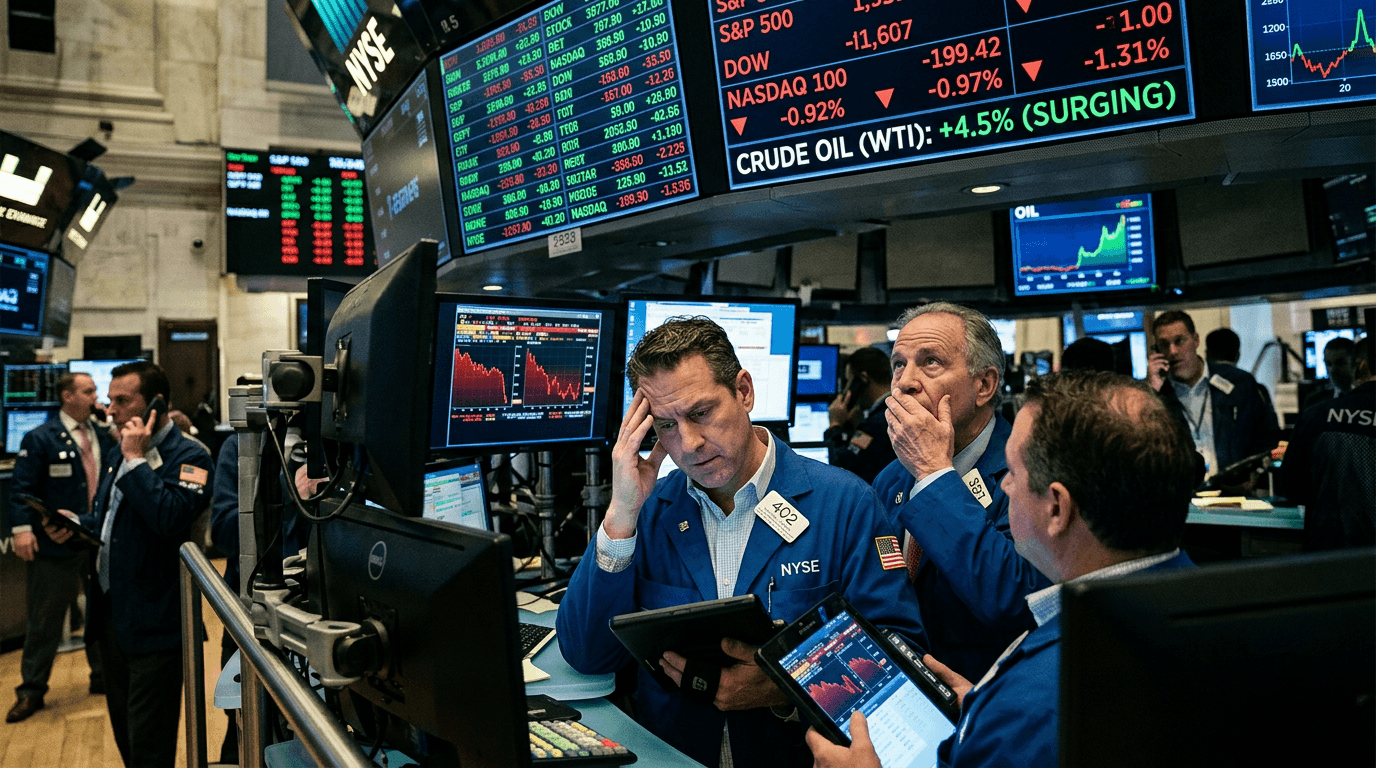
U.S. stock index futures are trading lower alongside the cash market as a renewed spike in oil prices and escalating tensions in the Middle East push investors into a risk‑off stance.[1][8][9] Dow futures have slipped around 0.5%–1% in recent sessions, while S&P 500 and Nasdaq futures have also moved noticeably lower, extending weakness in major U.S. benchmarks.[1][4][12] At the same time, crude benchmarks such as Brent and WTI have jumped toward or above key levels between the high‑70s and the $90–$100 range, reigniting inflation worries and tightening financial conditions.[2][6][7] The combination of rising energy costs, higher bond yields, and geopolitical uncertainty is filtering through global markets, with volatility products and safe‑haven assets reacting to the shift in sentiment.[8][9][13]
Market Snapshot: Futures, Cash Equities, And Oil
Equity index futures in the U.S. have come under sustained pressure as traders price in both higher input costs for corporations and greater macroeconomic uncertainty.[1][8] Recent moves show S&P 500 futures down roughly 0.4%–0.8%, Dow futures lower by 0.6%–1%, and Nasdaq futures off by about 1% or more, highlighting the vulnerability of growth and tech names to shifts in discount rates and risk appetite.[1][4][12] In the cash market, all three major indices — the Dow, S&P 500, and Nasdaq Composite — have posted broad declines, with some sessions seeing drops of more than 1%–1.5% as selling pressure extends beyond intraday futures moves into closing prices.[2][5][13]
On the commodity side, crude oil has surged on concerns about supply disruptions, particularly around the Strait of Hormuz, a critical chokepoint for global energy flows.[4][6][9] Brent crude has traded above $88 per barrel and has at times touched or approached $90, while other episodes have seen prices accelerate toward the $100 mark following attacks on tankers and infrastructure in the region.[2][6][7] These price spikes have quickly translated into inflation fears, as energy is a key input for transport, manufacturing, and services, and higher crude tends to feed into headline consumer price indices with a lag.[2][10][13]
Volatility products have responded accordingly, with implied volatility on major equity indices rising as traders rush to buy protection.[8][9] This reflects an expectation that the current mix of oil‑driven inflation pressure and geopolitical risk could produce larger price swings and potentially deeper drawdowns if tensions fail to ease.
Why Oil Shocks And Geopolitics Hit Equities
Rising oil prices act as both a tax on consumers and a margin squeeze for many companies, particularly those with energy‑intensive operations or limited ability to pass on higher costs.[2][10] When crude accelerates higher, investors often mark down earnings expectations for cyclical sectors such as industrials, airlines, automakers, and parts of consumer discretionary, triggering broad equity weakness.[5][13] At the same time, persistent inflation concerns can lead markets to push bond yields higher, either because central banks are expected to stay hawkish longer or because term premiums rise in response to uncertainty.[9][11]
Geopolitical escalation in the Middle East adds a second, powerful channel of risk. Events such as attacks on oil tankers, strikes on infrastructure, and military standoffs raise the probability of supply interruptions and draw global powers into complex political negotiations.[2][7][9] Markets dislike unquantifiable risk, so investors typically respond by de‑risking portfolios: trimming equity exposure, rotating into defensive sectors, and increasing allocations to cash, short‑term bonds, or traditional safe havens like gold.[5][13][15] The result is a synchronized move where risk assets sell off, volatility rises, and correlations between equities and commodities can temporarily increase.
From a macro perspective, the key question is whether the oil shock is brief and contained, or persistent and structural. Short‑lived spikes often result in sharp but reversible market moves; drawn‑out tensions that keep crude elevated near $90–$100 for months can alter the path of inflation, growth, and monetary policy, amplifying equity drawdowns.[2][10][14]
Sector And Asset Class Ripple Effects
The most immediate winners from higher oil prices are energy producers and related service companies, which benefit from improved margins, stronger cash flows, and in some cases, better pricing power.[2][5][13] Recent trading has shown energy indices outperforming the broader market even on days when most sectors close in the red, underscoring the defensive appeal of profitable oil and gas names during commodity rallies.[2][5]
Conversely, sectors with high fuel sensitivity — such as airlines, logistics, and parts of consumer discretionary — can suffer disproportionately.[5][10] These companies face rising operating costs and potential demand headwinds if consumer budgets are squeezed by higher gasoline and heating bills.[2][10] Financials and growth‑heavy segments, including technology, may be hurt indirectly if higher yields compress valuation multiples and funding conditions tighten.[9][11]
Beyond equities, bond markets have seen yields push higher as traders reassess the odds of rate cuts in the face of renewed inflation pressure.[9][11] The shift in fixed‑income pricing reinforces the risk‑off tone, as equity investors must contend not only with weaker growth expectations but also with a higher discount rate applied to future cash flows.[3][15] Volatility indices and options markets, meanwhile, reflect elevated demand for hedging, with higher premiums for downside protection on major benchmarks.[8][9]
Simulated Trading Takeaways For Simfi Traders
For traders using simulated finance platforms like E8 Markets, this environment offers a rich learning field for understanding cross‑asset dynamics without immediate real‑world capital at risk. The current backdrop illustrates how macro catalysts — oil shocks, geopolitical events, and interest‑rate expectations — can move index futures, cash equities, bonds, and volatility instruments in a tightly connected way.[2][8][9]
One practical takeaway is the importance of scenario planning. Simulated traders can test strategies under different assumptions: oil stabilizing near current levels, crude breaking significantly above $100, or a sudden de‑escalation that sends energy prices lower.[2][7][14] In each scenario, they can observe how index futures respond, which sectors lead or lag, and how implied volatility behaves, building intuition for real‑time decision‑making.
Another key lesson is the role of hedging. Using index futures, options on volatility products, or sector rotation, simulated traders can experiment with ways to protect a notional portfolio from macro shocks. For example, they might explore how adding an energy overweight or a volatility hedge changes the drawdown profile during risk‑off days when the Dow and Nasdaq are under pressure.[2][5][8] Practicing these techniques in a SimFi environment can help traders develop robust frameworks for managing risk when market conditions turn challenging.
What To Watch Next
Going forward, the trajectory of Middle East tensions and oil prices will remain central drivers of U.S. equity sentiment. Key indicators to monitor include headlines around the Strait of Hormuz, any further attacks on energy infrastructure, and diplomatic efforts aimed at de‑escalation between major regional players and global powers.[2][6][9] Traders should also watch how inflation data, central‑bank communications, and bond yields evolve in response to the energy shock, as these will shape expectations for growth, earnings, and valuation.[9][10][11]
For both live and simulated traders, the priority is to stay nimble, maintain a clear view of macro risks, and avoid over‑reacting to single headlines while still respecting the potential for large moves when geopolitics and commodities collide. By combining disciplined risk management with an understanding of how oil and conflict ripple through markets, traders can better navigate periods when futures and cash indices slip under the weight of rising energy prices and unresolved geopolitical tensions.[2][8][13]