
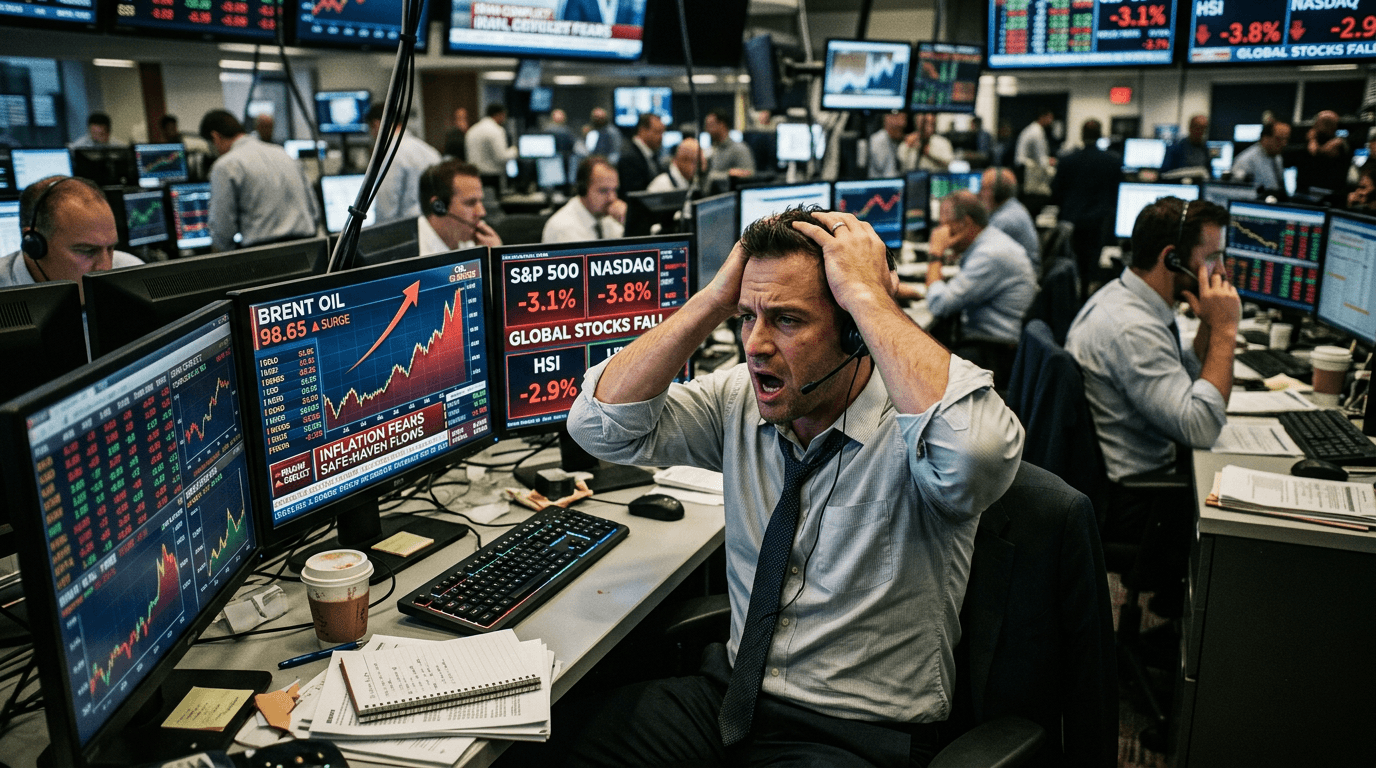
Oil markets are once again at the center of a global risk-off episode as the Iran–Middle East conflict drives crude futures sharply higher and sends shockwaves across currencies, equities, and credit. Higher energy prices are forcing investors to reassess inflation trajectories, interest-rate expectations, and geopolitical risk premia all at once, creating a complex backdrop for both real-money and simulated traders.
Markets Jolt As Middle East Risks Escalate
The latest escalation involving Iran has disrupted key production and shipping routes across the Gulf, triggering a surge in benchmark crude prices and intense volatility in oil futures.[1][4] Brent has jumped more than 25% since the conflict began, with prices pushing above $100 per barrel and briefly approaching $120 amid intraday spikes.[5][6] West Texas Intermediate (WTI) futures have swung between the high-$80s and above $107 before stabilizing near the high-$90s.[4]
This is not just a directional move; it is a volatility event. The closure or partial obstruction of the Strait of Hormuz—a narrow channel through which roughly a fifth to a quarter of global seaborne crude flows—has effectively blocked millions of barrels per day from reaching the market.[4][5][6] In response, the International Energy Agency has announced a record release of around 400 million barrels from strategic reserves in an effort to cushion the shock, underscoring how serious policymakers view the disruption.[5]
For traders, the message is clear: geopolitical risk in the Middle East is now a primary driver of short-term price action in energy contracts, not a peripheral factor.
Why Oil Futures React So Violently To Geopolitics
Oil futures are highly sensitive to perceived changes in supply, and geopolitical events can alter that perception more quickly than changes in actual production. During the first week of the conflict, markets initially moved cautiously, but once it became clear that exports from the region would remain idle, futures re-priced dramatically, lifting Brent nearly 30% from pre-war levels.[2]
The mechanics are straightforward but powerful
- When traders anticipate sustained supply disruptions, they bid up near-dated futures to reflect scarcity.
- Option markets respond with higher implied volatility, widening bid–ask spreads and amplifying price swings.
- Risk managers raise margin requirements, forcing some leveraged positions to unwind, which can add to intraday whipsaws.
The result is the kind of wide trading ranges seen recently—$20-plus per barrel peak-to-trough moves over just a few sessions.[1][4][5] Energy-intensive sectors such as airlines, chemicals, and fertilizers quickly feel the pinch through higher input costs, feeding into earnings expectations and equity valuations.[5][6]
In short, geopolitics doesn’t just move oil; it transmits risk across the entire asset spectrum.
Safe-haven Flows And Pressure On Global Risk Assets
As oil prices surged, classic safe havens—the U.S. dollar, gold, and to a lesser extent high-quality government bonds—attracted strong inflows.[1][3] Gold rallied as investors sought protection against both geopolitical uncertainty and the prospect of renewed inflation, while the dollar strengthened on its role as the world’s reserve currency and funding vehicle.
Risk assets, meanwhile, came under pressure:
- Major equity indices sold off, with European benchmarks down around 0.5–0.8% on conflict headlines.[3]
- Emerging-market stocks and currencies, particularly in energy-importing economies, faced outflows as higher oil costs threatened growth and widened current-account deficits.[1][6]
- Credit spreads in high-yield and EM debt widened as investors demanded more compensation for macro and geopolitical risk.
This pattern—oil up, dollar and gold up, equities and EM down—is a classic risk-off configuration. But the current episode has an added twist: the inflation shock is arriving in a world where central banks are already grappling with the aftermath of previous tightening cycles, making policy responses more complicated.
Inflation, Central Banks, And Macro Cross-currents
Rising energy prices feed directly into headline inflation, and the speed of the recent move has revived fears of “stagflation-lite”: higher prices combined with slower growth.[1][6] Gasoline and diesel costs are climbing for households and businesses, squeezing real incomes and potentially curbing consumption—the primary engine of many advanced economies.[1][6]
For central banks, this creates a dilemma:
- On one hand, renewed inflation pressure argues for maintaining or even re-tightening policy, especially if longer-term inflation expectations start to drift higher.
- On the other hand, weaker growth and higher market volatility argue for caution, particularly if financial conditions tighten abruptly through stronger currencies, wider credit spreads, and falling equities.
Investors are now repricing interest-rate expectations and term premia to reflect this more uncertain path. Yields at the long end of the curve may rise if markets anticipate structurally higher inflation, even as near-term rate cuts become less likely. This repricing feeds back into valuations across risk assets, especially growth stocks and leveraged strategies that are most sensitive to discount rates.
For traders, the macro takeaway is that an oil shock is never just about energy; it is about the entire policy and growth narrative.
Practical Takeaways For Traders And Simulated Finance Participants
For both live and SimFi traders, the current environment offers a valuable real-time case study in how geopolitics, commodities, and cross-asset correlations interact. Several practical lessons stand out:
1. Respect volatility and position sizing Oil futures and related products can move very quickly on headlines. The recent $20-per-barrel ranges illustrate why strict position sizing and dynamic stop-loss practices are essential.[4][5] In a simulated environment, this is the perfect time to test how your strategy behaves under stress scenarios, not just in trending markets.
2. Watch correlations, not just single charts Safe-haven flows into the dollar and gold, simultaneous pressure on equities, and stress in EM assets highlight how correlations can shift rapidly during geopolitical shocks.[1][3] Tracking cross-asset behavior—FX, commodities, equities, and rates—can provide early warnings and better context for trade decisions.
3. Separate short-term noise from medium-term themes Headline risk can drive sharp intraday moves, but medium-term price levels will ultimately depend on whether exports resume, how quickly damaged infrastructure is repaired, and whether coordinated reserve releases can bridge the gap.[2][5][6] Using simulated trading to test both “quick resolution” and “prolonged disruption” scenarios can sharpen your macro intuition.
4. Integrate policy risk into your playbook Higher energy prices feed into inflation and influence central-bank reactions. Macro trades—such as curves, inflation-linked products, or equity sector rotation—should factor in how persistent the oil shock could be and how policy makers are likely to respond. SimFi platforms allow you to experiment with these linkages without capital at risk, building the muscle memory to navigate similar episodes in the future.
As the Iran–Middle East conflict continues to evolve, markets will remain highly sensitive to news about shipping lanes, production facilities, and diplomatic negotiations. For traders, the challenge is to stay disciplined amid the noise, focus on robust risk management, and use tools—real or simulated—that help translate complex geopolitical developments into coherent trading frameworks.