
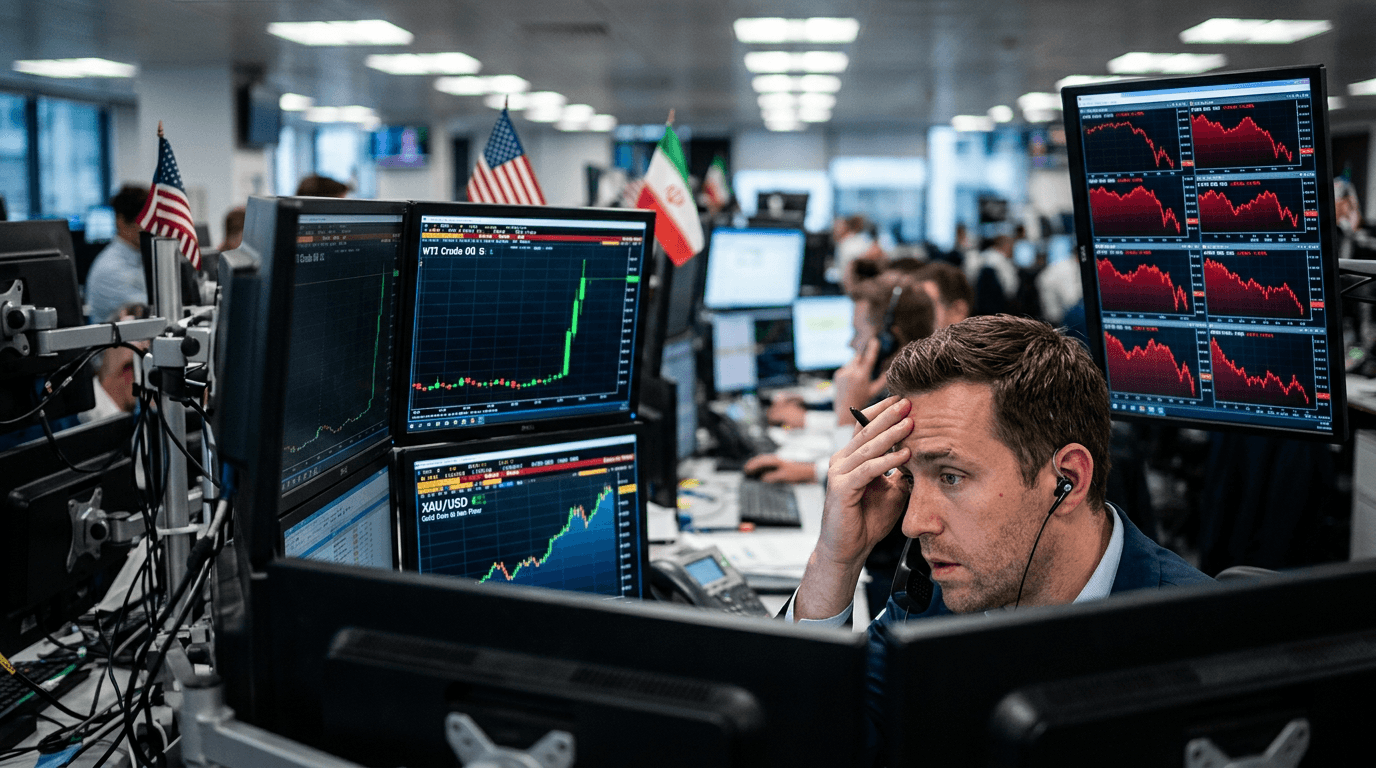
Oil’s latest surge is a vivid reminder that in global markets, geopolitics can move prices faster than fundamentals. Fresh U.S. strikes on Iranian targets linked to shipping near the Strait of Hormuz sparked a sharp risk-off reaction: crude futures jumped as much as 9%, pushing WTI into the low‑$80s and Brent toward the mid‑$80s, while equities came under pressure and capital rotated into traditional safe havens. This kind of cross‑asset move is exactly the scenario modern traders need to understand and be ready to simulate.
Market Reaction: Oil Spikes, Equities Stumble
The immediate driver of the move was renewed U.S. military action against Iran in a region that is critical to global energy transit. Around a fifth of the world’s oil and a significant share of LNG volumes pass through the Strait of Hormuz, so any threat to shipping there commands a risk premium in crude prices.[2] When strikes target assets tied to that transit, markets quickly price the possibility—however remote—of temporary disruption.
Strategists have been warning that traders now demand a sizable risk premium for barrels exposed to Iran‑related transit uncertainty. Goldman Sachs research, for example, has estimated that conflict‑driven transit risks have added roughly $14 per barrel to the price traders require versus pre‑conflict levels.[2] In more extreme scenarios, a full one‑month closure of Hormuz with limited mitigation could lift oil by as much as $10–$15 per barrel depending on how much spare pipeline capacity and strategic reserves are deployed.[2]
Equity markets tend to hate sudden energy spikes. Higher fuel and input costs compress margins, especially for energy‑intensive sectors such as airlines, logistics, chemicals and heavy manufacturing. At the same time, investors quickly factor in the potential for stickier inflation, which weighs on valuations by raising the probability of higher-for-longer interest rates. That combination—margin pressure plus tighter financial conditions—is what underpins broad equity selling into moves like this.
Inflation And Rate Expectations: Why Energy Matters
Oil shocks matter because they feed directly and indirectly into inflation. Energy prices show up in headline CPI via gasoline, diesel and utility bills, but they also ripple through the economy as firms pass on higher transport and production costs. Analysts have repeatedly noted in recent episodes that energy‑driven price shocks can have “second‑round” effects that keep inflation elevated for years, skewing risks “to the upside” compared with baseline forecasts.[4]
Central banks watch these dynamics closely. When crude jumps 5–10% in a short window, policymakers must assess whether the move is likely to be temporary or persistent. If a shock looks durable—say, because transit restrictions could last months—rate expectations can shift materially. Markets may start pricing fewer cuts or even the risk of renewed hikes, especially if inflation was already running above target before the oil spike.
In rate futures, this typically shows up as a bear‑steepening of the yield curve: long‑dated yields move higher as traders demand more compensation for inflation risk, while short‑dated yields reflect repricing of policy rates. For equities, higher real yields compress valuation multiples, which is why inflation‑linked energy shocks can hit indices even if growth expectations themselves haven’t changed much.
Haven Flows: Gold, Bonds And Fx
Whenever Middle East tensions escalate, it’s not just oil that moves. Investors often rotate into assets perceived as safer stores of value or more stable sources of return. That can mean:
- Increased demand for developed‑market government bonds, particularly U.S. Treasuries, as investors seek liquidity and security during geopolitical stress.
- Flows into gold, which has historically been treated as a hedge against both geopolitical risk and inflation.
- FX moves favoring the U.S. dollar, Swiss franc and, at times, the Japanese yen, as traders reduce exposure to higher‑beta currencies and EM FX.
This pattern reflects two overlapping narratives. First, the geopolitical risk story: war scares and escalation risks push capital toward jurisdictions and assets seen as politically and financially stable. Second, the inflation story: if higher oil is expected to persist, demand for inflation hedges like gold and inflation‑linked bonds typically increases, while currencies backed by more credible inflation‑fighting central banks may outperform.
For FX traders, the key is understanding how the energy shock interacts with each country’s macro profile. Big net importers of oil and gas often see their terms of trade deteriorate when crude spikes, which can weigh on their currencies. Exporters, by contrast, may enjoy improved fiscal and current account positions, which can support their FX—though that benefit can be partially offset if risk appetite evaporates globally.
SCENARIO PATHS: HOW QUICKLY CAN THE SPIKE REVERSE?
One nuance in trading these events is that energy markets can swing sharply in both directions as information evolves. Recent history shows large intraday ranges when Iran‑related risks flare. In one prior episode tied to U.S. strikes on Iranian nuclear facilities, Brent traded within a $10 band and later gave back more than 7% when it became clear that tanker traffic through Hormuz hadn’t been materially disrupted.[3]
Similarly, reports of diplomatic breakthroughs or ceasefires have triggered rapid downside reversals in crude. News of progress toward a U.S.–Iran deal to reopen Hormuz and allow merchant shipping to resume has previously pushed oil into its longest losing streak in months as markets priced a coming wave of supply.[5][7] These swings underscore that what matters most is not just the initial military action, but the subsequent signaling around transit, sanctions and negotiations.
For traders, this means oil spikes on geopolitical headlines are often best viewed through a scenario lens:
- Escalation with confirmed transit disruption: sustained higher prices, stronger inflation spillovers, more persistent risk‑off dynamics.
- Escalation without transit disruption: sharp initial spike, then high volatility as markets reassess the actual supply impact.
- De‑escalation or credible diplomatic progress: potential for rapid mean‑reversion or overshoot to the downside as the risk premium unwinds.
Practical Takeaways For Traders And Simulated Finance Users
Episodes like this are powerful training grounds for risk management and cross‑asset thinking, especially in a SimFi environment where traders can experiment without real capital at risk.
A few practical takeaways
- Build cross‑asset views: Don’t treat oil in isolation. Map out how crude spikes might affect equities by sector, FX by importer/exporter status, and rates via inflation expectations.
- Use scenarios, not single forecasts: Construct at least three paths—escalation, status quo and de‑escalation—and think through price, volatility and correlation changes in each.
- Respect liquidity and gap risk: Geopolitical headlines often hit outside regular trading hours, causing gaps in prices. Practice position sizing and stop placement that accounts for slippage.
- Monitor both fundamentals and flows: Track not just physical supply indicators (shipping data, official statements on transit) but also positioning and volatility metrics that reveal how crowded trades have become.
- Focus on process over prediction: In highly uncertain political situations, no one can reliably forecast the next headline. What traders can control is their framework for updating views and managing exposure when the news hits.
For E8 Markets users engaging in simulated trading, these environments offer a way to stress‑test strategies under conditions of rapid regime change. A system that performs well during calm periods but fails when oil jumps 9% and equities slide may need re‑thinking. Conversely, strategies that explicitly incorporate macro‑risk triggers, volatility filters and robust diversification can prove far more resilient across regimes.
Ultimately, renewed U.S.–Iran strikes and the resulting oil spike are a real‑time illustration of how tightly intertwined energy, geopolitics and global asset prices have become. Learning to navigate that intersection—calmly, systematically and across multiple markets—is increasingly essential for modern traders, whether they are trading live capital or honing their edge in a simulated environment.