
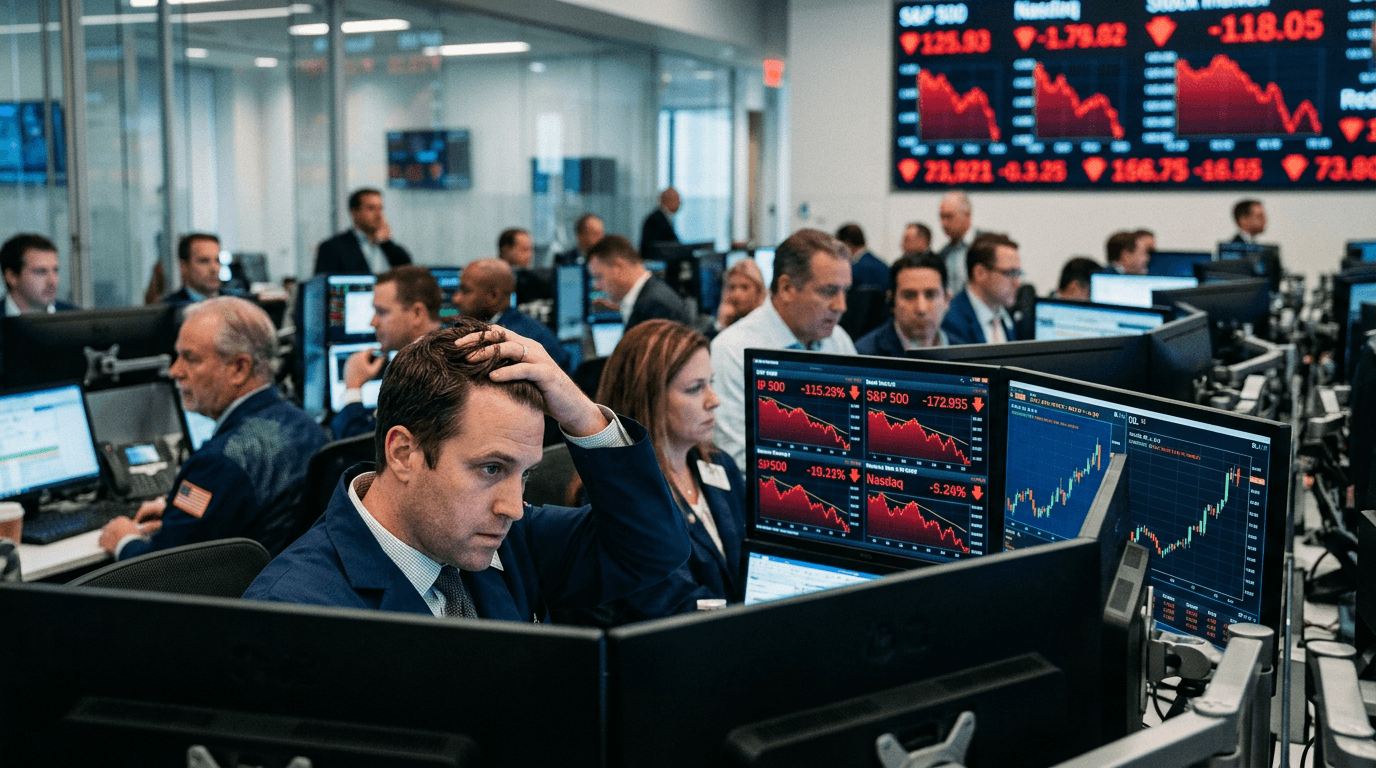
A sharp surge in oil prices has rattled U.S. equities, with benchmark crude jumping as much as 9% and West Texas Intermediate (WTI) touching its highest level since the summer of 2024.[1] Geopolitical tensions in the Middle East, including U.S. and Israeli military actions against Iran and heightened concerns around shipping routes, have pushed energy markets into a new risk regime and dragged equity futures and broader risk sentiment lower.[1][3]
Market Reaction: Oil Spikes, Stocks Stumble
The latest move in crude is not a marginal fluctuation; it is part of a sustained upswing in energy prices since the onset of the regional conflict, with U.S. oil benchmarks having risen more than 55% from their pre‑crisis levels.[3] In the most recent leg higher, Brent crude futures have approached the high‑$70s per barrel while WTI has traded just under $72, with intraday gains near 9% on the day.[1]
Equity markets have responded with a risk‑off tone. U.S. indices opened significantly lower as investors digested the inflationary implications of the oil shock, with the Dow Jones Industrial Average struggling and broader benchmarks initially under pressure.[1] While intraday volatility allowed some indices to pare losses, the overall picture remained one of fragile sentiment as traders weighed the likelihood that higher energy costs could feed through to consumer prices and central bank policy.[1][3]
The caution is not confined to U.S. cash markets. Futures tied to major U.S. indices have traded lower in overseas sessions, and Asian exchanges have seen broad declines, with several key benchmarks down around 1% as the combination of tech‑sector weakness and surging oil prices ripples through global risk assets.[3][8] This cross‑market reaction underscores how quickly geopolitically driven commodity moves can cascade into equities worldwide.
Why Oil Shocks Matter For Equities
For equity traders, the magnitude and speed of the oil move matters because crude is both a cost input and a macro signal. A 9% daily spike amplifies concerns that higher fuel and transportation costs will feed into headline inflation and squeeze margins for energy‑intensive sectors such as airlines, logistics, and manufacturing.[1][3] When these worries surface, they tend to pressure cyclical stocks and consumer‑facing names that are most vulnerable to cost pass‑through and demand erosion.
At the macro level, higher oil has already complicated expectations for interest‑rate cuts. Bond yields have moved higher as inflation risk premia expand, and markets have started to question how far and how fast central banks can ease policy if energy‑driven price pressures persist.[3][5] Equity valuations, particularly in growth and long‑duration assets, are sensitive to this repricing of the rate path, which helps explain why tech and high‑multiple segments often feel disproportionate pain during inflation scares.
Yet the story is not uniformly negative across sectors. Energy producers, refiners, and some commodity‑linked names typically benefit from higher realized prices and widening margins, and the latest surge has supported those parts of the market.[1][6] For diversified portfolios, an oil shock becomes a test of how well exposures are balanced between beneficiaries and victims of higher crude, and whether risk models adequately capture the correlation shifts that tend to occur in stress periods.
Futures Sentiment And Risk Assets
Equity futures are a useful real‑time gauge of how traders interpret the oil‑driven shock. Recent sessions have seen index futures trade lower on the initial headlines of intensified conflict and supply disruption, reflecting a knee‑jerk risk‑off reaction.[3][8] At the same time, the size of the move—often less than 1% in major U.S. futures—suggests markets may be past the point of maximum panic and are learning to calibrate geopolitical risk more selectively.[3]
Analysts have noted that markets appear to have reached a “peak fear” phase earlier in the conflict, and subsequent moves in oil and stocks show investors becoming somewhat less reactive to each new headline.[3] Instead of disorderly, multi‑percentage point sell‑offs, the current pattern features sharp but more contained adjustments, followed by intraday stabilization as traders reassess whether the latest development truly alters supply, inflation, or policy trajectories.
That said, risk assets remain highly sensitive to scenarios where energy supply routes—such as the Strait of Hormuz—face renewed disruption or blockade, as these would reinforce expectations of tight physical supply and persistent inflationary pressure.[3] In contrast, signs of de‑escalation or peace frameworks have previously triggered the opposite reaction: oil falling roughly 4%, equity futures rallying, and bond yields declining as markets price in reduced geopolitical and inflation risk.[5] For traders, the lesson is that futures sentiment will pivot quickly around perceived changes in conflict intensity and energy logistics.
How Traders Can Navigate Oil-driven Volatility
For both live and simulated traders, oil‑driven risk episodes are valuable stress tests of strategy, risk management, and psychology. One practical takeaway is the importance of understanding cross‑asset linkages: crude moves rarely stay confined to energy charts; they spill into FX, rates, and equities via inflation expectations, growth forecasts, and sector‑specific earnings sensitivity.[1][3]
Short‑term traders might focus on relative performance between sectors. Historically, energy, utilities, and some value‑oriented segments have held up better during commodity‑led inflation scares, while rate‑sensitive growth and consumer discretionary names tend to underperform.[1][3] Structuring trades around these relationships—such as pair trades between energy producers and fuel‑heavy industries—can provide more targeted risk exposure than broad index positions.
Risk management becomes paramount when volatility jumps. That includes tighter position sizing, more conservative leverage, and pre‑defined stop‑loss levels that account for the possibility of intraday gaps in both oil and equity markets. Simulated finance platforms are particularly useful here, allowing traders to practice responses to fast‑moving geopolitical shocks—such as adjusting exposure when crude gaps higher overnight and futures open lower—without capital at risk.
Longer‑term investors, meanwhile, can use episodes like this to reassess whether portfolios are robust to inflation surprises and geopolitical shocks. Scenario analysis—asking how the portfolio behaves if oil stays elevated, or if central banks slow rate cuts—can help identify hidden concentrations and build more resilient allocations, including thoughtful use of cash, defensive sectors, and real‑asset exposures.[3][5]
Looking Ahead: From Fear To Frameworks
The current backdrop of weakening U.S. stocks and surging oil prices illustrates how quickly geopolitical tension can flip the market narrative from optimism to caution. At the same time, recent history shows that sentiment can reverse just as rapidly if credible de‑escalation or peace frameworks emerge, with oil prices easing, futures rebounding, and bond markets pricing in less inflation risk.[5][7]
For traders and investors, the key is not to predict every twist in geopolitics, but to understand the transmission channels: energy supply to oil prices, oil prices to inflation and central bank policy, and policy expectations to equity valuations and sector performance.[1][3] By treating oil shocks as structured macro events rather than purely headline‑driven surprises, market participants can respond more rationally—using data, scenarios, and disciplined risk rules—rather than reacting emotionally to each new development.
In that sense, periods of heightened oil volatility are as much an opportunity as a threat. They force a re‑examination of assumptions about inflation, policy, and diversification, and they reward traders who can connect the dots between commodities and broader asset classes. Whether using real capital or simulated environments, mastering these dynamics is essential for navigating today’s geopolitically charged markets.