
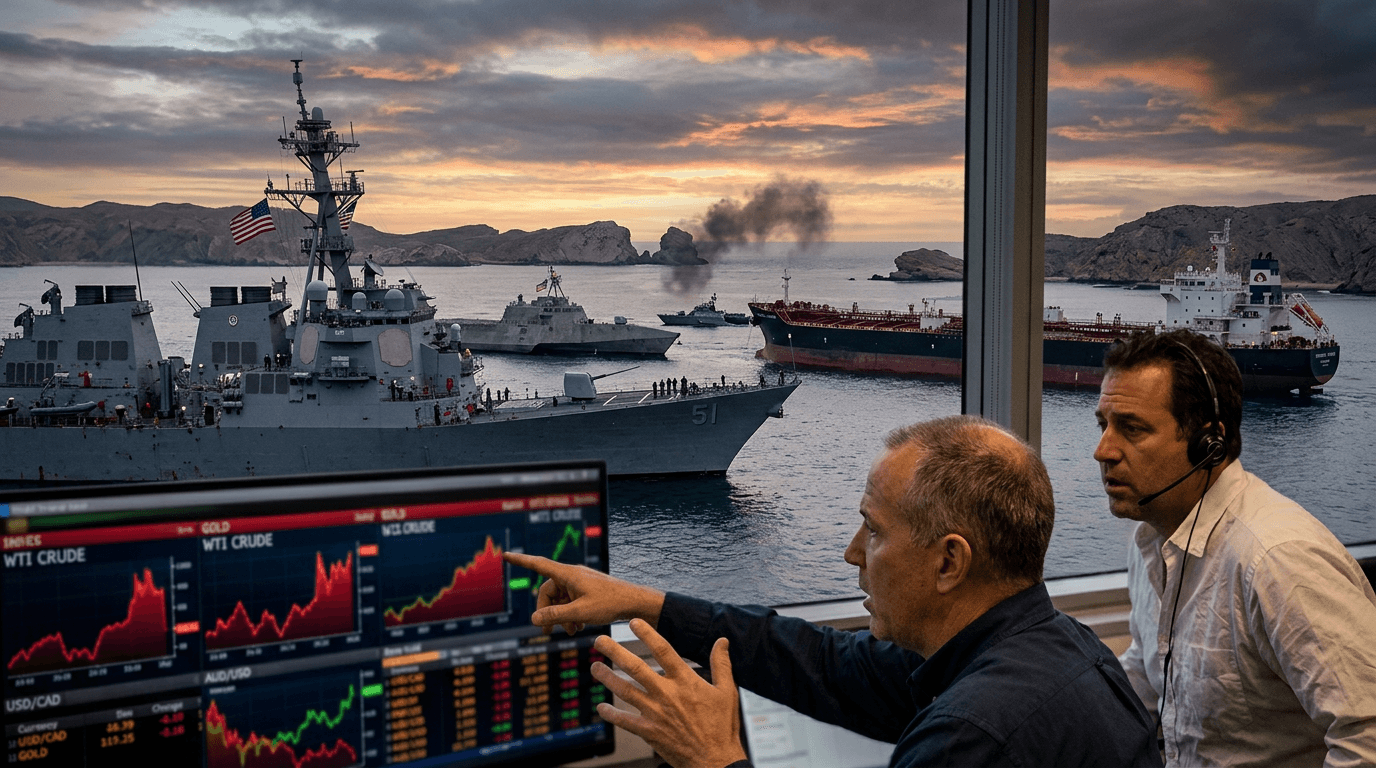
Crude oil prices have surged after the United States reimposed a naval blockade of Iran and attacks intensified in the Strait of Hormuz, pushing crude roughly 2% higher to a four‑week peak and jolting energy‑linked assets and inflation hedges.[6] This combination of geopolitical escalation and supply uncertainty is rippling through futures, currencies, and commodity markets, forcing traders to reassess both near‑term volatility and longer‑term inflation risks.[6][4]
Market Reaction: Oil And Energy-linked Assets
The immediate market response has been a sharp rise in crude benchmarks as participants price in the risk that part of Iranian supply will be sidelined or disrupted.[6] With the blockade targeting ships entering and leaving Iranian ports, traders are building a risk premium into oil prices to reflect the possibility of sustained constraints on exports and heightened danger to traffic through the Strait of Hormuz.[1][2][5]
Energy‑linked assets have moved in tandem. Equity markets tied to oil production and services, as well as commodity indices heavily weighted toward energy, tend to respond quickly when headline risk emerges around critical supply routes. A 2% move in crude on geopolitical news is enough to meaningfully shift short‑term profitability expectations for producers and refiners, especially those leveraged to spot prices.[6] For portfolio managers, the spike highlights how concentrated exposure to energy can amplify geopolitical shocks, while diversified inflation‑hedging strategies—spanning commodities, inflation‑linked bonds, and select real assets—can help smooth the impact.
Key takeaway: When the oil move is driven by supply risk rather than demand strength, it often comes with higher volatility and a wider range of possible outcomes, making risk management and position sizing critical.
Why The Strait Of Hormuz Matters
The U.S. blockade is focused on shipping to and from Iranian ports, with officials stating it aims to halt a substantial share of Iran’s seaborne trade, particularly crude exports.[1][2][5] Early estimates suggest that up to two million barrels per day of Iranian oil could be prevented from reaching global markets if enforcement remains tight, adding strain to an already cautious supply‑demand balance.[1] U.S. Central Command has reported dozens of vessels being redirected or turning back since the blockade took effect, underscoring the practical impact on shipping flows.[6][5]
Iranian officials have responded with escalatory rhetoric, warning they could halt exports and imports across the Persian Gulf and surrounding waters if the blockade is not lifted.[5] At the same time, investigative reporting and satellite tracking indicate a more complex picture: some tankers continue to load or linger near Iranian ports, suggesting that while the blockade is disruptive, it may not be completely airtight.[3][6][7] This uncertainty about how much oil is actually being constrained is itself a driver of volatility, as traders must discount conflicting information about flows.
Key takeaway: Markets do not wait for perfect clarity; the mere risk of disruption in a key chokepoint like the Strait of Hormuz can materially lift prices and volatility, even when enforcement details are contested.[1][3][5][7]
Inflation Expectations And Rate-sensitive Markets
Because energy costs feed directly into transportation, manufacturing, and consumer prices, a sudden rise in oil tends to push inflation expectations higher.[6] In this episode, the combination of higher crude and geopolitical uncertainty is already influencing rate‑sensitive futures markets, as traders reassess the path of interest rates and term premia.[6] When inflation expectations rise, fixed‑income markets often respond with higher yields on longer‑dated bonds, changes in breakeven inflation levels, and adjustments in futures tied to policy rates.
This shift matters for anyone exposed to rate‑sensitive assets—Treasury futures, interest‑rate swaps, mortgage‑linked securities, and even growth equities that are sensitive to discount rate changes. If central banks view the oil shock as transient, they may look through it; if they see it as contributing to persistent inflation pressures, they might signal a tighter stance or delay cuts. The current move is feeding into that debate, with investors using inflation hedges—such as commodities and inflation‑linked bonds—to cushion potential upside surprises in price data.[6]
Key takeaway: Geopolitical oil shocks are inflation shocks; they can move not just crude, but the entire curve of rate expectations and the relative appeal of inflation hedges versus nominal assets.
Global Fx Ripple: Winners And Losers
The FX market is responding along familiar lines: currencies of oil‑exporting countries tend to benefit from higher prices, while those of import‑dependent economies face pressure as their energy bills rise.[6] Oil‑linked and commodity‑producer currencies are seeing support, reflecting improved terms of trade and potential windfalls from elevated crude revenues.[6] In contrast, the shock is weighing on import‑heavy FX such as the Indian rupee, where higher energy costs feed into trade deficits and inflation risks, challenging central bank policy and investor confidence.[6][4]
Safe‑haven dynamics can also emerge. In periods of heightened geopolitical tension, capital often rotates toward perceived havens such as the U.S. dollar and, in some cases, the Japanese yen, even when the initial catalyst is negative for risk assets broadly. That can complicate the picture: an oil‑exporter might see a stronger local currency from improved fundamentals, but still face headwinds if global risk aversion and a stronger dollar tighten financial conditions. For traders, monitoring both terms‑of‑trade effects and broader risk sentiment is essential.
Key takeaway: Oil shocks rearrange FX winners and losers quickly; traders who understand the linkage between energy dependence, inflation, and monetary policy are better positioned to navigate those moves.
Practical Takeaways For Traders And Investors
For active traders and investors, this episode reinforces several practical lessons. First, geopolitical risk around critical supply routes can emerge suddenly and reprice markets faster than fundamental data releases. Having predefined rules for position sizing, maximum leverage, and stop‑loss levels can help avoid emotionally driven decisions when headlines hit. Second, cross‑asset awareness—connecting moves in crude, rates, FX, and equity sectors—is crucial, as opportunities and risks often appear in the correlations rather than in a single market.
In a Simulated Finance environment, traders can use scenarios like the U.S. naval blockade of Iran to stress‑test strategies in a risk‑free setting. By replaying or modeling oil‑shock conditions—wider bid‑ask spreads, faster intraday swings, correlated moves in commodity currencies and rate futures—participants can refine execution plans and hedging approaches before committing real capital. Scenario practice can include testing how portfolios respond to further escalation, partial de‑escalation, or mixed signals about enforcement effectiveness.[1][3][5][6]
Key takeaway: Use live geopolitical events as case studies—whether in real or simulated markets—to build playbooks for future shocks, focusing on disciplined risk management, cross‑asset thinking, and clear criteria for when to adjust or exit positions.