
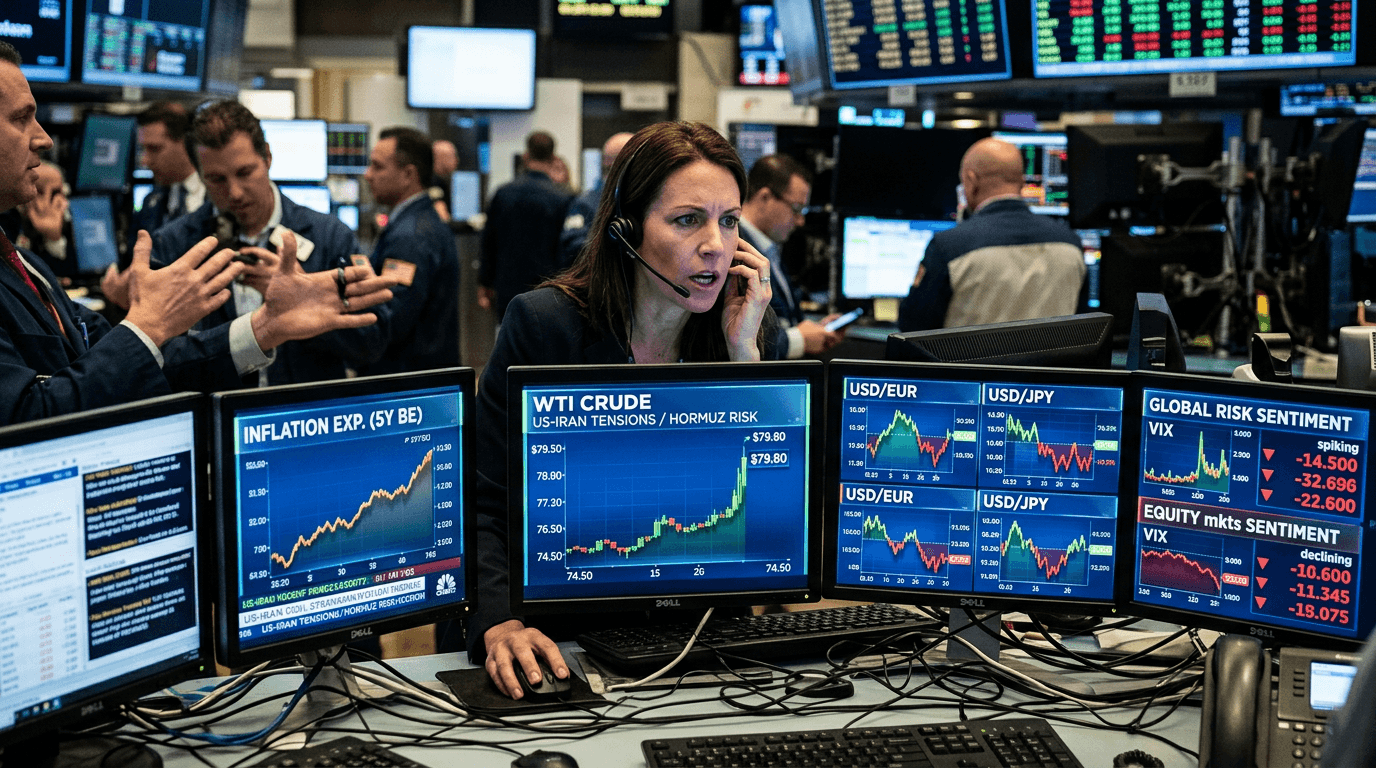
Oil futures are once again at the center of global markets as renewed US‑Iran tensions and fresh risks around the Strait of Hormuz send crude prices sharply higher and ripple across inflation expectations, FX markets, and broader risk sentiment.[2][4] Traders have quickly repriced the geopolitical risk premium in energy, with crude futures jumping by roughly 5–9% on the latest headlines.[2] That move is big enough to matter not just for oil specialists, but for anyone trading macro, FX, equities, or rates—because energy shocks are rarely isolated events.
Geopolitical Flashpoint: Strait Of Hormuz
The Strait of Hormuz is one of the world’s most critical shipping chokepoints, funnelling about one‑fifth of global oil supply and significant volumes of natural gas through a narrow passage between Iran and Oman.[4] Recent reports suggest renewed military tensions, intermittent closure claims, and increased risks to commercial shipping, leaving tankers stranded and traffic flows uncertain.[2][4] When a corridor that vital becomes a political bargaining chip, markets respond quickly.
In previous episodes, even hints that the strait might reopen or that a framework deal between the US and Iran was near led oil prices to drop sharply and equities to rally as traders relaxed their worst‑case assumptions.[6] The latest flare‑up reverses that dynamic: crude benchmarks like West Texas Intermediate and Brent have spiked, wholesale gasoline and heating oil prices are up, and volatility has picked up across energy contracts.[2] Practical takeaway: when a key supply route is in the headlines, expect fast repricing not only in oil itself but in assets tied to global growth, trade, and inflation.
Oil Price Shock And Inflation Expectations
Energy is a core input into almost every part of the economy, so a 5–9% jump in crude futures is more than a simple commodity move.[2] Higher oil and refined product prices feed directly into transport costs, air travel, shipping, and eventually consumer prices at the pump and in store shelves.[2][4] That dynamic is why central banks—and traders in rates markets—watch energy shocks so closely.
When markets see geopolitical risk driving oil higher, many participants immediately revisit their inflation scenarios. Elevated fuel costs can push headline inflation up, but just as important is the effect on inflation expectations: households and businesses may begin to anticipate sustained price pressure, which can make policy makers slower to cut interest rates or more willing to hike if the shock persists.[4] That has knock‑on effects for interest‑rate‑sensitive assets such as growth stocks, long‑duration bonds, and real estate plays, which often come under pressure when the market prices in a “higher for longer” rate path.
For traders, the takeaway is straightforward: an oil spike is also an inflation and rates story. In a simulated or live environment, it is worth tracking how breakeven inflation, yield curves, and rate futures respond to energy headlines—not just crude prices alone. Scenario analysis that connects oil moves to central bank reaction functions can provide a more complete picture of risk.
Fx Market Reaction: Oil Currencies And Safe Havens
The FX market responds to oil shocks through several channels. First, so‑called “oil‑linked” currencies—like the Canadian dollar, Norwegian krone, and various petro‑exporter EM currencies—often strengthen when crude surges, as markets anticipate improved terms of trade and fiscal revenue for those economies. Second, countries that are large net importers of energy may see their currencies weaken as higher import bills weigh on growth and external balances.
At the same time, heightened geopolitical risk typically revives demand for traditional safe‑haven currencies such as the US dollar, Japanese yen, and Swiss franc, particularly when equity volatility rises and investors trim risk exposures. Recent tensions have already seen traders rotating into the dollar and defensive assets as they navigate the conflict‑versus‑ceasefire headlines around the Gulf.[1][2][4] That push‑pull—oil‑benefiting currencies versus global risk‑off flows into havens—creates rich trading setups but also raises overall FX risk sentiment.
Practical takeaway: in periods of oil‑driven stress, FX traders should map out which currencies are most directly exposed to energy fundamentals and which are primarily driven by risk appetite. In a SimFi setting, this is an ideal opportunity to test strategies that pair petro‑currencies against import‑dependent currencies, or that hedge equity risk using FX safe havens when energy volatility climbs.
RISK SENTIMENT AND CROSS‑ASSET VOLATILITY
Energy shocks of geopolitical origin tend to raise uncertainty across markets. Equity index futures have slipped in recent episodes as investors reassess earnings outlooks, particularly for sectors sensitive to fuel costs and global trade.[2][4] Small‑cap and cyclical stocks often underperform, while defense, energy, and certain value segments can benefit from both higher commodity prices and heightened geopolitical spending.
Volatility metrics respond accordingly. Implied volatility in equity and FX options typically rises as traders price in wider potential outcome ranges—from a quick diplomatic de‑escalation and normalization of shipping to a prolonged disruption with sustained high oil prices.[2][4][6] Cross‑asset correlations can also shift: where stocks and commodities may sometimes move together in healthy risk‑on phases, oil spikes tied to conflict often coincide with weaker equity performance and stronger safe‑haven demand.
For traders, the key takeaway is that news around the Strait of Hormuz is a volatility story as much as a direction story. It may be more effective to think in terms of positioning for swings—via options, volatility strategies, or diversified baskets—rather than simply trying to call the next $5 move in crude.
How Traders Can Navigate Simulated And Real Markets
For SimFi users and active traders alike, episodes like this are valuable learning laboratories. The news flow is fast, the causal chains are complex, and the market reaction touches multiple asset classes—from crude and refined products to equities, FX, and rates. Using a simulated environment, traders can practice building comprehensive playbooks that go beyond single‑asset trades.
A structured approach might include: tracking real‑time headlines around US‑Iran negotiations and Strait of Hormuz shipping updates; monitoring price action in Brent and WTI alongside gasoline and heating oil; mapping the impact on inflation expectations and rate futures; and observing how oil‑exporter and importer currencies react over different time horizons.[2][4][6] Layering in risk management—position sizing, stop‑loss discipline, and diversification across uncorrelated themes—can help refine strategies before deploying them in live markets.
The broader takeaway is that geopolitical energy shocks are recurring features of global markets, not one‑off anomalies. Understanding how they transmit through inflation, FX, and risk sentiment is essential for any trader seeking to navigate macro cycles with confidence. Whether in a simulated framework or with real capital at stake, the ability to read the intersection of politics, shipping, and commodities can turn a chaotic headline into a structured trading opportunity.