
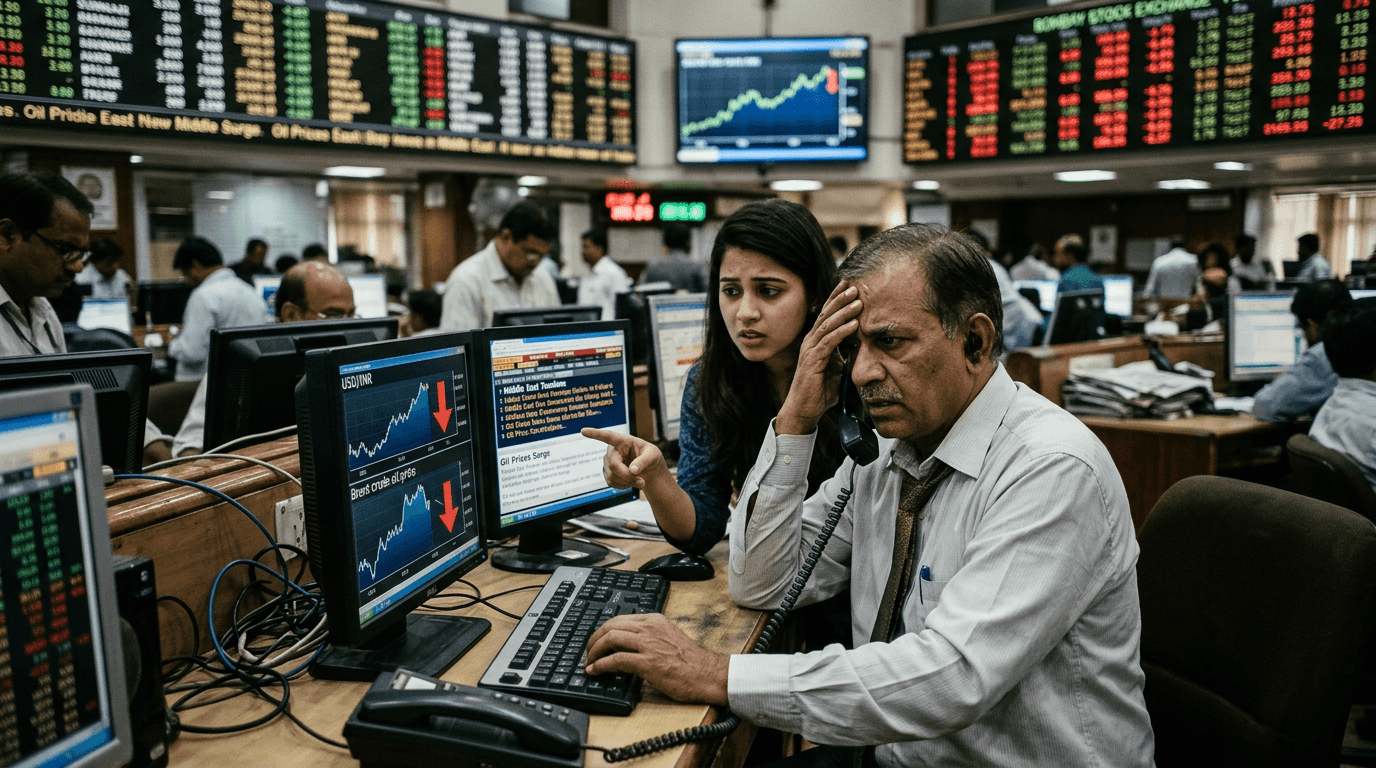
India’s policymakers are once again on the defensive as the rupee slides to record lows under the combined weight of surging oil prices and heightened geopolitical risk in the Middle East. The currency’s sharp depreciation, now making it one of Asia’s worst performers this year, is not just a market story—it is a macroeconomic stress test for an energy‑dependent, import‑heavy economy. For traders and investors, this episode is a real‑time case study in how external shocks, capital flows, and policy responses interact in emerging markets.
WHAT IS DRIVING THE RUPEE’S SLIDE?
At the core of the rupee’s weakness is a classic terms‑of‑trade shock: India imports more than 80% of its crude oil, so every sustained rise in Brent prices mechanically widens the trade deficit and boosts demand for dollars. With crude oscillating well into triple‑digit territory amid US–Iran tensions and broader Gulf instability, refiners and energy companies must buy more dollars to fund costlier imports. That structural bid for USD comes just as risk sentiment deteriorates, pulling foreign capital out of local equities and bonds.
The result is a powerful squeeze on the balance of payments. Analysts now expect the current account deficit to more than double compared with last year, potentially exceeding 2% of GDP, a level historically associated with currency fragility in India. Foreign portfolio investors have already withdrawn tens of billions of dollars from Indian assets as geopolitical risk premia rise and US yields remain attractive. This combination—high oil, strong dollar, and capital outflows—is precisely the environment in which emerging market FX tends to reprice sharply.
Regional conflict adds another layer of uncertainty. Each headline about escalations in the Gulf or disruptions near key shipping routes like the Strait of Hormuz is quickly reflected in oil futures and, by extension, in USD/INR. That tight coupling between geopolitical news flow and currency pricing is why rupee volatility has spiked and intraday moves have grown more violent.
How India Is Trying To Stabilise The Rupee
The Reserve Bank of India (RBI) and the government have deployed a mix of conventional and targeted tools to lean against the pressure. On the market side, the RBI has been selling dollars from its foreign exchange reserves—still substantial, but already down from their recent peak—to smooth volatility and signal its intent to avoid disorderly moves. It has also tightened oversight of FX flows and curtailed speculative positioning in onshore derivatives, hoping to limit excess leverage and herd behaviour.
On the real‑economy side, policymakers are trying to dampen India’s appetite for “dollar‑heavy” imports. Measures include restrictions on silver bar imports and calls for restraint in gold purchases—both major channels through which households and businesses historically convert rupee savings into hard‑asset exposure. Authorities have floated or revived ideas like voluntary austerity on luxury overseas travel and potential incentives for non‑resident Indian (NRI) dollar deposits, echoing policy playbooks used during past episodes of external stress.
A special credit line for oil importers is another tool to manage dollar demand more efficiently. By providing targeted liquidity and reducing the need for panic buying in the spot market, such facilities can help smooth the demand profile for FX. Taken together, these steps are designed not to engineer a reversal of the rupee’s trend—policy makers know they cannot fight fundamentals forever—but to buy time, reduce volatility, and prevent a self‑reinforcing crisis of confidence.
MACRO IMPLICATIONS: INFLATION, GROWTH, AND POLICY TRADE‑OFFS
A weaker rupee pushes imported inflation higher, especially when it coincides with elevated energy prices. Costlier fuel filters through to transportation, manufacturing, fertilisers, and ultimately food prices, amplifying inflation pressures at a time when central banks worldwide remain wary of loosening policy too soon. For India, which had made progress in stabilising inflation in recent years, the oil‑FX combo threatens to reverse those gains.
That forces difficult trade‑offs for the RBI. Hiking interest rates aggressively to defend the currency could help slow capital outflows and support the rupee, but at the cost of tighter financial conditions and potentially slower growth. On the other hand, tolerating more currency weakness risks unanchoring inflation expectations and hurting real incomes, particularly among lower‑income households most exposed to higher fuel and food prices. This is why the current episode is as much a policy challenge as a market event.
Fiscal dynamics also come under strain. Higher oil prices can force the government to choose between allowing retail fuel prices to rise—stoking inflation and political pressure—or absorbing some of the shock through lower tax collections or subsidies, which widens the fiscal deficit. A larger fiscal gap can, in turn, weigh on bond markets and feed into currency risk premia. For investors, the interplay between fiscal, monetary, and external balances is central to medium‑term views on India’s asset prices.
What This Means For Traders And Investors
For FX and macro traders, the message is clear: USD/INR is now a high‑beta expression of global energy risk and Middle East geopolitics. Directional bias will be heavily influenced by oil’s trajectory and any signs of de‑escalation or escalation in regional conflict. In this environment, ignoring crude futures while trading INR is effectively trading with incomplete information.
Equity and fixed‑income traders also need to reassess assumptions around earnings, margins, and yields. Exporters in IT services, pharmaceuticals, and certain manufacturing segments can benefit from a weaker rupee in local‑currency terms, potentially offsetting some headwinds for domestic demand‑oriented sectors that face higher input costs. On the bond side, rising inflation expectations and external risk premia may push yields higher, challenging duration trades and necessitating more active risk management.
For global investors with diversified EM exposure, the rupee’s underperformance is a reminder that country‑specific vulnerabilities matter even in a broad “EM risk‑on” or “risk‑off” regime. India’s growth story remains compelling over the long run, but short‑term currency and rate volatility can materially impact returns, especially for unhedged positions. Allocators must decide whether to hedge FX risk, selectively add on weakness, or rotate exposure across regions.
HOW TRADERS CAN NAVIGATE INR AND OIL‑LINKED VOLATILITY
From a practical trading perspective, there are several disciplines that become essential in this type of environment. First, treat oil price levels and volatility as core inputs into your USD/INR scenarios. Map out simple conditional views: for example, what happens to INR if Brent sustains above $120 versus a pullback below $100? This can inform position sizing and strike selection for options strategies.
Second, track high‑frequency indicators of capital flows and policy signals. FPI flow data, changes in RBI FX reserves, and official commentary on external stability can all foreshadow shifts in the intensity of intervention or tolerance for further depreciation. Sudden changes in import rules for gold, silver, or other “store of value” assets may also hint at growing concern within policymaking circles about dollar demand.
Third, manage leverage and liquidity risk carefully. Episodes like this often feature sharp intraday spikes, gapped openings after geopolitical headlines, and temporary dislocations between onshore and offshore pricing. Using wider but clearly defined stop‑losses, avoiding overcrowded leveraged positions, and diversifying across instruments—spot, forwards, and options—can reduce the risk of forced liquidation at precisely the wrong moment.
What To Watch Next
Looking ahead, three variables will likely dominate the rupee’s trajectory: the path of crude oil, the evolution of Middle East tensions, and the global rate environment led by the US Federal Reserve. A sustained de‑escalation in the Gulf that pulls oil prices lower could quickly ease pressure on India’s external balances, allowing the RBI to scale back intervention and let fundamentals reassert. Conversely, any disruption to shipping lanes or energy infrastructure could push oil higher and reignite concerns about a larger balance‑of‑payments gap.
Domestically, watch for signs of more aggressive policy measures if the rupee approaches psychologically important thresholds or if reserves fall more sharply. These could include tighter controls on certain outward remittances, new schemes to attract NRI deposits, or calibrated fuel price adjustments. How decisively authorities respond will shape both near‑term volatility and longer‑term investor confidence.
For participants in simulated and live markets alike, the current environment is a powerful reminder that FX is not just about interest rate differentials or technical levels—it is about the real economy, politics, and global supply chains. Understanding how these forces intersect in India today offers lessons that apply across emerging markets whenever external shocks test the resilience of domestic policy frameworks.