
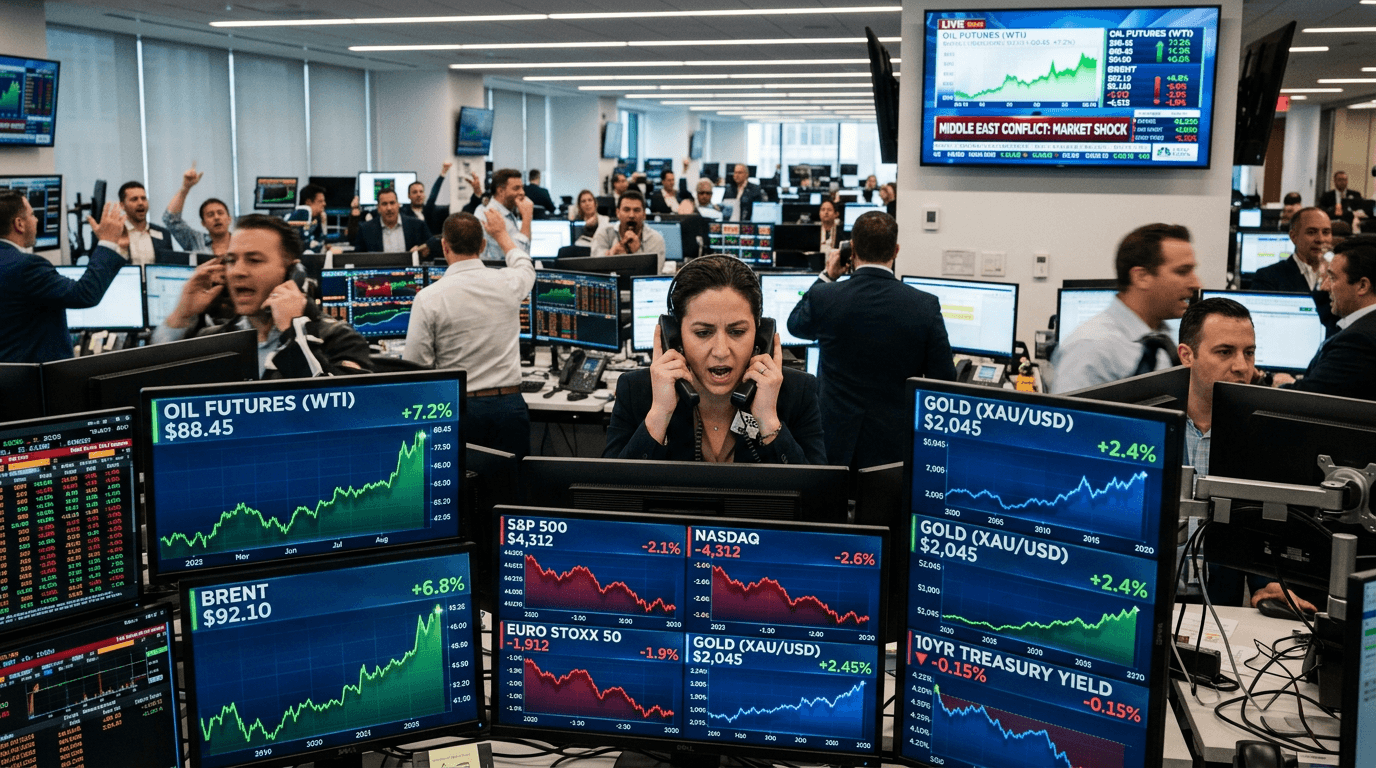
Oil markets have been jolted by a sudden surge in futures prices as the war involving Iran, the U.S., and Israel spills across the Middle East, forcing traders to reprice geopolitical risk almost overnight.[7][5] Brent crude has jumped into the $80–85 range, with intraday gains as high as 9–13%, levels last seen in early 2025.[7][2][5] This oil shock is rippling through global markets, hitting equities and emerging‑market assets, while driving flows into traditional safe havens such as the U.S. dollar, yen, and Swiss franc.[3][6] For traders and investors, the move is a reminder that geopolitics can rapidly reshape the risk landscape, even in an environment that previously appeared comfortable with oversupply and subdued volatility.[7]
Oil Price Shock: What's Driving The Surge
The immediate catalyst for the price spike has been joint U.S. and Israeli strikes on Iran, followed by retaliatory attacks that have disrupted energy infrastructure across the region.[7][5] Facilities in key producers, including Saudi Arabia and Qatar, have been shut or curtailed after drone strikes and missile attacks, amplifying concerns about sustained production outages.[5] At the same time, shipping through the Strait of Hormuz—a chokepoint for roughly one‑fifth of the world’s crude oil trade—has been severely disrupted, with satellite imagery showing traffic almost at a standstill and reports of around 150 ships stranded.[2][5]
Oil majors and trading houses have paused shipments through the Strait, effectively cutting off much of OPEC’s seaborne supply from the market and forcing a rapid repricing of future supply conditions.[2] As a result, Brent futures have spiked as much as 13% to above $82 per barrel, their highest levels since January 2025, while WTI has climbed into the low $70s.[7][2] Notably, this shock is arriving on top of an existing uptrend: Brent had already gained about 19% year‑to‑date, with visible global inventories near historical averages and buyers paying an incremental “risk premium” as tensions in the Gulf escalated.[7] Analysts now see an $80–90 trading range in the near term, with scenarios that push Brent well above $100 per barrel if disruptions through Hormuz persist for several weeks.[7][2]
Ripple Effects Across Risk Assets
The oil surge has quickly fed into broader risk sentiment, with equity markets and higher‑beta assets tightening in response.[3][8] U.S. stock futures fell in the initial reaction to strikes on Iranian nuclear facilities, with Dow, S&P 500, and Nasdaq futures all down around 0.4–0.5%.[3] As oil benchmarks rallied sharply—up over 40% on the month in some contracts—international financial markets showed signs of stress, particularly in segments most sensitive to growth and funding costs.[8] Emerging‑market assets, which tend to underperform in “risk‑off” environments and are often net oil importers, have been under pressure as investors reassess both energy costs and capital flows.[8]
Sector dispersion is becoming a key theme for equity traders. Energy producers and oil‑linked services can benefit from higher prices and widening margins, while fuel‑intensive sectors such as airlines, logistics, and parts of consumer discretionary face margin compression. This divergence is magnified in emerging markets, where higher import bills may weaken currencies and complicate fiscal positions—especially for countries already battling elevated inflation and limited policy space. For portfolio managers, the shock underscores the importance of scenario analysis: stress‑testing positions for sudden moves in commodities and funding costs, rather than assuming that volatility will remain anchored.
SAFE‑HAVEN FLOWS AND FX MARKET REACTION
Safe‑haven flows have been a defining feature of the market response. The U.S. dollar has strengthened, rising about 0.3% in one recent episode as investors sought the relative security of the world’s reserve currency amid military strikes on Iran.[3] Historically, the dollar tends to firm during periods of geopolitical stress, even when underlying U.S. fundamentals are mixed, because global portfolios pivot to liquidity and perceived safety.[3] Similar dynamics often support the Japanese yen and Swiss franc, which are widely treated as safe‑haven currencies in risk‑off regimes, and recent price action is consistent with this pattern.[6]
For FX traders, this environment typically brings higher volatility around headlines, intraday spikes in risk‑sensitive pairs, and a preference for owning currencies backed by strong external balances and deep government bond markets. Cross‑asset moves matter: equity drawdowns, widening credit spreads, and rising oil prices can all reinforce demand for USD, JPY, and CHF as investors hedge portfolios or unwind carry trades. Geopolitical premium is also visible in option markets, where implied volatility often rises as demand for downside protection increases. Managing leverage, respecting gap risk around news, and being disciplined about stop‑loss placement become critical in such conditions.
Inflation, Central Banks And The Macro Outlook
Beyond immediate price moves, the key macro question is whether this oil shock triggers a renewed inflation impulse just as many economies were trying to normalize after the last cycle of price spikes. Higher crude prices translate into more expensive gasoline and diesel, with analysts warning that U.S. gasoline could push above $3 per gallon if disruptions persist, after already jumping to the highest levels since mid‑2024.[7] If Brent were to break through $100 per barrel on prolonged shipping or production outages, the impact on consumer prices and inflation expectations would be difficult for central banks to ignore.[7]
Policymakers had begun to look through energy volatility, focusing more on core inflation and wage dynamics. A sustained oil move higher would complicate that narrative, potentially delaying rate‑cut plans or even reviving the risk of renewed tightening in some jurisdictions. For growth, the combination of higher fuel costs, weaker risk sentiment, and tighter financial conditions could slow activity, particularly in energy‑importing countries. Traders who focus on macro themes will be watching central‑bank communication closely: shifts in guidance around inflation risks, energy pass‑through, and the balance between growth and price stability can significantly reprice rates, FX, and equity indices.
How Traders Can Navigate A Geopolitical Oil Shock
For active traders, the current environment offers opportunity but also elevated risk. The first principle is to recognize that geopolitical shocks can create large, fast moves with limited liquidity, especially around weekend headlines and overnight sessions. Position sizing and leverage should be calibrated to higher volatility: what felt conservative in a low‑vol regime may be aggressive when crude is swinging several percentage points in a single session.[7]
Second, cross‑asset awareness is essential. Oil futures, energy equities, emerging‑market FX, and safe‑haven currencies are all part of the same narrative; treating them in isolation can lead to unintended concentration in a single macro theme. Building playbooks for different scenarios—rapid de‑escalation, extended disruption to Hormuz, or further targeting of energy infrastructure—helps traders map which assets are likely to outperform or underperform in each case.[2][7]
Third, this is an environment where simulated trading can be particularly valuable. Practicing strategies around oil shocks, safe‑haven flows, and risk‑off episodes in a risk‑free setting allows traders to test entry and exit rules, hedging techniques, and position sizing without capital at stake. Whether focusing on crude futures, index CFDs, or major FX pairs, a structured simulation of geopolitical stress can improve discipline when the real market moves.
Finally, staying anchored in process matters more than reacting to every headline. Clarifying your time horizon, defining your risk limits, and using objective signals—such as volatility measures, correlations, and price levels—can help you navigate a noisy environment where emotion often drives short‑term moves. Geopolitical risk is not new to markets, but when it intersects with critical energy arteries, its impact can be both swift and far‑reaching. Being prepared, rather than surprised, is what differentiates resilient trading performance from reactive decision‑making.