
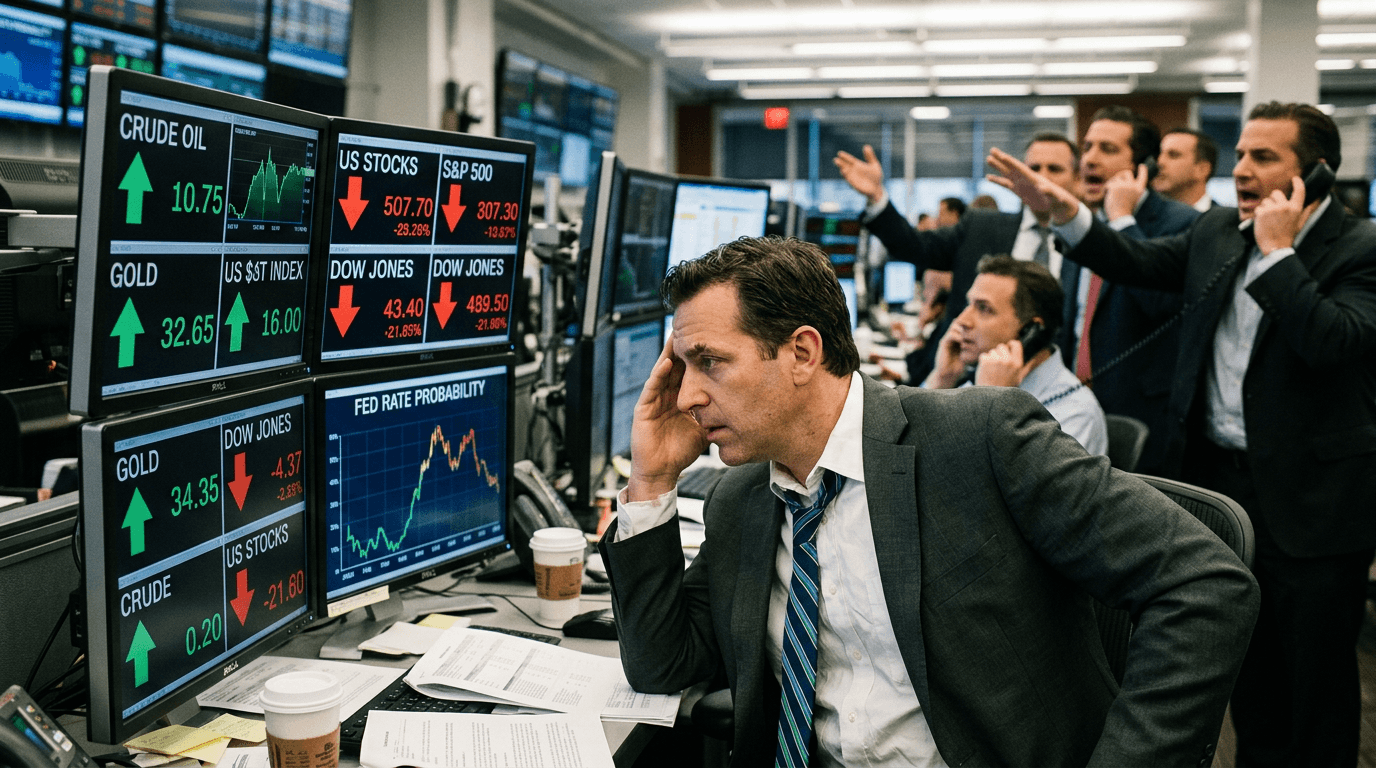
Escalating military tensions between the United States and Iran have jolted global markets, with West Texas Intermediate (WTI) crude jumping roughly 9% to above $81 per barrel and Brent crude trading near $86. The move has slammed US equities, driven investors into safe-haven assets like gold and the US dollar, and reignited concerns that the next leg of inflation could once again be driven by energy.
Market Shock: Oil Spikes, Stocks Slide
The immediate reaction to the latest flare-up in the US–Iran conflict has been classic “risk-off” behavior. Oil markets repriced geopolitical risk almost instantly, bidding up crude futures on fears of potential disruptions to supply routes and regional production capacity.
US equity indices, which had been pricing in a relatively benign macro backdrop and a path toward lower interest rates, sold off sharply. High-beta sectors and growth names saw outsized declines as investors rotated away from risk. Equity index futures reflected this repricing in real time, with implied volatility rising across major US benchmarks.
At the same time, safe-haven assets caught a strong bid. Gold rallied as investors sought protection from geopolitical uncertainty and inflation risk, while the US dollar strengthened against a broad basket of currencies, tightening global financial conditions and putting pressure on risk assets worldwide.
Why Higher Oil Prices Rattle Inflation And Fed Expectations
A 9% move in crude is not just about energy traders—it feeds directly into the macro narrative that central banks, especially the Federal Reserve, are watching closely. Energy is a key component of both headline inflation and business operating costs. When oil jumps:
1) Input costs rise for transportation, manufacturing, and logistics-heavy sectors. 2) Consumers feel the squeeze via higher gasoline prices and utility bills. 3) Corporate margins can compress if companies can’t fully pass higher costs on to customers.
Markets had been positioning for eventual rate cuts from the Fed, based on a view that inflation was trending lower and growth was moderating. A sustained oil spike complicates that story. If higher energy prices bleed into broader price pressures, the Fed may have to keep rates elevated for longer, or slow the pace of any planned cuts.
That possibility is now being reflected in rates markets. Yields on shorter-dated Treasuries—most sensitive to Fed expectations—can stay higher than equity bulls would like, which tends to pressure valuations, particularly for long-duration, growth-oriented stocks.
For traders, the key question is whether this oil move is a short-lived geopolitical spike or the start of a more persistent uptrend that re-anchors inflation expectations. The answer will heavily influence how aggressively the Fed can pivot toward easier policy.
Cross-asset Moves: Winners, Losers, And Correlations
Whenever oil jumps on geopolitical risk, correlations across asset classes tend to shift quickly. This episode is no different.
Energy equities and oil-linked ETFs are obvious beneficiaries. Integrated oil majors, exploration and production companies, and select service providers can see near-term support as higher crude prices improve revenue and cash flow prospects. However, if the conflict escalates to the point where physical infrastructure is threatened, even energy stocks can become volatile and decouple from crude.
On the currency side, the US dollar’s safe-haven status is front and center. A stronger dollar often weighs on commodities priced in dollars, but in a geopolitical shock that directly targets supply, crude can rise alongside the greenback. Oil-sensitive currencies like the Canadian dollar (CAD), Norwegian krone (NOK), and some emerging-market petro-currencies may find pockets of support, although risk-off sentiment can limit their upside versus the dollar.
Gold and, to a lesser extent, other precious metals rally when geopolitical risk rises and real yields fall or stabilize. If traders start to assume that the Fed cannot easily cut rates because of renewed inflation risk, but also cannot hike aggressively in a fragile geopolitical environment, that mix can be supportive for gold as an alternative store of value.
In rates and credit, investors typically prefer the perceived safety of government bonds when geopolitical risk escalates. However, if higher oil prices keep inflation expectations elevated, longer-term yields may not fall as much as in a “pure” risk-off event. That can create a more complex backdrop for bond traders, where duration and inflation risk must be managed simultaneously.
What This Means For Traders In Simulated And Live Markets
For traders—whether in simulated finance environments or trading live capital—this kind of cross-asset shock is both a risk and an opportunity. Volatility increases, correlations become more pronounced, and intraday swings can be larger and faster.
Key practical considerations include
1) Position sizing and leverage: A 9% move in crude can quickly translate into outsized P&L swings, especially in leveraged accounts. Reducing position sizes and avoiding over-concentration in correlated positions (for example, long oil, long energy stocks, and long CAD simultaneously) can help control risk.
2) Scenario planning: Traders should map out scenarios—further escalation, a prolonged standoff, or a rapid de-escalation. Each path has different implications for crude, equities, and FX. Building trade plans around these scenarios helps avoid reactive, emotional decisions when headlines hit.
3) Timeframe discipline: Intraday volatility can look attractive, but it also amplifies noise. Short-term traders might focus on well-defined levels in futures and major FX pairs, while swing traders may prefer to wait for daily closes to confirm breakouts or reversals before committing capital.
Simulated trading environments are particularly useful in this kind of market because they allow traders to test how their strategies behave under stressed conditions—without the emotional and financial pressure of real losses. Tracking performance across oil-related assets, equity indices, and FX pairs during this episode can provide valuable insight into strategy robustness.
Key Levels And Risks To Watch
Going forward, a few themes and levels are likely to guide market behavior:
1) Crude oil support and resistance: If WTI sustains prices above the low-80s, traders may start to price in a more structural risk premium, especially if shipping routes or production facilities face ongoing threats. A swift return to the mid-70s would suggest the market sees the spike as temporary.
2) Headline risk and gap risk: Overnight developments in the US–Iran theater can lead to gaps at market open, particularly in futures. Traders should be cautious holding large, directional positions unhedged through weekends or key diplomatic milestones.
3) Fed communication: Any shift in Federal Reserve rhetoric—acknowledging energy-driven inflation risk or tempering expectations for cuts—will be closely watched. Press conferences, speeches, and minutes can all move markets when read through the lens of higher oil.
4) Equity sector rotation: Defensive sectors (utilities, consumer staples, healthcare) often outperform during risk-off episodes, while cyclical and rate-sensitive segments may lag. Monitoring sector performance can help confirm whether the market is treating the oil spike as a short-lived shock or something more lasting.
For traders, the overarching lesson is that geopolitical risk can reprice markets far faster than fundamental data releases. Having a framework for how oil, equities, FX, and rates interact in these moments is essential. Whether testing strategies in a simulated environment or navigating live portfolios, disciplined risk management, scenario planning, and cross-asset awareness are the edge.