
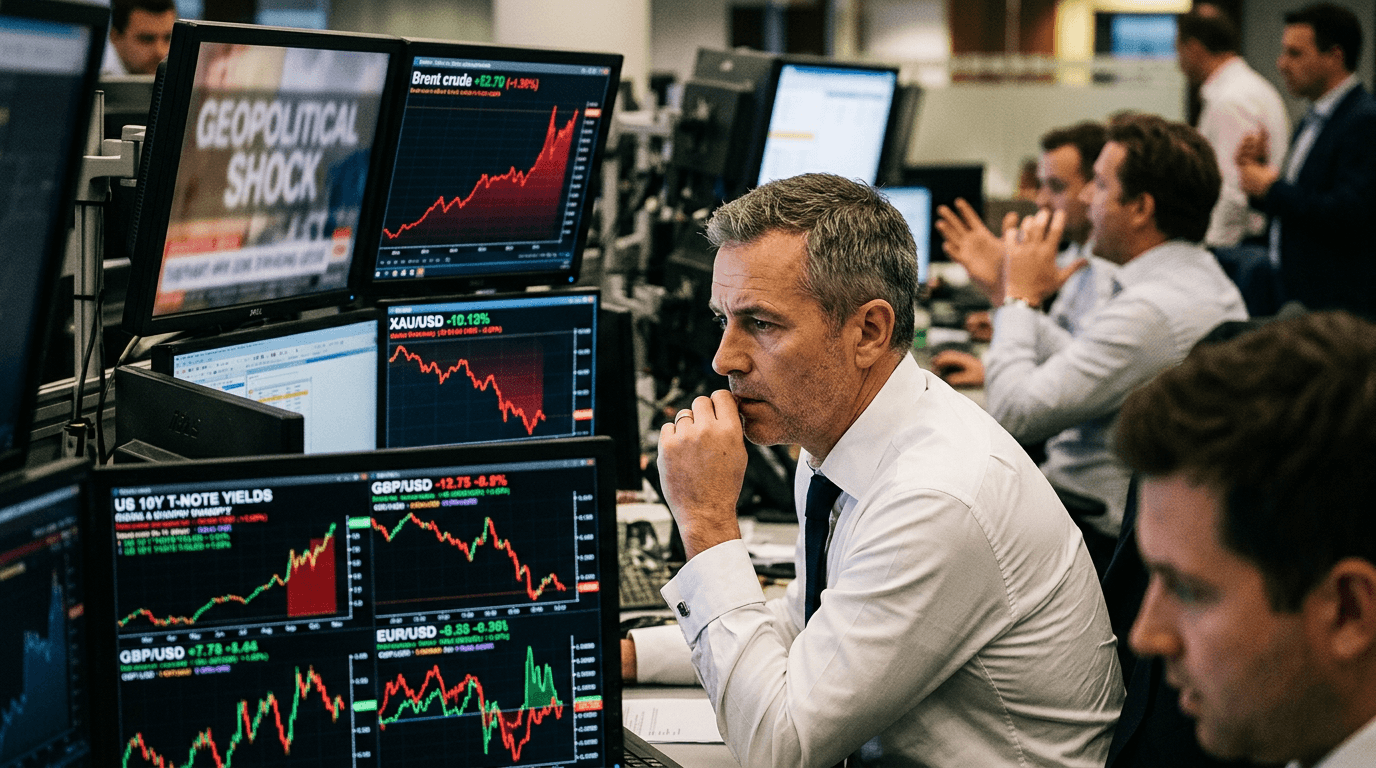
Oil’s latest surge is a reminder that markets don’t just trade data – they trade fear. Rising Middle East tensions and renewed US‑Iran war concerns have pushed crude sharply higher, briefly adding close to 9% in a matter of sessions and lifting prices to the highest levels since mid‑2024.[2][6][8] At the same time, gold has pulled back, and inflation expectations are edging higher as investors rapidly reprice energy costs and the broader macro outlook.[2][4]
Geopolitical Risk Returns To The Oil Market
When the market sees “US‑Iran war” in headlines, it immediately thinks about supply routes, production capacity, and risk premia. The Middle East still accounts for a large share of global crude, and chokepoints like the Strait of Hormuz and the Red Sea are critical arteries for energy flows.[1][7]
In recent flare‑ups, military actions involving Iran, Israel, and US forces have triggered double‑digit intraday spikes in oil, with Brent at times jumping 8–13% and trading in the mid‑90s to high‑90s per barrel, while WTI followed closely behind.[1][2][3][6][8] Importantly, these moves have often occurred even when physical supply has not yet been materially disrupted and major export infrastructure continues to operate.[3]
That pattern highlights a key point for traders: in geopolitically driven rallies, the market prices risk, not just reality. A perceived probability of disruption – such as potential attacks on tankers or threats to block shipping lanes – is enough to lift futures sharply as hedgers, speculators, and producers adjust positioning.[1][2][3][7]
As oil rips higher, the entire energy complex responds. Futures curves can shift from mild backwardation into steeper structures as near‑term supply fears dominate, while options markets see implied volatility rise as participants pay up for downside protection or upside exposure. These dynamics feed through into equity sectors, particularly energy, transportation, and industrials, creating pockets of both opportunity and stress across the risk asset spectrum.[2][8]
Why Gold Can Fall Even As Tensions Rise
Intuitively, many expect gold to rally whenever geopolitical risk spikes. Yet in this episode, the sharp move in oil coincided with a pullback in gold prices – and that apparent contradiction is a valuable lesson in cross‑asset behavior.[2][4]
First, capital doesn’t move to “safe havens” in a straight line. It rotates between gold, major FX (like the US dollar and Swiss franc), and rates markets depending on which risk the market is most focused on: growth, inflation, or financial stability. In an oil‑shock scenario, inflation fears and bond yields can rise, increasing the opportunity cost of holding non‑yielding assets like gold and prompting some investors to switch toward cash or short‑duration bonds instead.[2][4]
Second, gold often reacts to real yields and expectations for central bank policy more than to headlines alone. If a spike in energy prices leads traders to anticipate tighter monetary conditions or higher nominal rates to counter inflation, that can pressure gold even while geopolitical risks remain elevated. In addition, rapid moves in oil can trigger profit‑taking in winning trades to fund margin calls or rebalance portfolios, and gold is a liquid asset that is frequently sold for that purpose.
For active traders, this means “risk‑off” isn’t a single trade. A Middle East shock can simultaneously push oil higher, gold lower, and the dollar stronger, while select sovereign yields rise – a configuration that may look unusual but is entirely plausible when the dominant narrative is energy‑driven inflation rather than systemic financial stress.[2][4]
Inflation Expectations, Bonds, And Macro Repricing
Oil is a core input in the global economy, so a sudden 8–9% jump in crude quickly feeds into inflation expectations. Markets know that headline consumer prices are highly sensitive to gasoline, diesel, transportation, and shipping costs.[2][4][7]
As energy prices rise, breakeven inflation rates – derived from the spread between nominal and inflation‑linked bonds – often move higher, particularly in economies heavily reliant on imported oil. Euro‑area yields, for example, have seen support in similar episodes as traders price in more persistent inflation risks and reduce the odds of aggressive rate cuts.[2][4]
This repricing can steepen parts of the curve, with longer‑dated yields rising relative to short maturities if investors expect inflation to remain above central bank targets for longer. At the same time, higher real yields can tighten financial conditions for corporates and households, raising the cost of capital and dampening risk appetite in equities and credit.
However, history also shows that if tensions cool and physical supply remains intact, oil prices can quickly retreat from their peaks, and those inflation expectations will adjust accordingly.[3][4] For macro‑focused traders, the key is recognizing that geopolitical oil shocks are often impulse events: they create sharp, fast repricing episodes rather than smooth trends, and positioning needs to reflect that asymmetry.
Implications For Traders And Simulated Finance Participants
For traders on a SimFi platform like E8 Markets, this type of event is a live stress test of strategy robustness. An oil‑driven geopolitical shock touches multiple asset classes simultaneously – commodities, FX, rates, equities – and challenges any approach that relies on stable correlations.
Trend‑followers may see strong short‑term signals in crude and energy equities, but must manage whipsaw risk if diplomatic headlines suddenly reverse the move. Mean‑reversion traders need clear rules to avoid repeatedly fading an emotionally driven market that can stay extended longer than models anticipate. Macro and relative‑value strategies must update views on inflation, central bank reaction functions, and sector dispersion in real time.
Simulated environments offer a valuable sandbox: traders can test how their systems respond to an abrupt 9% spike in oil, a rotation out of gold, and shifting bond yields without real capital at risk. Running scenario analyses – for example, “What happens if the Strait of Hormuz is threatened but not closed?” versus “What if actual supply disruption occurs?” – helps refine both position sizing and risk limits.[1][3][7]
Practical Takeaways For Active Traders
- Treat geopolitical oil shocks as cross‑asset events, not single‑market stories. Oil, gold, FX, and rates will all react, but not always in the intuitive direction.
- Focus on drivers, not just prices. Distinguish between moves driven by actual supply disruption and those driven by risk premia and headline anxiety.[1][3]
- Watch inflation expectations and real yields closely. They often determine whether gold sells off, whether bond markets support or undermine equities, and how central bank narratives evolve.[2][4]
- Re‑evaluate correlation assumptions. In an energy‑led shock, traditional “safe havens” can diverge: gold may fall while the dollar and short‑term government bonds gain.
- Use simulated trading to rehearse playbooks. Define in advance how your strategies respond to large gap moves, volatility spikes, and rapid changes in macro narratives, so you are prepared when the next geopolitical headline hits.
Ultimately, Middle East tension and US‑Iran war fears are a reminder that markets can pivot rapidly from complacency to concern. For traders, the edge lies not in predicting each headline, but in understanding how shocks transmit through oil, gold, inflation expectations, and yields – and in having a disciplined framework ready before the next surge arrives.