
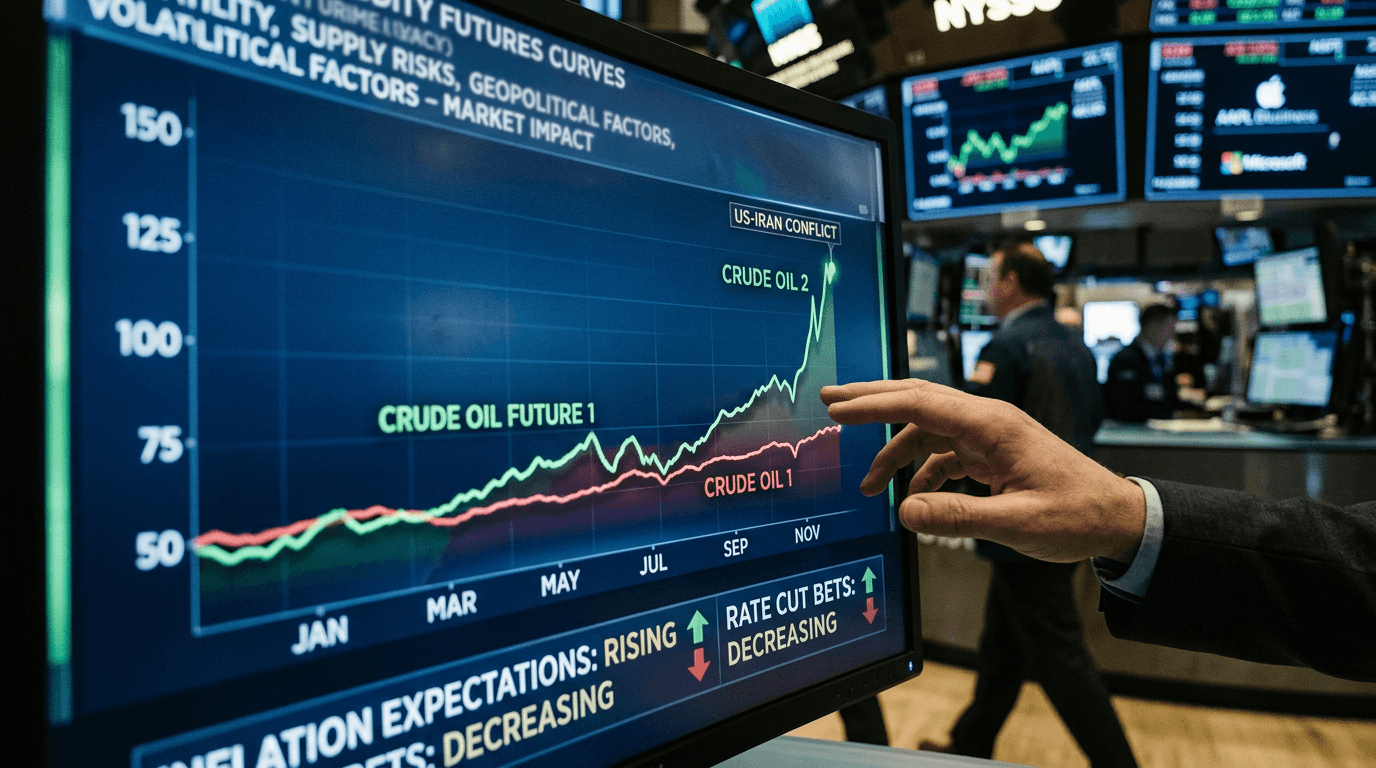
Oil’s latest surge is a textbook example of how geopolitics can ripple through every corner of the market. Crude futures jumped roughly 9%, with US benchmark prices near $81.6 and Brent approaching $85.9 – their highest levels since mid‑2024 – as traders rushed to price in supply risk from the escalating US‑Iran conflict.[1][8] That move is now reverberating across futures curves, inflation expectations, and central bank rate‑cut bets, creating both danger and opportunity for active traders.
Market Shock: Why This Oil Spike Matters
The trigger is the intensifying conflict between the US and Iran and the threat it poses to energy infrastructure and key shipping routes in the Gulf, especially the Strait of Hormuz.[1][3] This narrow waterway handles a large share of global crude flows, so any disruption immediately forces the market to reassess supply security.[1][3]
As the conflict widened, some major producers and trading firms reportedly halted shipments through the Strait, and vessel traffic slowed dramatically.[1] At the same time, Iran has signaled it could move toward a full closure of Hormuz or open additional fronts, such as the Bab el‑Mandeb Strait near Yemen.[3] For markets, this is not just a political headline – it is a direct threat to physical supply routes.
The result: a sharp repricing in crude futures. Brent and WTI pushed to levels not seen for many months, reversing prior declines and reigniting the risk of triple‑digit oil if tanker flows are not quickly restored.[1][8] In historical episodes, similar Middle East shocks have driven oil up 40% or more in a matter of weeks, feeding through to gasoline, diesel and broader energy costs.[4][5]
Key takeaway: This is a genuine supply‑risk event, not a routine price fluctuation, and the market is treating it accordingly.
Futures Curves: From Complacency To Risk Premium
The first place the shock shows up is the futures curve – the market’s best approximation of where prices might trade over time.
When traders suddenly assign a higher probability to supply disruption, near‑dated contracts tend to spike relative to longer‑dated ones, reflecting immediate scarcity and the urgency of hedging current flows.[1] That can push the curve into steeper backwardation, where spot and front‑month prices trade at a premium to later maturities.
In the current episode, crude futures across the curve have repriced higher as participants hedge exposure and rebuild risk premia that had eroded during calmer months.[1][8] Commercial hedgers, refiners, airlines and transport companies are active on the risk‑management side, while speculative flows amplify moves as volatility jumps.
Equity index futures and other commodity contracts are also feeling the impact. Global stock benchmarks have shown intraday swings as energy prices rise, with some indices slipping while others hold near recent highs on the back of strong tech and AI‑related names.[2][3] These offsetting forces – higher input costs versus resilient earnings – are driving choppier short‑term price action rather than a one‑directional crash.
For SimFi traders, this is a critical teaching moment:
- Oil is not an isolated asset; its futures curve interacts with equity, FX and rates markets.
- Curve shape changes (contango vs backwardation) can matter as much as headline spot prices for strategy design.
- Volatility can cluster around geopolitics, rewarding disciplined risk management.
Inflation Expectations: Energy As A Transmission Channel
The jump in oil and gas prices is already stoking inflation concerns.[1][8][6] Fuel costs feed directly into transportation, logistics, food distribution and manufacturing, making energy a powerful transmission channel from geopolitics to consumer prices.[6]
In prior Iran‑related spikes, US gasoline has jumped meaningfully within weeks, with national averages rising by dozens of cents per gallon and pushing pump prices to multi‑year highs.[4][5][6] That dynamic raises household costs, compresses disposable income and can dampen sentiment even if the broader economy remains relatively robust.[4][5]
Market‑based inflation gauges, such as breakeven rates embedded in inflation‑linked bonds, often move with large commodity shocks. When traders suddenly see a path to higher near‑term energy prices, they tend to mark up short‑dated inflation expectations, even if longer‑term expectations remain anchored by central bank credibility and structural forces.
Recent commentary around this conflict highlights exactly that: analysts warn that the energy spike risks pushing headline inflation to its highest level in nearly two years, complicating the disinflation narrative that had underpinned expectations for rate cuts.[6][9] For policymakers who target inflation averages, a renewed upswing driven by oil is especially problematic because it is both visible to consumers and politically sensitive.
Key takeaway: Higher energy prices can re‑ignite inflation pressures quickly, even if they start from the supply side rather than domestic demand.
Central Bank Bets: Rate Cuts Pushed Further Out
The inflation story feeds directly into the rates market. Before the conflict escalated, futures markets had been pricing a path of gradual rate cuts from the Federal Reserve and other major central banks as inflation cooled from prior peaks. A sudden energy‑driven inflation shock forces traders to reassess that path.
When inflation risks rise, central banks face an uncomfortable trade‑off:
- Cut too soon, and they risk validating higher inflation.
- Delay cuts, and they risk slowing growth or tightening financial conditions unnecessarily.
Historically, energy‑led inflation spikes have made central banks more cautious, especially when inflation is already above target or only recently back toward it. Rate‑cut expectations move accordingly – with fewer cuts priced in, cuts delayed into later quarters, or in some cases the probability of renewed hikes inching higher.
Current commentary suggests exactly this pattern: the surge in oil is “hurting rate‑cut expectations” for the Fed and others, as traders weigh the risk that policymakers will want more evidence that underlying inflation is coming down before easing policy.[1][8] That repricing shows up in Fed funds futures, government bond yields and curve shape, feeding into everything from mortgage rates to corporate financing costs.
For traders, the implication is clear: this is not just an energy trade, it is a macro trade. Positioning in rates, FX and equity index futures must account for the possibility that central banks stay restrictive for longer.
How Active And Simulated Traders Can Respond
In a SimFi environment, events like the US‑Iran oil shock are valuable stress tests for both strategies and psychology. They allow traders to experience how a single geopolitical catalyst can impact multiple asset classes without risking real capital.
A few practical takeaways
- Watch correlations: Energy, equities, rates and FX may move in new patterns as the shock unfolds. Strategies built on historical relationships must adapt.
- Respect gap risk: Geopolitical headlines can hit outside regular trading hours, causing gaps in futures and CFD prices. Scenario analysis and conservative sizing can limit damage.
- Separate signal from noise: Not every headline changes the fundamental trajectory. Focus on supply‑route disruptions, policy responses and sustained price shifts, rather than short‑lived spikes.
- Think across horizons: Short‑term traders may focus on intraday volatility and event‑driven moves, while swing and macro traders look at the evolving inflation and central bank narrative.
Ultimately, the oil price spike linked to the US‑Iran conflict is a reminder that markets remain highly sensitive to geopolitical risk, especially when it touches core inputs like energy. Understanding how such shocks flow through futures curves, inflation expectations and central bank bets is now essential for anyone trading – or learning to trade – in today’s interconnected financial system.