
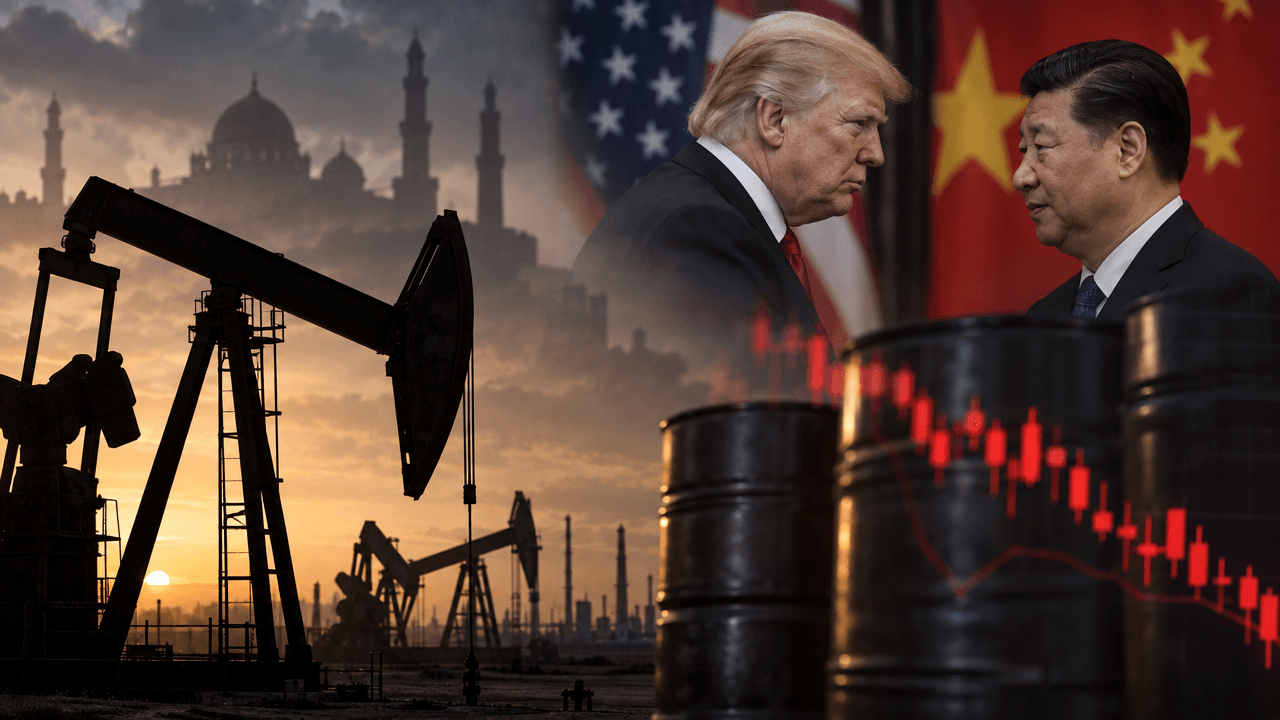
Oil futures are extending a multi‑day slide as traders unwind a sizable geopolitical risk premium and reposition ahead the upcoming Trump–Xi summit, with benchmark prices slipping back toward the low‑$100s for Brent and mid‑$90s for WTI.[8][12][13] The move marks a notable pause after a powerful run‑up driven by Middle East conflict fears, and it is already rippling through energy‑sensitive currencies and inflation expectations across global macro and futures markets.[1][7]
Current Sell-off In Oil Futures
Front‑month Brent is trading around the $102 per barrel area, down roughly 2% on the day and extending a four‑session losing streak that has pushed prices below recent highs above $104–105.[8][12] U.S. benchmark WTI has slipped toward the mid‑$90s, with some intraday prints dipping through $92–94 as long positions built on Middle East risk are progressively unwound.[13][12] The speed of the reversal reflects how much of the prior rally was driven by fear rather than structural supply tightness, and how quickly that fear can evaporate when physical flows show signs of normalization.[1][12]
From a term‑structure perspective, the recent sell‑off is softening the degree of backwardation that had emerged as traders priced in short‑term scarcity, although curves remain relatively tight versus pre‑conflict levels.[5][8] Volatility has ticked higher as options markets reprice the probability of further downside if diplomatic progress continues and macro data point to slower demand growth.[5][6] For SimFi traders, this environment creates a rich laboratory for studying how futures curves, volatility surfaces, and cross‑asset correlations react to fast‑moving geopolitical narratives.
Middle East Supply Fears Receding
The central driver of the pullback is easing concern about immediate Middle East supply disruptions, particularly around Saudi infrastructure and key export routes.[1][3] Reports that Saudi Arabia is arranging additional crude cargoes via Oman and exploring alternative routing options have helped convince markets that near‑term physical shortages are less likely than initially feared.[1][3][10] At the same time, signals that damaged pipelines could return to service sooner than expected have reduced the need to price in prolonged outages.[1][12]
Inventory data and export flows are reinforcing this message. Analysts point to builds in refined product stocks in the U.S., Singapore, and Europe, alongside increased fuel exports from China, as evidence that global balances are not as tight as headline price levels above $100 might suggest.[10][6] As these data points accumulate, the geopolitical risk premium embedded in both Brent and WTI is being chipped away, explaining why prices can fall 2–3% in a single session even when the underlying conflict has not fully resolved.[1][12]
For traders, this is a textbook example of how markets trade the rate of change in perceived risk rather than the absolute level of tension. When the probability of a worst‑case disruption falls—even modestly—prices can move sharply, regardless of whether headlines still look worrying on the surface.[3][10]
TRUMP–XI SUMMIT AND MACRO SENTIMENT
The upcoming summit between U.S. President Donald Trump and China’s President Xi Jinping is adding another layer of uncertainty, encouraging more cautious positioning in oil and broader risk assets.[11][5] Energy traders are acutely aware that any progress or setback on trade, sanctions, or broader geopolitical cooperation could reshape expectations for global growth and commodity demand.[11][5] As a result, some market participants are reluctant to maintain large directional bets in crude ahead of key headlines from Beijing.
Previous episodes have shown that even modest shifts in policy language around tariffs, technology exports, or security guarantees can swing growth expectations and with them the demand outlook for energy.[11][5] If the summit delivers a more constructive tone, it could support risk assets, but it might simultaneously reinforce the view that Middle East tensions will be managed through diplomacy rather than confrontation, capping any fresh risk premium in oil.[3][11] Conversely, a breakdown in talks or escalation of strategic rivalry could weigh on demand expectations and credit conditions, potentially turning crude into more of a growth‑sensitive asset than a pure geopolitical hedge.[5][6]
Impact On Currencies, Inflation Expectations, And Simfi Markets
The current slide in oil is already affecting energy‑linked currencies such as the Canadian dollar, Norwegian krone, and Russian ruble, which tend to track changes in crude prices and terms of trade.[1][7] Lower oil is also nudging down market‑based inflation expectations, as seen in the behavior of breakeven rates and inflation‑linked futures, particularly in regions where energy carries a large weight in consumer price baskets.[1][8] These cross‑asset moves highlight why crude remains a central input in macro trading strategies and risk models.
For SimFi users, this episode offers a rich multi‑asset case study: oil futures declining after a geopolitical spike, energy‑sensitive FX weakening, inflation expectations cooling, and equity sectors—especially energy and industrials—adjusting their earnings outlooks.[1][7][5] By replaying these scenarios in a simulated environment, traders can test how different positioning—long crude versus short energy equities, or long inflation breakevens versus short oil—would have performed as the narrative shifted from “shortage risk” to “diplomatic progress.”[5][8]
Implications For Traders And Risk Management
For discretionary and systematic traders alike, several practical lessons emerge from this multi‑day slide. First, risk premiums built on fragile narratives can unwind far faster than they were accumulated, so position sizing and stop‑loss discipline are critical when trading geopolitical themes.[1][12] Second, watching physical indicators—shipping routes, inventory data, export flows—helps distinguish between a sentiment‑driven rally and a move supported by genuine shortage.[3][10] Third, cross‑asset signals in currencies and inflation markets can provide early confirmation that a move in crude is gaining macro traction rather than remaining confined to the commodity complex.[1][7]
SimFi platforms like E8 Markets allow traders to practice these skills without real capital at risk. Users can structure scenarios around different summit outcomes, varying assumptions about Middle East disruptions, and alternative policy paths for major central banks.[5][8] By stress‑testing portfolios against shocks to oil, FX, and rates, traders improve their ability to respond when similar episodes unfold in live markets.
Key Takeaways
Oil’s multi‑day slide underscores how quickly risk premiums can deflate when evidence points to more stable supply and potential diplomatic progress.[1][3][12] The convergence of easing Middle East fears and event risk around the Trump–Xi summit has shifted the focus from scarcity to macro uncertainty, pressuring crude, energy‑linked currencies, and inflation expectations in tandem.[1][7][11] For traders engaging through SimFi or live markets, the message is clear: stay attuned to both physical flows and policy signals, build robust scenario plans, and treat geopolitical rallies as opportunities that demand disciplined management rather than complacent confidence.