
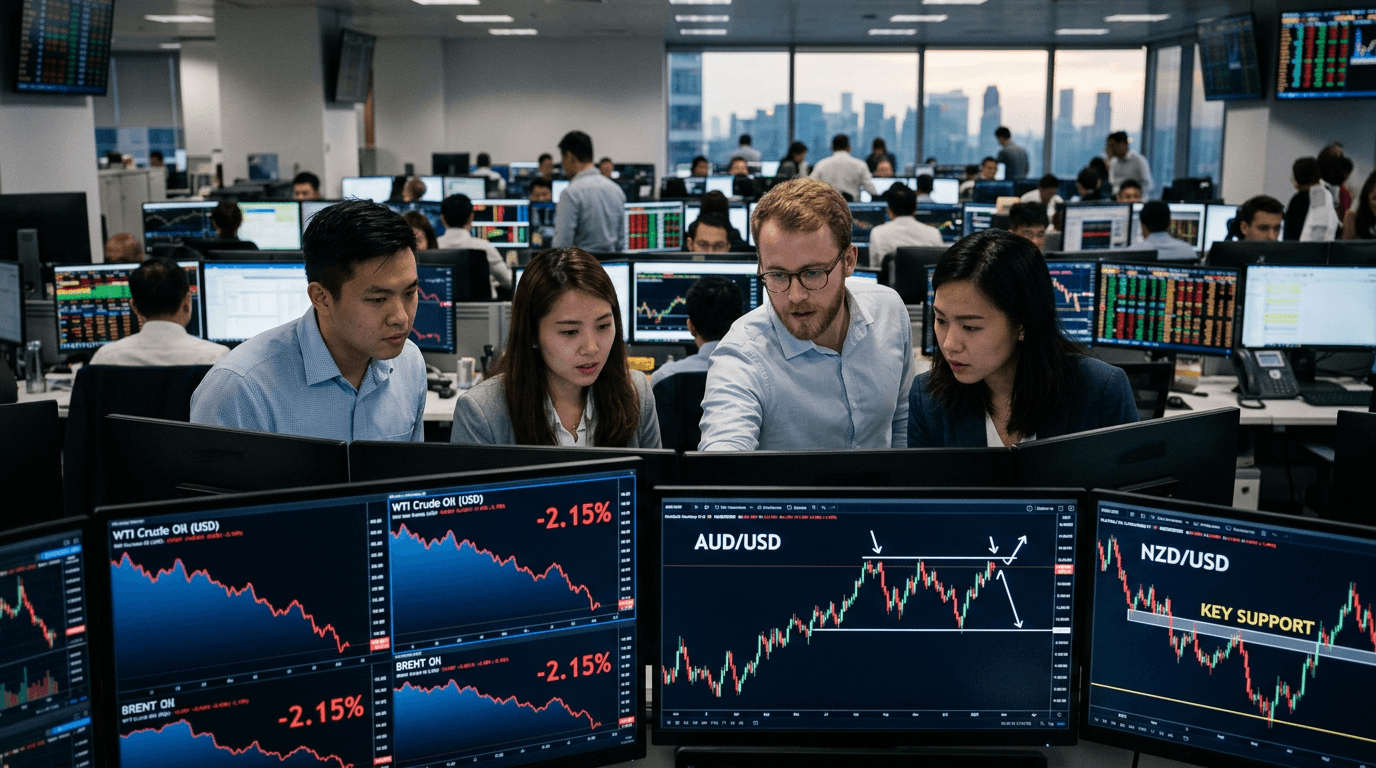
Oil’s latest slide is a reminder that geopolitical risk does not move markets in a straight line. As traders shift focus from immediate disruption in the Strait of Hormuz toward ongoing talks between Iran and Oman, the risk premium embedded in crude has started to come off, pressuring prices and rippling through energy-linked assets.[1][10][14] At the same time, commodity currencies such as AUD and NZD are consolidating against a slightly softer US dollar, keeping the commodity FX theme firmly in play.[1][11]
Markets Repricing Hormuz Risk
The Strait of Hormuz is one of the world’s most critical energy chokepoints, with recent conflict-driven disruptions repeatedly jolting crude benchmarks and shipping routes.[5] Episodes in which more tankers have successfully transited the strait have tended to ease supply fears and push prices lower, as seen in prior sessions where Brent and WTI fell sharply once some shipping lanes reopened.[10][14] Today’s move fits that pattern: as investors perceive a slightly lower probability of a prolonged blockade, they reprice the geopolitical premium that had been supporting oil.
Diplomatic engagement between Iran and regional partners such as Oman signals a potential path toward restoring more stable flows, even if the situation remains fluid and fragile.[12][13] Markets are highly sensitive to this shift in narrative—from “closed and escalating” to “negotiating and possibly reopening”—and that sensitivity shows up as fast adjustments in futures curves, volatility, and risk positioning.[10][12][13] For short-term traders, the key takeaway is that sentiment around Hormuz can flip quickly, with prices reacting not just to physical shipments but to headlines about talks, threats, and ceasefire prospects.[5][10]
Why Tensions Can Drive Oil Lower Instead Of Higher
At first glance, it may seem contradictory that heightened focus on Hormuz tensions coincides with lower oil prices. In reality, prices respond to changes in expectations, not just to the level of risk itself. When markets shift from fearing fresh supply disruption toward anticipating partial normalization or successful diplomacy, the embedded risk premium in crude can unwind even while headlines remain tense.[10][12][14]
Recent history illustrates this dynamic clearly. When more tankers exited the Strait of Hormuz, easing immediate supply concerns, Brent and WTI extended declines as traders reduced hedges and took profit on earlier risk-driven rallies.[10][14] Similarly, when negotiations over reopening the shipping corridor gained traction, prices reacted as much to the possibility of future flows as to current disruptions.[12] For traders, the lesson is that geopolitical trades are about trajectory: whether risk is perceived to be worsening, stabilizing, or improving.
This also explains why volatility around Hormuz can be asymmetric. Sharp rallies tend to occur on sudden escalations—such as fresh attacks or threats to close key routes—while slower, grinding declines follow periods when diplomacy or incremental shipping improvements chip away at worst-case scenarios.[6][10][14] Successful trading in this environment requires staying ahead of the narrative arc, rather than reacting mechanically to each new headline.
Commodity Fx: Aud And Nzd Remain In Focus
Oil’s move is not only an energy story; it is also feeding into commodity FX. As crude softens and energy-linked assets come under pressure, the Australian dollar (AUD) and New Zealand dollar (NZD) are consolidating against a slightly weaker US dollar, keeping these currencies firmly on traders’ radar.[1][11] Even though Australia and New Zealand are not major crude exporters, their currencies often trade as proxies for global commodity demand and risk appetite, particularly in macro and carry strategies.
When oil re-prices on geopolitical news, it can influence broader commodity sentiment and growth expectations, which in turn affects AUD and NZD via trade, terms of trade, and investor positioning. In a softer oil environment, commodity FX may see more two-way price action rather than one-directional trends, especially if the US dollar is also easing on shifting rate or risk expectations.[1][11] That creates a backdrop where relative value, correlation trading, and cross-asset analysis become more important than outright directional calls.
For FX traders, the practical takeaway is to monitor how oil volatility interacts with broader risk sentiment. A day when crude sells off but equities hold up, for example, may have a very different impact on AUD and NZD than a session where both commodities and stocks move lower together. Alignment—or divergence—across asset classes often matters more than the crude move in isolation.
Energy-linked Assets And Broader Risk Sentiment
Weaker oil prices tend to weigh on energy equities, high-yield credit tied to the sector, and the currencies of key exporters, while potentially supporting importers via improved terms of trade. In the current environment, the market is juggling two competing forces: the drag from lower prices on energy-linked names, and the potential relief that comes from reduced fears of a prolonged shipping blockade through Hormuz.[5][10][14]
If traders believe that the latest slide reflects progress toward more normal supply, they may rotate away from pure geopolitical hedges and toward more cyclical or rate-sensitive trades. On the other hand, persistent uncertainty and stop‑start diplomacy can keep volatility elevated, encouraging tactical rather than long-term positioning.[12][13] This tug of war underscores why cross-asset context—equities, credit, rates, and FX—is essential when interpreting any single commodity move.
For portfolio builders, the actionable point is to map exposures to energy and geopolitics explicitly. Understanding how a simulated portfolio reacts to shifts in oil—through direct positions, sector tilts, and FX exposure—helps avoid unintended concentration in a single risk theme.
Trading Implications In A Simulated Environment
A simulated finance environment is well suited to studying geopolitical shock cycles like the Hormuz story. Traders can replay scenarios where crude gaps higher on escalations and then grinds lower as diplomacy and logistics slowly improve, testing how different strategies perform across the full cycle rather than just the initial shock. This is particularly valuable for refining risk management: where to set stops, when to reduce size, and how to diversify across commodities and FX.
One useful exercise is to build hypothetical portfolios with varying degrees of energy and commodity FX exposure, then stress‑test them against paths where oil falls on easing tensions but remains headline‑sensitive. Comparing outcomes across these scenarios highlights which approaches rely too heavily on a single narrative and which are robust to regime shifts. Another is to study correlation breakdowns—periods when AUD and NZD deviate from their usual relationship with commodities, as they consolidate against moves in the US dollar.
Ultimately, the current backdrop shows that geopolitical risk is a moving target, not a static label. Oil sliding on Hormuz headlines, commodity FX staying in play, and energy-linked assets adjusting in real time all underscore the importance of flexible thinking and disciplined execution. For traders, whether in live or simulated markets, the edge lies in connecting these moving pieces into a coherent view and being ready to adapt as the narrative evolves.