
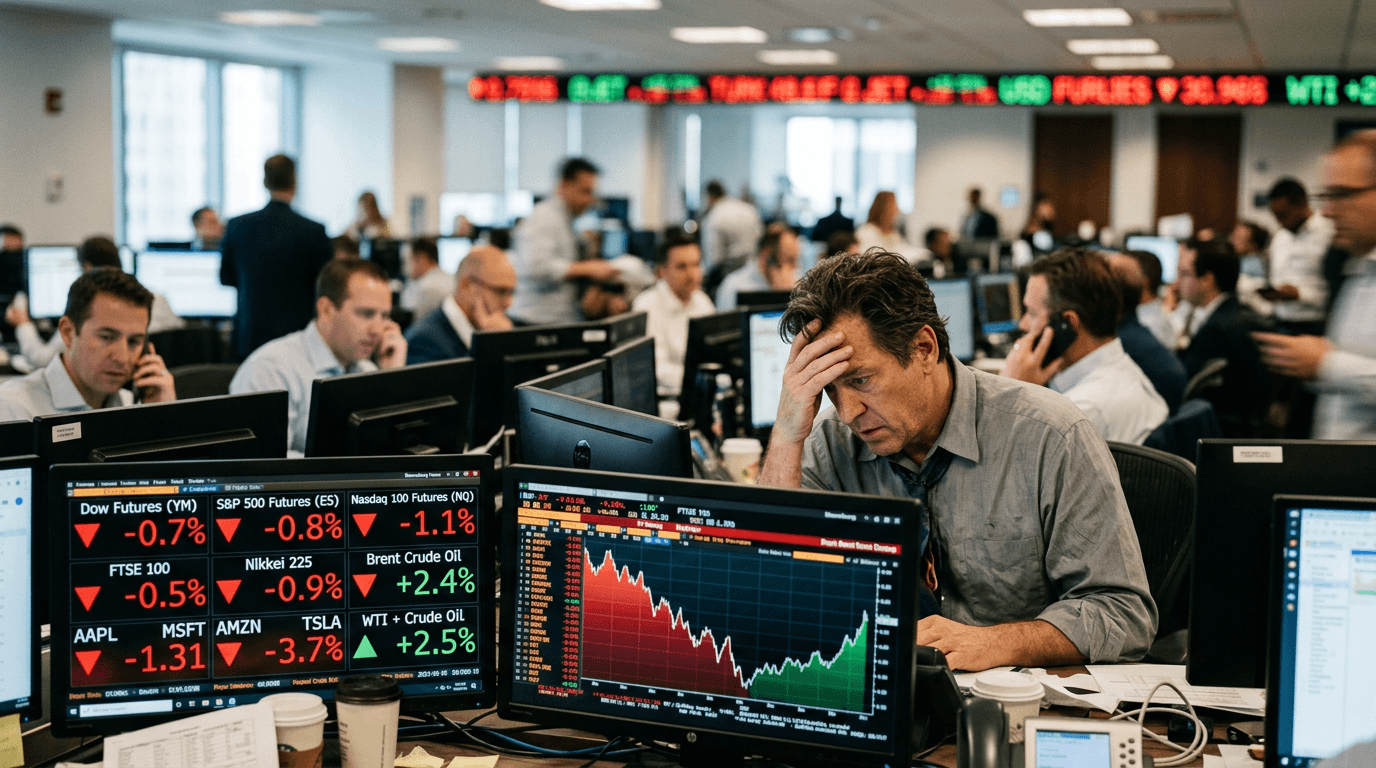
Risk appetite is on the back foot again as US equity futures edge lower and global stocks wobble, with a fresh spike in oil prices and renewed tension between the US and Iran forcing investors to reassess risk across portfolios.[4][5] The moves highlight how quickly sentiment can swing when geopolitics intersects with already fragile markets, particularly in crowded areas like technology and semiconductors.[2][5]
Market Snapshot: Futures, Oil And Global Equities
Overnight, futures tied to the major US indices traded in the red, pointing to a softer start for cash markets.[4][5] Contracts on the Dow Jones Industrial Average fell by around 150 points, while S&P 500 futures slipped about 0.3–0.4% and Nasdaq 100 futures underperformed with declines in the 0.5–0.6% range.[4][5] That underperformance in Nasdaq futures is consistent with a broader tech-led pullback that began late last week and has yet to fully stabilize.[2][5]
Oil has moved sharply higher as traders price in the risk that escalating tension in the Middle East disrupts supply routes and raises the geopolitical risk premium embedded in crude.[5] West Texas Intermediate (WTI) crude recently jumped more than 3%, trading close to the mid‑$90s per barrel, after headlines suggested a fragile ceasefire between Washington, Tehran and regional actors was at risk.[5] Higher energy prices immediately feed into inflation expectations and corporate cost projections, which is why equity markets tend to react quickly when oil surges.
The risk-off tone is not limited to the US. Asian equity markets closed broadly lower, with South Korea’s Kospi suffering one of the steepest drops, and Japan’s Nikkei also retreating as traders digested reports of missile launches and renewed US strikes.[4][5] European stocks opened weaker as well, with the pan‑regional Stoxx 600 index down around 0.5% and most sectors in negative territory.[5] This synchronized weakness across regions is a hallmark of geopolitical shocks: when the driver is global rather than local, correlations between markets tend to jump.
Why Geopolitics And Oil Prices Hit Risk Appetite
Geopolitical events affect markets through several channels, and the current US‑Iran dynamic touches almost all of them. First, there is the direct supply risk. Iran is a key player in regional energy flows, and any conflict that threatens production or transport routes raises the probability of tighter oil supplies and sustained higher prices.[5] For investors already watching inflation data closely, a renewed oil spike complicates the macro picture, potentially delaying rate cuts or limiting central banks’ ability to respond to growth concerns.
Second, geopolitics introduces uncertainty that is hard to model. Unlike economic data, which follows predictable release schedules and historical patterns, sudden strikes or missile launches can occur without warning and have non‑linear effects on sentiment. The recent “self‑defense strikes” by the US against Iran triggered immediate selling in futures, even though the move did not change earnings forecasts or valuation models overnight.[4] What changed was the perceived distribution of future outcomes – in other words, tail risk.
Third, risk events often accelerate positioning shifts that were already underway. Tech and AI‑related trades had become crowded after months of outperformance, leaving investors vulnerable to profit‑taking and forced de‑risking when sentiment turned.[5] Geopolitical stress can act as the catalyst for unwinding those positions, as traders look to lock in gains and rotate into relatively defensive sectors such as utilities, staples, or selected energy names that benefit from higher crude.
Tech And Semiconductors Under Pressure
Technology and semiconductor stocks sit at the heart of this risk-off episode. The Nasdaq 100 recently logged its biggest daily fall since April 2025, and futures tied to the index remain notably weaker than their S&P 500 or Dow counterparts.[2] In parallel, a sharp overnight sell-off in Asian technology indices spilled into US markets, pushing E‑mini Nasdaq futures down more than 2% at one point and putting particular pressure on semiconductor and memory names.[3]
More than two‑thirds of tech stocks now trade at least 20% below their recent highs, underlining just how broad the correction has become. That statistic matters for risk management: it signals that the move is not confined to a handful of high‑beta names but has spread across the sector, impacting portfolio‑level exposure and factor risks such as growth, momentum and high valuation.
The fundamental story for tech has not disappeared, but the market narrative is shifting from “AI at any price” toward “AI at a reasonable price.”[5] Asian technology shares, for instance, extended their decline after a more than 4.5% drop in the US tech‑heavy Nasdaq the prior week, suggesting that global investors are reassessing the pace of AI demand rather than abandoning it outright.[5] For traders, this shift emphasizes the importance of understanding where earnings visibility is strong and where valuations rely more on long‑dated optimism than near‑term cash flows.
Implications For Traders And Simulated Finance Participants
For active traders and SimFi users, this environment offers both risk and opportunity. Volatility in index futures, sector ETFs, and single‑stock names has picked up, with options markets seeing elevated volumes as investors reach for hedges and short‑term trades.[3] Higher implied volatility can improve the risk‑reward of strategies such as spreads, straddles, or delta‑hedged positions – provided participants are disciplined about sizing and scenario analysis.
This is precisely the type of backdrop where simulated trading can add real educational value. Stress‑testing a portfolio against different oil price paths, various levels of tech drawdowns, or alternative geopolitical outcomes helps clarify how sensitive P&L is to each risk factor. SimFi environments allow traders to:
- Recreate recent sessions with real‑world price moves in futures, oil, and tech.
- Test how portfolio drawdowns change when correlations across regions spike.
- Explore rotation strategies, such as trimming high‑beta tech and adding exposure to energy or defensive sectors, without risking live capital.
By running these experiments when the news flow is intense, traders can develop a more intuitive feel for how macro shocks transmit through markets – a skill that often differentiates experienced risk managers from short‑term speculators.
How To Frame The Next Moves
Looking ahead, a few signposts will help determine whether this episode remains a short‑lived shock or evolves into a more persistent regime shift. First, watch oil. If crude prices stabilize or retreat on credible signs of de‑escalation between the US and Iran, equity markets could quickly refocus on earnings and monetary policy, allowing risk assets to find a floor.[5][7] If, instead, oil keeps grinding higher, the inflation and margin story becomes more challenging and could justify lower multiples in energy‑sensitive sectors.
Second, monitor the balance between geopolitical headlines and economic data. Recent PMI figures above the 50 threshold still point to expansion in key economies, suggesting that the macro backdrop has not collapsed even as markets digest geopolitical stress.[3] If growth indicators hold up and central banks maintain a broadly supportive stance, dips in cyclicals and quality tech may attract buyers once volatility subsides.
Third, pay attention to positioning and market internals. The fact that so many tech names are trading 20% or more below their highs indicates that de‑risking has gone a long way already. At some point, valuations and long‑term themes can reassert themselves, particularly in companies with strong balance sheets and clear cash‑flow visibility. For now, though, futures and global equity indices are signaling that the market needs greater clarity on geopolitics and oil before fully embracing risk again.[4][5]