
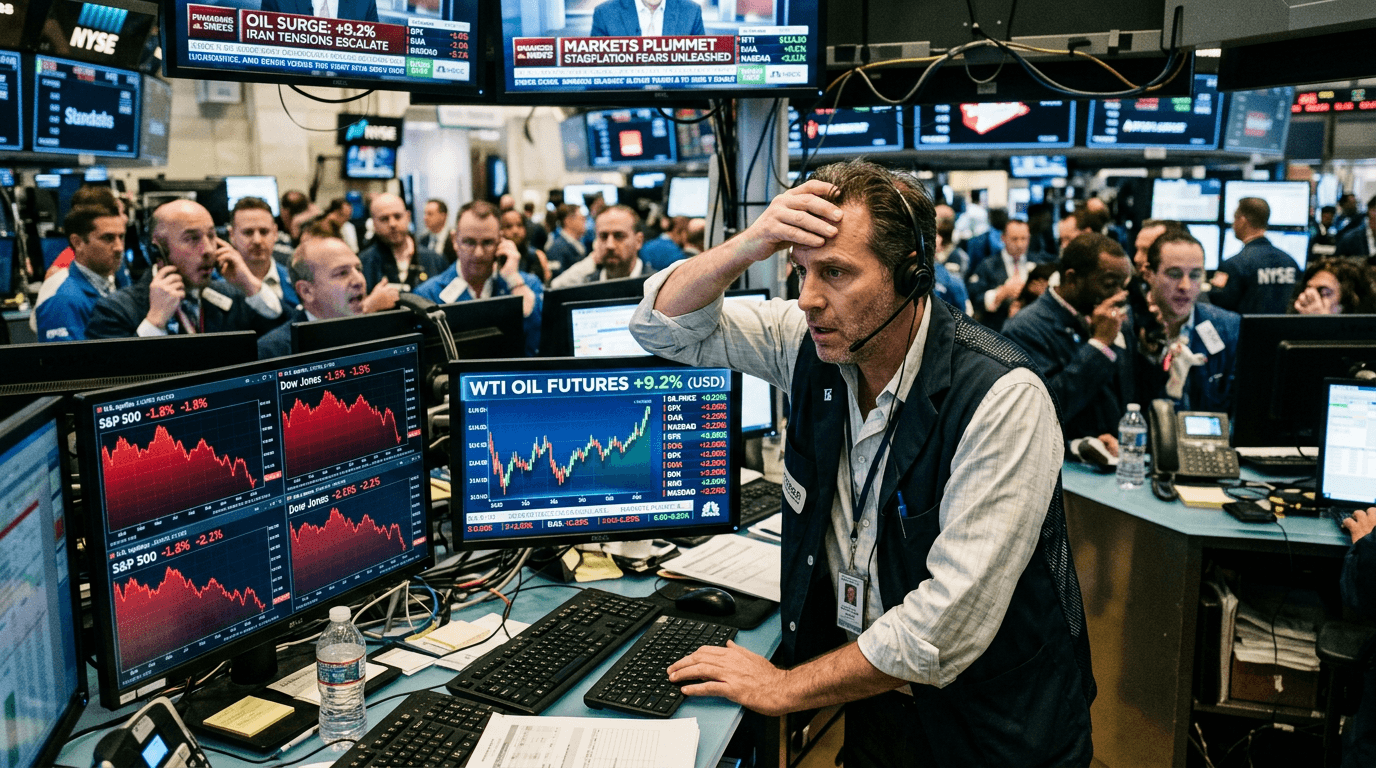
Oil futures surged as much as 9% in intraday trade as the conflict with Iran escalated, sending benchmark prices toward and above $120 per barrel and knocking U.S. stock indices sharply lower.[1][4] The move triggered a fast rotation across futures markets: energy contracts rallied, while rate‑sensitive and growth sectors came under pressure as traders quickly repriced inflation and growth risks.[1][2] For many participants, this was a textbook example of how geopolitics can ripple through commodities, equities, rates, and volatility all at once.
Behind the headlines is a deeper story about market structure, supply chains, and investor psychology. Understanding how and why a 9% spike in crude can hit everything from tech stocks to Treasury yields is essential for anyone trading real or simulated markets.
Why Oil Spiked: The Iran Conflict And Supply Routes
Iran is a critical player in Middle East energy flows, and the conflict has raised fears about disruptions to production and, more importantly, to shipping routes. When tensions escalated and the risk to energy infrastructure increased, futures markets responded almost instantly, pushing crude sharply higher.[1] At the core of market anxiety is the Strait of Hormuz, the narrow choke point through which a large share of global oil and LNG exports pass. Following its closure during the Iran war, Brent crude previously surged past $120 per barrel as exports were stranded, highlighting how sensitive prices are to this single bottleneck.[4]
Oil futures did not just drift higher; they gapped and spiked, reflecting a jump in perceived tail risk rather than a slow grind in fundamentals. In these situations, traders are not just pricing current supply and demand—they are discounting worst‑case scenarios: extended disruptions, shipping attacks, or a broader regional conflict.
This is also a story about leverage and positioning. Before the conflict escalated, many traders had become comfortable with a narrative of easing inflation and slowing demand. A sudden geopolitical shock forced a rapid short‑covering in crude and a scramble to add upside protection via call options and long futures, contributing to the size and speed of the move.
HOW THE OIL SHOCK HIT U.S. EQUITIES
A 9% spike in oil would not automatically have to crush equities—but the context matters. U.S. indices have been trading near elevated valuations and heavily concentrated in growth and tech names that are sensitive to interest rates and macro expectations. When oil jumped, the market quickly connected the dots: higher energy costs can push inflation back up, squeeze corporate margins, and pressure consumer spending.[2]
The immediate reaction was classic “risk‑off” with nuance:
- Broad U.S. equity indices moved lower as risk appetite faded.
- Energy stocks and futures outperformed, benefiting from higher crude prices and rising earnings expectations.
- Rate‑sensitive sectors—like technology, small caps, and speculative growth—sold off on the prospect of higher inflation, stickier interest rates, and slower growth.
- Defensive sectors (utilities, staples, health care) saw relatively smaller declines as investors rotated toward perceived safety.
This kind of move reflects a shift in the correlation regime. In “Goldilocks” environments, equities and commodities can rise together on growth optimism. In a stagflation scare, oil can rise while stocks fall because the driver is cost‑push inflation and geopolitical risk, not stronger demand.
For index futures traders, the lesson is that macro shocks often express themselves through sector dispersion. The headline may focus on the S&P 500, but under the surface, there can be violent rotations between energy, financials, defensives, and growth.
Inflation, Stagflation Fears, And Policy Expectations
One reason this oil spike was so market‑moving is that it revived fears of stagflation—a combination of slower growth and higher inflation. When crude prices jump due to supply disruptions rather than strong demand, the shock acts like a tax on the global economy: input costs rise, profit margins tighten, and households see less disposable income.
Institutions like the IMF have warned that sustained oil price spikes from conflicts in the region can weigh on global growth while pushing inflation higher, complicating central bank policy.[2] If inflation expectations rise again, policymakers may have less room to cut rates or may even need to maintain tighter conditions for longer.
Markets quickly begin to reprice
- Inflation breakevens and commodity‑linked assets may rise.
- Rate‑cut expectations get pushed out in time.
- Yield curves can flatten if investors fear slower growth but still expect restrictive policy.
For traders, this linkage between an oil futures candle and the entire macro framework is critical. A single day’s price action may be noise, but a series of elevated closes in crude can fundamentally change the path of inflation, rates, and earnings estimates.
PLAYBOOK FOR TRADERS IN AN OIL‑DRIVEN SHOCK
An oil shock tied to geopolitics is not a rare “black swan”—it is a recurring feature of markets. That makes it a valuable scenario to study and rehearse, especially in simulated environments where you can test ideas without capital at risk. Here are practical angles to focus on:
1. Map the transmission channels Don’t stop at “oil is up, stocks are down.” Ask: - Which sectors benefit (energy, some commodities) and which suffer (transport, airlines, discretionary)? - How might credit spreads react as higher costs pressure weaker balance sheets? - What does this imply for inflation expectations and rate futures?
2. Study term structure and volatility Oil shocks often distort the futures curve (contango vs backwardation). A sudden spike from supply fears can pull the front of the curve sharply higher relative to longer‑dated contracts. Understanding curve dynamics helps with spread trades and hedging strategies.
3. Stress‑test positions and sizing A 9% intraday move is a reminder to respect tail risk. Traders should examine: - How much leverage their strategies are using. - What happens to their portfolio if key assets move 2–3 standard deviations in a single session. - Whether stops and hedges are placed realistically given volatility.
4. Use simulated markets as a training ground Simulated finance platforms let traders replay or approximate scenarios like the Iran‑driven oil spike: - Practice reacting when crude gaps higher and index futures gap lower at the open. - Experiment with hedging equity exposure via energy longs or volatility products. - Test systematic rules—such as reducing risk when realized volatility breaks above a threshold.
By doing this in a risk‑free environment, traders can see how their decision‑making holds up under stress and refine their frameworks before facing similar conditions in live markets.
Conclusion: Turning Volatility Into An Edge
The 9% spike in oil futures and the accompanying drop in U.S. equities underline how interconnected modern markets are and how quickly narratives can flip from “soft landing” to “stagflation risk.”[1][2] A geopolitical event thousands of miles away can reprice crude, alter inflation expectations, pressure high‑growth stocks, and shift the entire conversation around monetary policy in a matter of hours.
For traders and investors, the goal is not to predict the next conflict but to build robust playbooks for when shocks inevitably arrive. That means understanding the mechanics of commodity futures, the sector‑level impacts on equities, and the macro linkages to inflation and rates. It also means practicing discipline: controlling position size, respecting volatility, and avoiding impulsive decisions in the heat of the move.
Simulated trading environments offer a powerful way to turn these episodes into structured learning opportunities. By systematically replaying scenarios like the Iran‑driven oil shock, you can transform market turbulence into an edge—developing the skills, frameworks, and emotional resilience needed to navigate the next bout of geopolitical volatility with greater confidence and control.