
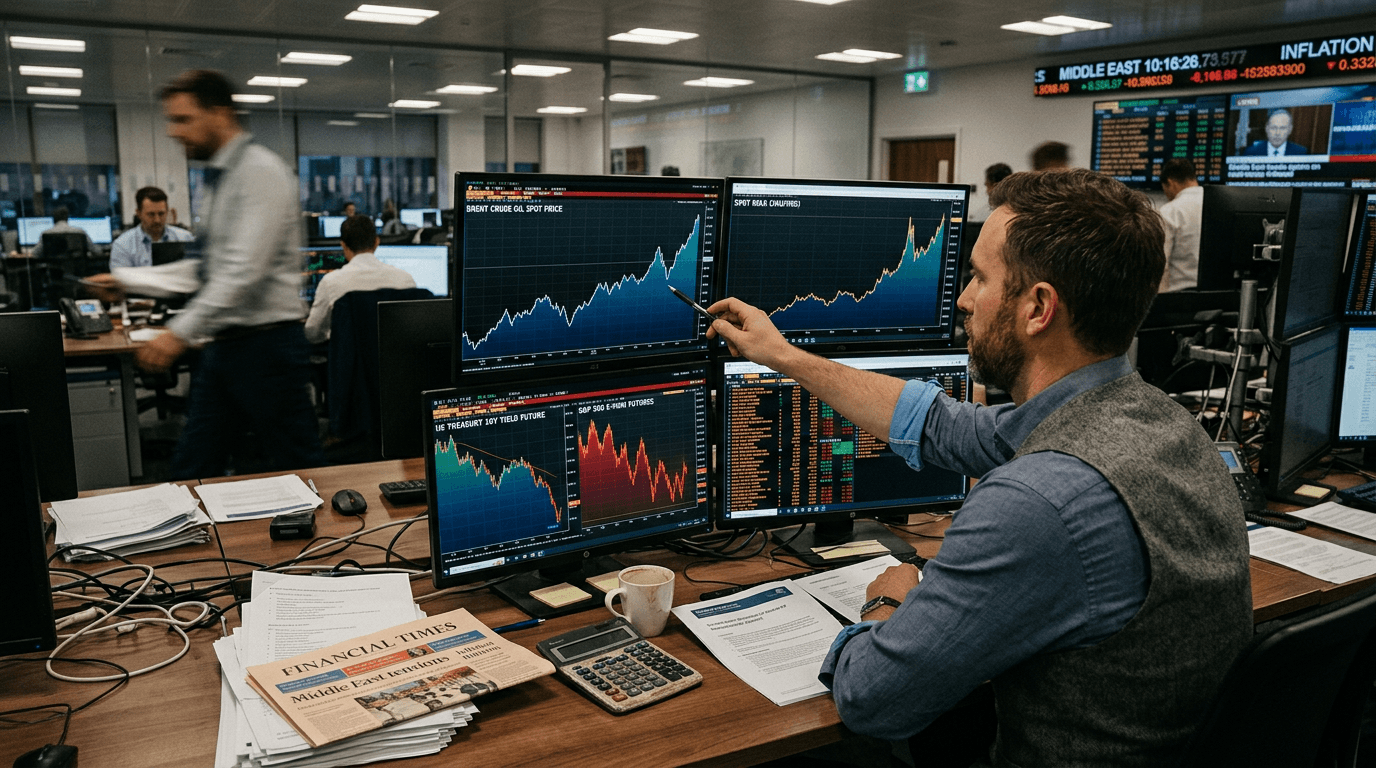
Crude oil’s latest surge has once again put geopolitics at the center of the market narrative, as renewed Middle East tensions pushed US benchmarks to their highest intraday levels since mid‑2024 on war‑related supply fears.[1][5] The move has not only lifted gold on safe‑haven demand, but also nudged inflation expectations higher, forcing traders to reassess positioning across rates and equity index futures.[1] This is a textbook example of how quickly cross‑asset dynamics can shift when energy markets, geopolitics, and monetary policy intersect.
Middle East Tensions And The Oil Price Shock
When tensions flare in the Middle East, oil is often the first asset to react, and the latest escalation has followed that playbook closely.[5] The region remains critical for global supply, including key shipping routes such as the Strait of Hormuz, so any threat to flows can quickly translate into a higher risk premium in crude.[4][6] Recent headlines around conflict and potential disruptions to exports have driven an intraday spike of around 7–8% in oil, with prices jumping from the low‑60s a few weeks ago to the high‑70s.[5]
What matters for markets is not just the move itself, but what it signals about potential future supply. Analysts have rushed to revise their scenarios, with some now openly discussing the possibility of triple‑digit oil if the conflict intensifies or supply is materially disrupted.[5][6] Even if these higher targets do not materialize, the threat alone is enough to keep volatility elevated and encourage hedging activity across energy futures and options.
For traders, this kind of shock highlights the importance of monitoring both fundamentals (inventories, OPEC+ policy, demand data) and risk premia embedded in prices. In an environment where geopolitics can move the market as much as traditional supply‑demand factors, positioning can shift rapidly as participants toggle between “base case” and “tail risk” scenarios.
Why Higher Oil Feeds Inflation Expectations
Oil is not just another commodity; it is a core input into transportation, manufacturing, and global supply chains. Historically, sustained oil‑price spikes have tended to push inflation higher and growth lower as higher transport and input costs ripple through the economy.[6] Even if central banks often “look through” temporary energy shocks, markets still pay close attention because energy costs can bleed into broader price pressures over time.
In this latest episode, the jump in crude has pushed investors to reassess the path of headline inflation in the months ahead.[1][6] If energy remains elevated, headline inflation may prove stickier than previously expected, complicating the task for central banks that were preparing to ease policy or accelerate rate cuts. That reassessment shows up in inflation expectations, often measured through breakeven inflation rates (the difference between nominal and inflation‑linked bond yields) and inflation swap markets.
As inflation expectations edge higher, nominal yields may move up as well, reflecting both higher expected inflation and a potential increase in term premia—the extra compensation investors demand for holding longer‑dated bonds.[6] That is why a geopolitical shock in oil can immediately translate into a repricing along the yield curve, even before any new data is released. Traders in rates futures and options—whether in government bond contracts or short‑term interest rate products—respond by adjusting the timing and magnitude of expected central bank moves.
GOLD’S DUAL ROLE: SAFE HAVEN AND INFLATION HEDGE
Gold sits at the crossroads of this story. Renewed US–Iran tensions and elevated crude prices have sent investors back into gold, reinforcing its traditional status as a safe haven during geopolitical stress.[1][2][3] As the conflict has intensified, market participants have rotated out of riskier assets and into gold, seeking shelter from potential drawdowns in equities and credit.[1][2][7]
But gold is not just a crisis hedge; it also acts as an inflation hedge over longer horizons.[1][2][3] When oil spikes and markets start to price more persistent inflation, gold can become a tool to preserve real purchasing power.[1][2] This twin role is visible today: safe‑haven flows are responding to heightened geopolitical risk, while inflation‑hedging flows are reacting to the prospect of more elevated energy‑driven price pressures.[1][2]
These supportive forces for gold are not happening in a vacuum. Higher inflation expectations that push nominal yields up can also lift real yields (inflation‑adjusted rates), which historically tends to cap gold’s upside.[1] Currently, markets are balancing these opposing forces: safe‑haven and inflation‑hedging demand on one side, and the drag from potentially higher real yields and a still‑restrictive policy stance on the other.[1][6] For traders, this means gold’s trajectory will likely depend on which narrative dominates: “prolonged conflict and stubborn inflation” versus “contained shock and steady disinflation.”
Ripple Effects In Rates And Equity Index Futures
An oil‑driven shift in inflation expectations reverberates quickly through rates markets. If traders believe that higher energy prices will keep inflation elevated for longer, they may reduce the number or speed of rate cuts priced into short‑term interest rate futures.[1][6] On the long end of the curve, yields can rise as investors demand extra compensation for inflation risk and uncertainty, leading to a bear‑steepening or bear‑flattening depending on how growth expectations evolve.
Equity index futures are caught in the cross‑fire between higher inflation, changing rate expectations, and rising geopolitical risk. On one hand, sectors tied to energy and commodities may benefit from higher prices and wider margins. On the other, higher discount rates and a more uncertain growth outlook can pressure valuations for rate‑sensitive areas such as growth and technology stocks. Risk sentiment also matters: when safe‑haven assets like gold attract strong inflows, it often reflects a broader de‑risking that can weigh on equity indices.[1][3]
For index traders, the key is to understand which factor the market is prioritizing: higher commodity revenues, tighter financial conditions, or pure risk‑off behavior. The answer can differ by region and sector, which is why relative performance across indices (e.g., energy‑heavy benchmarks versus tech‑heavy ones) often diverges in these episodes.
How Traders Can Navigate This Environment
Events like an oil price spike driven by Middle East tensions underscore the need for a multi‑asset, macro‑aware approach. Rather than treating oil, gold, rates, and equities in isolation, traders benefit from mapping out the linkages: oil to inflation, inflation to rates, rates and risk sentiment to gold and equity indices.
A practical framework might include
- Monitoring key indicators: front‑month and deferred oil futures, implied volatility in energy and gold, inflation breakevens, real yields, and market‑implied policy paths via rates futures.[1][3][6]
- Building scenarios: a short, sharp oil spike that fades versus a prolonged conflict that keeps energy elevated. Each scenario implies different paths for inflation, central bank policy, and cross‑asset correlations.
- Managing correlation risk: in stress episodes, traditional diversification can break down as many risk assets move together. Using assets like gold as partial hedges can help, but traders should constantly reassess correlations rather than assume they are static.[1][3][7]
- Practicing in a low‑risk environment: simulated or demo trading environments give traders space to test how their strategies behave when oil, gold, and rates all move sharply at once, without the pressure of real capital at risk. This can be particularly valuable for refining execution and risk‑management rules.
Ultimately, the current episode is a reminder that markets can reprice quickly when geopolitics, commodities, and monetary policy intersect. Middle East tensions have pushed oil higher, lifted safe‑haven demand for gold, and nudged inflation expectations upward—forcing a rethink of rate and equity index futures positioning.[1][5][6] For traders, staying adaptable, data‑driven, and cross‑asset aware is essential to turning this kind of volatility from a source of risk into a potential source of opportunity.