
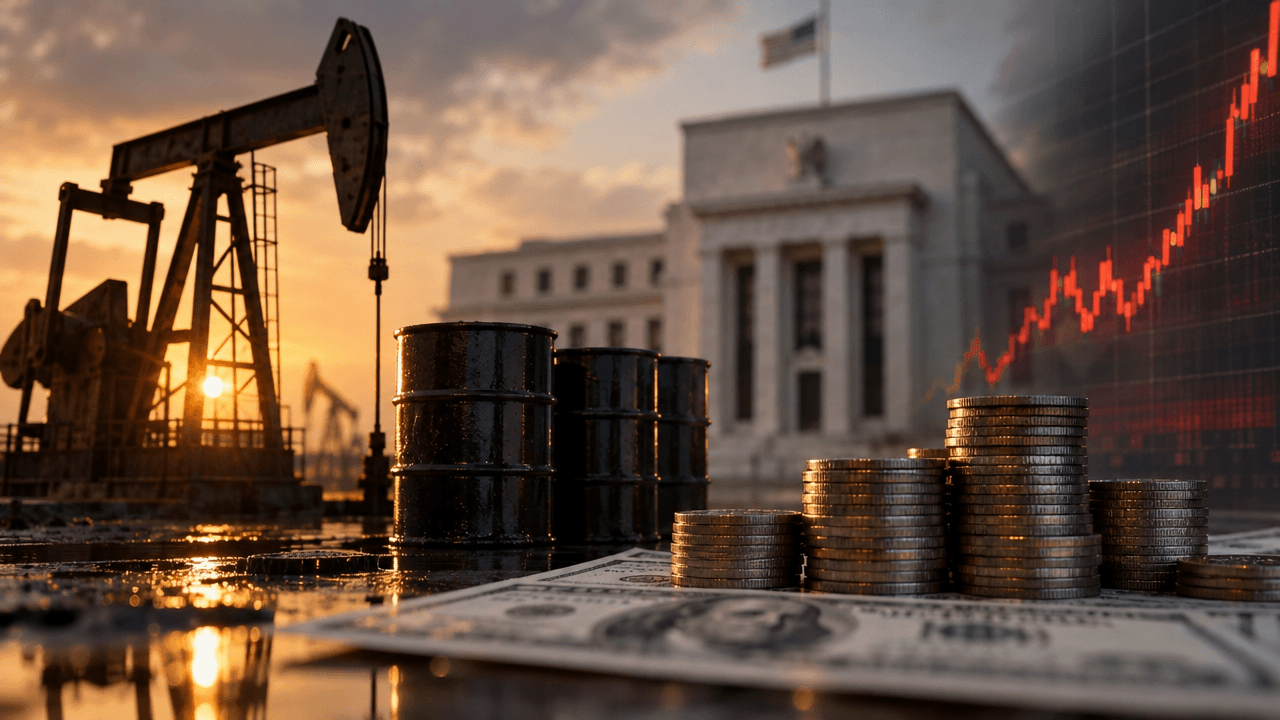
Oil’s latest surge has turned a familiar market risk into a broader challenge for investors: higher energy prices are pressuring corporate profits, reviving inflation concerns, and forcing traders to reconsider the path of Federal Reserve policy. U.S. equities sold off sharply after crude prices rose more than 3% on worries that Middle East tensions could disrupt supply. [2]
The reaction highlights how quickly an energy shock can spread across financial markets. Oil affects transportation, manufacturing, utilities, consumer goods, and nearly every company that relies on fuel or petroleum-based inputs. At the same time, rising gasoline and energy costs can lift inflation expectations, reducing the likelihood that central banks will ease policy.
For traders, the key question is no longer simply whether oil prices will continue higher. It is whether the increase is temporary, or whether it becomes persistent enough to keep inflation elevated and interest rates restrictive for longer.
The Oil-inflation Connection
Energy prices influence inflation in two important ways. The first is direct: households pay more for gasoline, heating, electricity, and other energy-related products. The second is indirect: businesses facing higher fuel and transportation costs may raise prices to protect profit margins.
That second effect can take longer to appear. A delivery company may initially absorb higher diesel costs, but sustained increases can eventually lead to higher shipping fees. Manufacturers may face rising expenses for transportation, plastics, and industrial inputs. Retailers could pass those costs to consumers through higher prices.
Recent hotter-than-expected consumer and producer inflation readings have made the market more sensitive to the oil rally. The combination of stronger underlying price pressures and higher energy costs suggests that inflation may not cool as quickly as investors previously hoped. Reuters reported that producer inflation was already running above expectations, with energy-related costs contributing to the pressure. [9]
This creates a difficult environment for policymakers. A temporary oil spike may not require an aggressive response, but a prolonged increase can influence inflation expectations and wage negotiations. The Federal Reserve must therefore assess not only current energy prices, but also whether the shock is spreading through the broader economy.
Why Wall Street Sold Off
Higher oil prices create a mixed picture for equities. Energy producers and some oil-service companies may benefit from stronger commodity prices. However, the broader market often suffers because higher operating costs reduce earnings expectations and higher interest rates lower the value investors assign to future profits.
Growth stocks are particularly vulnerable. Technology companies and other high-duration businesses derive much of their valuation from earnings expected years in the future. When bond yields rise in response to stronger inflation or tighter monetary policy, those future cash flows become less attractive in present-value terms.
The latest selloff also came as investors reassessed already expensive parts of the market, including artificial intelligence-related stocks. Oil served as an additional source of uncertainty at a time when traders were already questioning whether lofty technology valuations could be justified. [4]
Consumer-facing companies face a different problem. Higher fuel prices reduce household purchasing power, leaving consumers with less money for discretionary spending. Airlines, delivery businesses, logistics companies, and manufacturers may also experience margin pressure unless they can raise prices quickly.
The result is a market that rewards select energy exposures while punishing businesses with high costs, weak pricing power, or valuations that depend heavily on lower interest rates.
THE FEDERAL RESERVE’S DIFFICULT CHOICE
Markets increasingly expect the Federal Reserve to leave interest rates unchanged this month. That expectation reflects the need to gather more information before responding to what could still be a temporary energy shock. A pause would allow policymakers to evaluate whether inflation is broadening or whether the economy is beginning to slow under the weight of previous rate increases.
However, the policy outlook beyond this month has become more hawkish. Barclays now expects quarter-point rate increases in both December and January, compared with its previous forecast for a December hike alone. [3]
That change matters because it shifts the market narrative from “one final increase” to a potentially more sustained tightening cycle. Even if the Fed holds rates steady in October, investors may continue pricing higher borrowing costs into mortgages, corporate debt, equity valuations, and currency markets.
The Fed must balance two risks. Tightening too aggressively could weaken employment and economic growth. Waiting too long could allow an energy-driven inflation shock to become embedded. Policymakers will likely focus on inflation expectations, wage growth, consumer demand, and evidence that businesses are passing higher energy costs through to customers.
What Traders Should Watch
Oil volatility should remain a central market indicator. Traders should monitor whether supply concerns are producing sustained price gains or only short-term spikes. A temporary geopolitical premium may fade if supply routes normalize. A prolonged disruption would present a more serious threat to inflation and economic activity.
Bond yields are another important signal. If oil rises while Treasury yields remain relatively stable, investors may view the shock as temporary. If both oil and yields climb together, markets may be pricing a stronger risk that inflation will force the Fed to keep rates higher for longer.
Sector performance can also reveal how investors are interpreting the news. Relative strength in energy stocks alongside weakness in transportation, consumer discretionary, and technology shares would suggest that markets are focusing on margin pressure and interest rates rather than viewing higher oil prices as a sign of stronger demand.
Finally, traders should avoid reacting to a single headline. Geopolitical markets can move quickly in both directions. Risk management, smaller position sizes, defined stops, and a clear understanding of exposure to oil and interest rates are especially important during periods of sharp volatility.
The Bigger Market Lesson
The oil surge demonstrates why markets rarely treat commodities as isolated assets. A move in crude can change inflation expectations, bond yields, equity valuations, and central bank forecasts almost simultaneously.
For now, the most likely outcome is a cautious Federal Reserve pause followed by increased debate over future hikes. But the durability of the oil rally will determine whether this is a temporary shock or the beginning of a more persistent inflation problem. Investors who track the links between energy prices, inflation data, and monetary policy will be better positioned to distinguish short-term volatility from a genuine change in the market regime.