
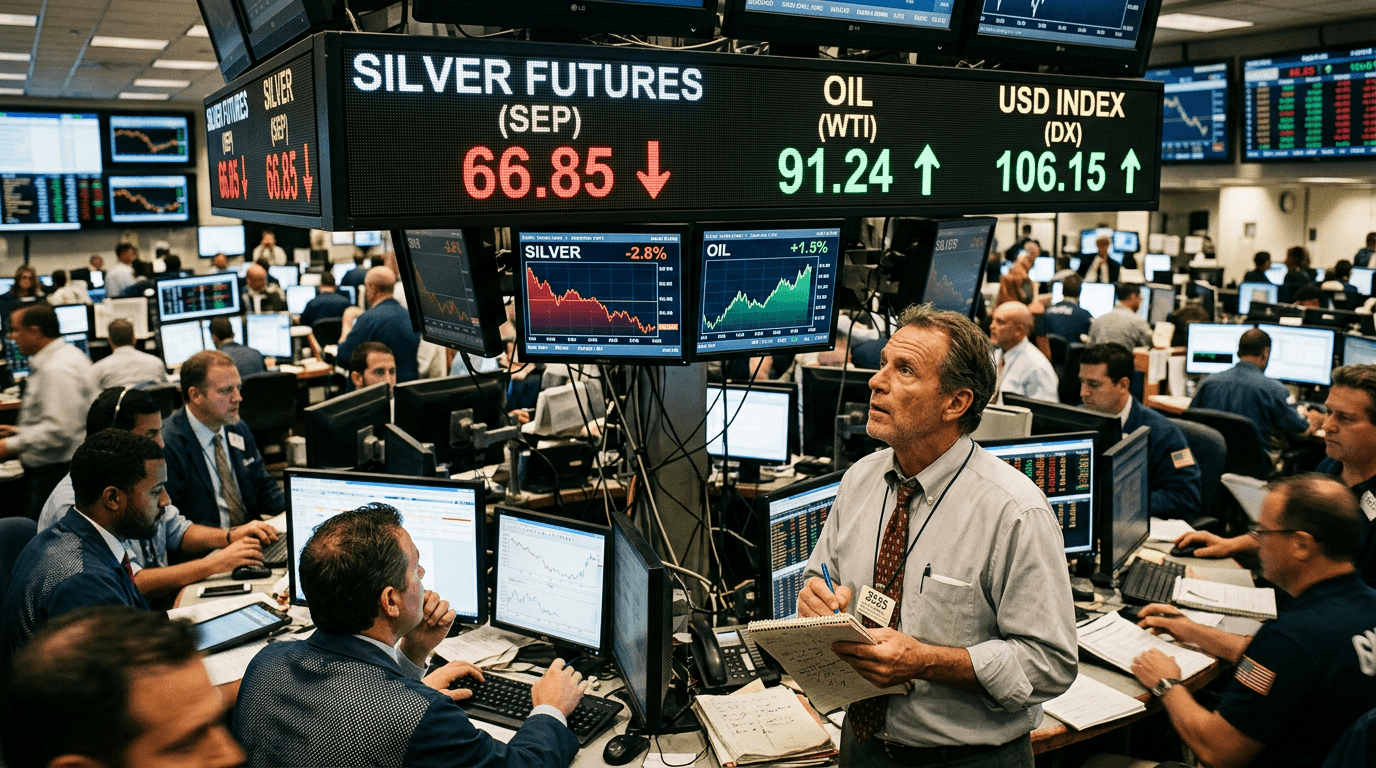
Oil’s latest surge and a stronger dollar have combined to knock precious metals lower, with silver futures slipping below the key $67 per ounce threshold. This move caps a volatile period for metals, as traders reassess inflation expectations, geopolitical risk and the timing of future Federal Reserve decisions[6][9][15]. For market participants, this is less a standalone headline and more a signal of how quickly cross‑asset dynamics can reshape the trading landscape.
Market Snapshot: Silver Under Pressure
Silver futures have been grinding lower after briefly trading above the mid‑$60s, with front‑month contracts recently slipping under $67 and intraday ranges stretching down toward the $66 area[1][2][9]. That break below $67 matters because it sits near a recent consolidation zone where buyers had previously stepped in, turning it into an important psychological and technical level for short‑term traders[1][9]. When widely watched levels give way, volatility often follows as stops are triggered and algorithms rebalance exposure.
The pullback in silver has not occurred in isolation. Gold and other precious metals have also faced selling pressure, reflecting a broader risk‑off tone toward non‑yielding assets as yields and the dollar move higher[6][13][15]. In recent weeks, spot silver saw multiple sessions with losses of 2–4%, underscoring how quickly sentiment can flip when macro drivers line up against the metals complex[6][13][15]. For traders, these swings highlight the need to anchor decisions not only in charts but also in the macro narrative.
How Oil And The Dollar Pressure Precious Metals
A key catalyst behind the latest decline in silver has been the renewed climb in oil prices amid heightened Middle East tensions[6][13][15]. Higher crude prices feed inflation concerns and can push expectations for policy rates toward “higher for longer,” which in turn lifts government bond yields and tightens financial conditions[6][15]. Recent commentary from commodity strategists has emphasized that rising Brent prices are increasing the likelihood of additional rate hikes or delayed cuts, especially in the United States[6][14].
Higher yields and a stronger dollar form a classic headwind for precious metals. As real and nominal yields rise, the opportunity cost of holding gold and silver—assets that do not pay interest—also increases, making them less attractive relative to fixed income[14][15]. At the same time, a firmer dollar tends to pressure dollar‑denominated commodities because it raises the effective price for non‑US buyers and often prompts portfolio reallocations away from metals[13][15]. This combination has been cited repeatedly in recent market coverage as a key driver behind the softness in gold and silver prices[6][13][15].
For silver specifically, the macro impact is two‑fold. On one side, silver behaves like a precious metal and is sensitive to rates and FX. On the other, its industrial demand link to sectors like electronics, solar and manufacturing means that higher energy costs can compress margins and weigh on demand expectations. When traders see oil spiking, yields rising and growth uncertainty increasing, silver can trade as both a victim of tighter financial conditions and a proxy for cyclical risk.
Futures Positioning: What The Data Is Saying
Beyond prices, positioning data in precious metals futures shows how investors are reacting beneath the surface. Recent analysis indicates that outright long positions in silver futures have dropped meaningfully, with one report noting a roughly 9% decline in longs alongside a modest uptick in shorts over a recent observation period[14]. The total outright long exposure was described as more than 40% below the 12‑month average, pointing to a cautious stance among speculative players[14].
This retreat in bullish positioning aligns with the macro picture. Rising 10‑year US yields from levels below 4% earlier in the year toward the mid‑4% range have been flagged as a visible headwind for both gold and silver[14]. When rates move in that direction, many systematic strategies reduce long exposure in metals, and discretionary traders become more selective in adding leverage. The outcome is a market dominated by shorter‑term trading flows rather than longer‑horizon investment demand.
For SimFi traders on platforms such as E8 Markets, this positioning backdrop offers a practical lesson: price action alone rarely tells the full story. When speculative longs are significantly below their typical levels, rallies can be sharp but fragile, as there is less structural buying support on the way up and more risk of profit‑taking at the first sign of macro stress. Understanding where futures positioning sits relative to history can help frame both risk and reward in simulated strategies.
Implications For Simulated Traders And Strategy Design
The recent move in silver below $67 is an ideal case study for building and testing multi‑factor trading approaches within a simulated environment. One obvious takeaway is the importance of integrating cross‑asset signals—such as oil prices, Treasury yields and dollar strength—into metals strategies rather than treating precious metals as isolated instruments[6][14][15]. Simulated portfolios can be structured to react dynamically when these macro variables breach predefined thresholds, adjusting exposure to silver and gold accordingly.
Risk management is another core theme. Silver’s intraday ranges between roughly $66 and $68 over recent sessions show how quickly prices can move during periods of macro uncertainty[2][3][9]. In a SimFi setting, traders can experiment with volatility‑adjusted position sizing, wider but logically placed stop‑loss levels and scenario analysis that tests how strategies behave when silver gaps through levels like $67. Doing this work in a simulated environment allows systematic refinement without the emotional and financial stress that comes with live drawdowns.
Finally, the divergence between shorter‑term trading flows and longer‑term investment narratives provides fertile ground for strategy experimentation. Macro headlines about Middle East risk, inflation and central bank policy can drive fast moves, but industrial and jewelry demand for silver evolves more slowly[14]. Simulated traders can test frameworks that separate fast‑reacting macro signals from slower fundamental trends, aiming to capture tactical opportunities without losing sight of the bigger picture.
Key Takeaways For The Weeks Ahead
Several practical conclusions emerge from the current backdrop. First, the breakdown in silver below $67 highlights the sensitivity of metals to shifts in oil, yields and the dollar, making cross‑asset monitoring essential for anyone trading or simulating strategies in this space[6][9][15]. Second, futures positioning data shows that speculative appetite for silver is subdued, suggesting that rallies may face resistance until the macro environment becomes more supportive[14].
Third, the prevailing “higher for longer” rate narrative means precious metals are likely to remain choppy, with sentiment swings driven by incoming data and geopolitical headlines[6][14][15]. In this context, simulated trading platforms offer an effective way to stress‑test ideas, refine entry and exit rules and understand how strategies respond when key levels—like $67 in silver—are breached. As the macro story evolves, traders who systematically connect price action, positioning and cross‑asset signals will be better placed to navigate the next phase in metals markets.