
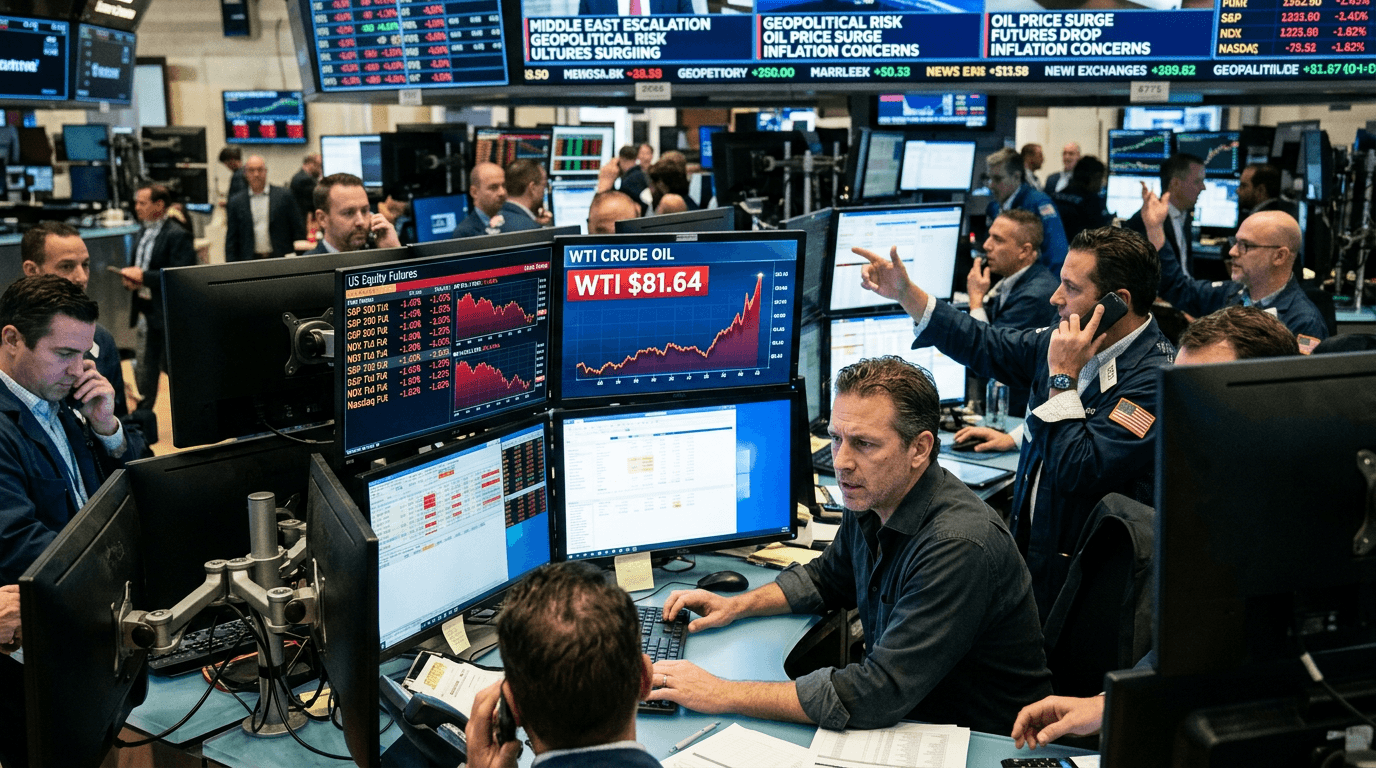
The stock market opened with a distinctly cautious tone as geopolitical tensions between the US and Iran sent shockwaves through global financial markets. Energy prices exploded higher, with crude oil surging 9% to reach $81.64 for West Texas Intermediate and $85.85 for Brent, while equity futures retreated from recent gains. This sharp reversal highlights a critical market dynamic that traders need to understand: how external shocks propagate through interconnected financial systems and why diversification across asset classes becomes essential during periods of heightened uncertainty.
The Oil Price Explosion
The 9% spike in oil prices represents one of the largest single-day moves we've seen in recent months, driven purely by geopolitical risk premium. When tensions escalate in the Middle East, oil markets react almost instantaneously because roughly 30% of the world's seaborne oil passes through the Strait of Hormuz, a chokepoint that could theoretically be disrupted by military action. This supply disruption fear translates directly into higher prices at the pump and increased costs for energy-intensive industries.
What makes this particular situation notable is the speed of the move. Traders didn't have time to gradually price in the risk. Instead, the market jumped higher as news of US-Iran clashes broke, suggesting that positioning in energy futures was lean and that many participants were caught off-guard. This is a classic example of how black swan events can trigger liquidity crunches in specific sectors.
Equity Futures Hand Back Recent Gains
S&P 500 futures extended losses, with the index down around 1% at various points throughout the session. The Dow Jones futures also retreated, signaling broad weakness across the market. What's particularly telling is that these declines erased gains that had been built up following the Federal Reserve's decision to hold interest rates steady at 3.5 to 3.75%.
The irony here is important to recognize. Earlier in the week, equity markets responded positively to Fed stability and solid earnings reports from major tech companies like Microsoft and Meta. However, when faced with the sudden shock of rising oil prices and geopolitical uncertainty, investors immediately reassessed their risk tolerance and moved toward defensive positions. This behavior underscores how fragile recent market gains can be when built on the foundation of policy support rather than fundamental economic improvement.
The Inflation-recession Paradox
Rising oil prices create a difficult predicament for the Federal Reserve and for investors. On one hand, higher energy costs feed directly into inflation, potentially forcing the Fed to maintain higher interest rates for longer than the market currently expects. On the other hand, escalating oil prices represent a demand shock that could slow economic growth and tip the economy into recession.
The CME FedWatch Tool was showing 100% probability of the Fed holding rates steady at the next meeting, indicating the market believes the central bank will maintain a wait-and-see approach. However, if oil prices remain elevated and begin to filter through into broader inflation measures, the Fed may be forced to signal a longer hold on rate cuts or even potentially raise rates again. For traders, this uncertainty is critical because it affects everything from bond yields to equity valuations.
The 10-year Treasury yield was hovering around 4.32%, while the 2-year bond yielded 3.79%. This relatively flat yield curve in uncertain times typically suggests that investors are pricing in economic slowdown. When bond investors become pessimistic about growth, equity multiples tend to compress as well.
Sector Rotation And Market Dynamics
During periods of oil price spikes, we typically see a shift in which sectors outperform. Energy stocks naturally benefit from higher crude prices, and we did see energy and consumer staples as majority gainers even as broader equity markets struggled. Conversely, consumer discretionary, materials, and information technology sectors showed the steepest losses. This rotation is predictable but important for portfolio positioning.
For traders in a simulated finance environment, this dynamic creates interesting opportunities. You can overweight energy exposure while simultaneously hedging broader equity market risk through puts or short positions in tech-heavy indices like the Nasdaq. The key is recognizing that not all sectors suffer equally during geopolitical shocks.
What Traders Should Monitor
The critical variable to watch going forward is whether oil prices stabilize or continue climbing. If WTI crude pushes toward $90 or higher, we could see more significant equity market deterioration. Additionally, pay attention to any hawkish signals from Fed officials interpreting this as an inflation threat.
Volatility indexes spiked during the initial shock, creating potential entry points for those comfortable deploying capital into weakness. However, position sizing becomes critical when dealing with black swan events, as the initial move is often just the beginning.
Key Takeaways
The 9% surge in oil prices serves as a stark reminder that financial markets remain vulnerable to external shocks. While the Fed's decision to hold rates steady provided some comfort earlier in the week, geopolitical events demonstrated that monetary policy operates in a complex environment influenced by factors beyond central bank control. For traders, this environment demands active risk management, awareness of sector-specific dynamics, and a willingness to quickly reassess portfolio positioning when new information emerges. The intersection of potential inflation, recession risks, and energy market disruption creates both challenges and opportunities for those who understand how to navigate volatility.