
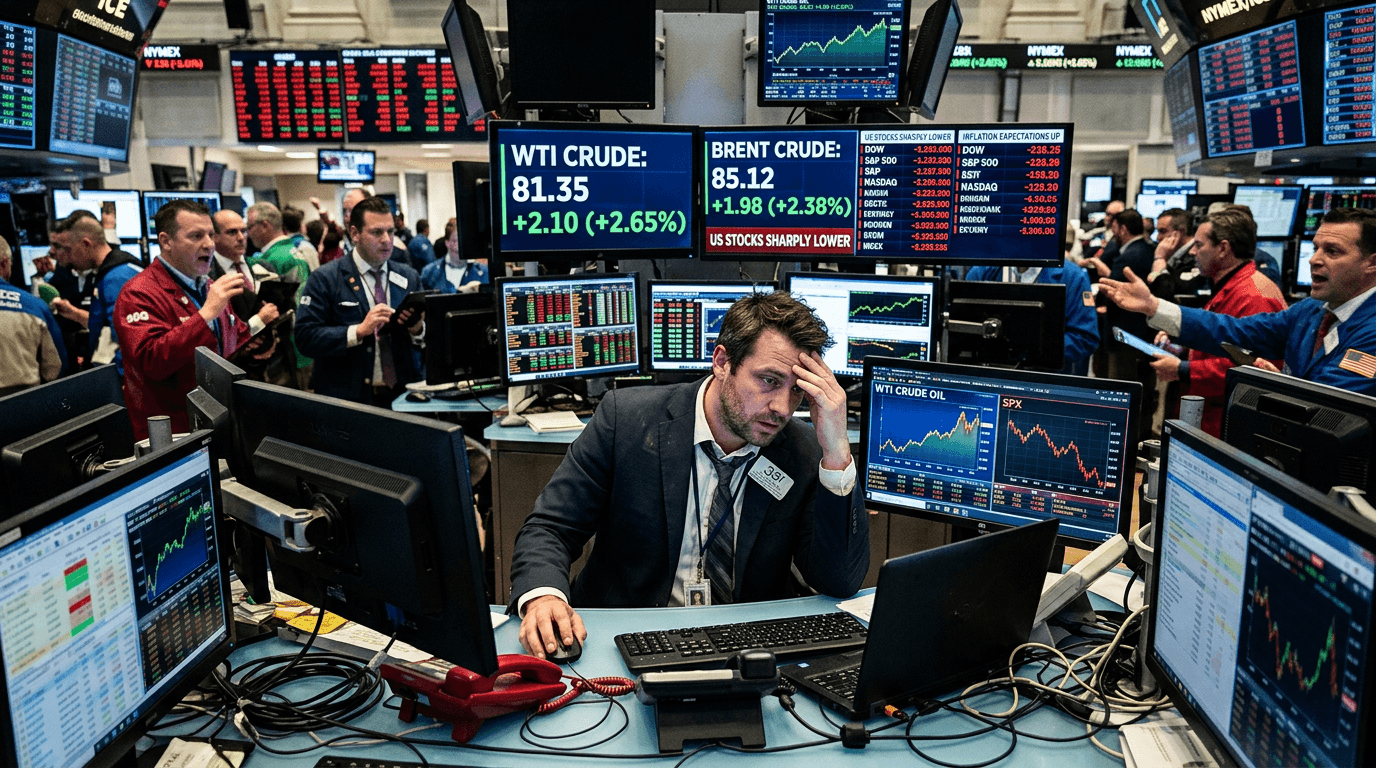
Oil’s nearly 9% surge in a single session has jolted markets, knocking U.S. equities lower and reviving a familiar concern: geopolitical risk in the Middle East is back at the center of the macro narrative. With West Texas Intermediate (WTI) briefly touching around $81.6 per barrel and Brent crude near $85.9, traders are rapidly repricing energy risk, inflation expectations, and the path of central-bank policy. The result is a classic risk-off move that is spilling across futures, FX, and equity markets.
WHAT HAPPENED: OIL PRICES SPIKE ON IRAN–U.S. TENSIONS
The immediate catalyst is an escalation in the Iran–U.S. conflict, including reports of intensified military activity that market participants interpret as a direct threat to energy infrastructure and shipping lanes.
In energy markets, perception is often as powerful as actual supply disruption. When traders see greater risk to oil flows from the Gulf—particularly any hint of pressure around the Strait of Hormuz—the risk premium embedded in crude prices expands quickly. That is precisely what today’s price action reflects.
A nearly 9% jump is not a routine move in a commodity as heavily traded as crude oil. It signals:
- A rush by short sellers to cover positions.
- Aggressive hedging by producers, refiners, and airlines.
- Speculative flows piling into energy futures and related options.
The velocity of the move matters as much as the magnitude. Rapid repricing tends to trigger margin calls, algorithmic responses, and volatility clustering, all of which can amplify intraday swings in both energy and broader asset markets.
WHY U.S. EQUITIES SOLD OFF
At first glance, higher oil prices can look “good” for energy stocks. In the short term, they often are. Integrated oil majors, exploration and production firms, and parts of the oilfield services space may see higher expected cash flows when crude jumps.
But the broader equity market cares more about costs, confidence, and central banks.
Higher crude prices translate into higher input costs for a wide range of industries—from transportation and logistics to manufacturing and consumer goods. Markets also quickly extrapolate higher gasoline and diesel prices, which can squeeze consumer disposable income and sentiment.
As oil surged, U.S. indices weakened into the afternoon. That pattern reflects three overlapping fears:
1. Margin pressure: Non-energy corporates may face rising costs they cannot fully pass on to customers. 2. Slower growth: Higher energy costs can act like a tax on the economy, particularly if the move is sustained. 3. Policy uncertainty: If inflation pressures re-accelerate, the “easy” path to rate cuts becomes much less certain.
In this environment, investors typically rotate out of cyclicals and high-duration growth names and into defensives, value, and hard-asset plays—or simply raise cash.
Inflation, Central Banks, And The Macro Narrative
Today’s oil spike lands in a market that had been cautiously hopeful about central-bank easing. Any move that threatens to re-ignite inflation worries can quickly reverse that optimism.
Higher oil prices impact inflation in two ways
- Direct effect: More expensive gasoline, heating fuel, and energy-intensive services.
- Indirect effect: Higher shipping and production costs that filter into the prices of goods over time.
Even if central bankers focus on “core” inflation, persistent energy shocks can bleed into core categories via transportation and production costs. Markets don’t wait for the official data—they move on expectations.
That’s why rate-sensitive assets reacted so sharply. A higher crude price path can:
- Push market-implied rate cuts further into the future.
- Lift longer-term bond yields as inflation risk premia widen.
- Strengthen the U.S. dollar if traders see the Federal Reserve staying tighter for longer.
In FX, oil-importing economies may see currency pressure as their trade balances deteriorate, while major exporters can gain, at least initially. These cross-currents can significantly affect multi-asset portfolios and leveraged trading strategies.
How Traders Can Navigate Heightened Energy Risk
For active traders—whether in real or simulated environments—this kind of geopolitical shock provides both opportunity and risk. Volatile sessions expose weaknesses in strategy, risk management, and emotional control.
Key considerations
1. Respect the volatility regime shift Implied and realized volatility in crude, equity indices, and related FX pairs tend to spike during geopolitical shocks. Position sizes that felt conservative last week may be aggressive today.
- Consider recalibrating position sizing based on current volatility.
- Use wider, thoughtfully placed stops instead of tight levels that will be easily swept by noise.
2. Understand correlations, but don’t assume they’re static In risk-off episodes linked to geopolitical risk:
- Oil often rises (on supply fears) while broad equities fall.
- The U.S. dollar and safe-haven assets like Treasuries or gold may benefit.
- High-beta sectors and small caps can underperform.
However, correlations can change as the narrative evolves. If oil keeps rising and starts to threaten growth more than it signals inflation, energy equities themselves can eventually roll over. Monitor how sectors and assets respond day by day, not just how they “should” respond in theory.
3. Prioritize event risk and news flow In geopolitically driven markets, headlines can override technical setups.
- Be aware of key potential flashpoints: additional strikes, diplomatic moves, or comments around strategic reserves.
- Recognize that liquidity can thin out around major news, amplifying price gaps and slippage.
Using simulated trading environments, traders can stress-test their strategies against fast, gap-prone markets without capital at risk. It’s a valuable way to practice execution, scenario planning, and discipline when the tape turns chaotic.
4. Think in scenarios, not certainties Instead of asking “Will oil go higher?” frame questions like:
- Scenario A: Conflict escalates and oil sustains above recent highs—what does that mean for my equity, FX, and rate exposures?
- Scenario B: Diplomatic progress emerges and oil retraces—how do I avoid being trapped on the wrong side of a sharp reversal?
- Scenario C: Oil remains elevated but stable—how does that reshape sector rotation and macro trades over weeks, not hours?
Building playbooks for each scenario encourages structured thinking and reduces impulsive decision-making.
Key Takeaways For Active Market Participants
Today’s oil surge is more than a single-session shock; it’s a reminder that geopolitical risk can reprice entire asset classes in hours. The short-term moves may fade, but the implications can linger if the Iran–U.S. conflict continues to threaten supply routes and energy infrastructure.
For traders and investors, the essential lessons are:
- Geopolitical shocks can trigger outsized moves, particularly in commodities tied to critical infrastructure and chokepoints.
- Higher oil prices don’t just affect energy stocks—they ripple across inflation expectations, central-bank policy, and broad equity valuations.
- Risk management must adapt to volatility regime changes; what worked in a low-volatility environment may be dangerous now.
- Practicing in simulated environments can help traders build and test strategies for exactly these kinds of high-stress market conditions.
As the situation evolves, markets will continue to recalibrate around three axes: the degree of actual supply disruption, the persistence of higher energy prices, and the response from policymakers. Staying disciplined, informed, and flexible will be more valuable than trying to predict each headline.