
1. Start DIRECTLY with the first paragraph - NO preamble 2. PLAIN TEXT format (no HTML, no markdown) 3. Use ALL CAPS for section headings on their own line 4. Separate paragraphs with blank lines 5. Include 3-5 main sections with clear takeaways 6. Engaging and educational content 7. At the END: TITLE, EXCERPT, NEWSIMPACTSCORE on separate lines
The search results provide good information: - Oil prices surged 9% to $81.64 for WTI, Brent at $85.85 - US-Iran military escalation - Strait of Hormuz closure affecting 20% of global oil supply - 10-11 million barrels per day removed from market - Impact on Treasury yields and inflation expectations - Impact on equities and stock markets - Asian refiners paying record premiums - Persian Gulf producers cutting production - Could go higher to $100+ or even $200 if conflict continues - Safe-haven flows - Inflation concerns
Let me structure this: 1. Opening paragraph - the immediate market reaction 2. What's driving the surge (supply disruption mechanics) 3. The stock market impact (equities pressured, safe-haven flows) 4. Inflation and Fed policy implications 5. What traders should watch
Let me write this in plain text, with clear section headings in ALL CAPS.
Word count target: ~800 words
Let me cite the search results appropriately as I go.
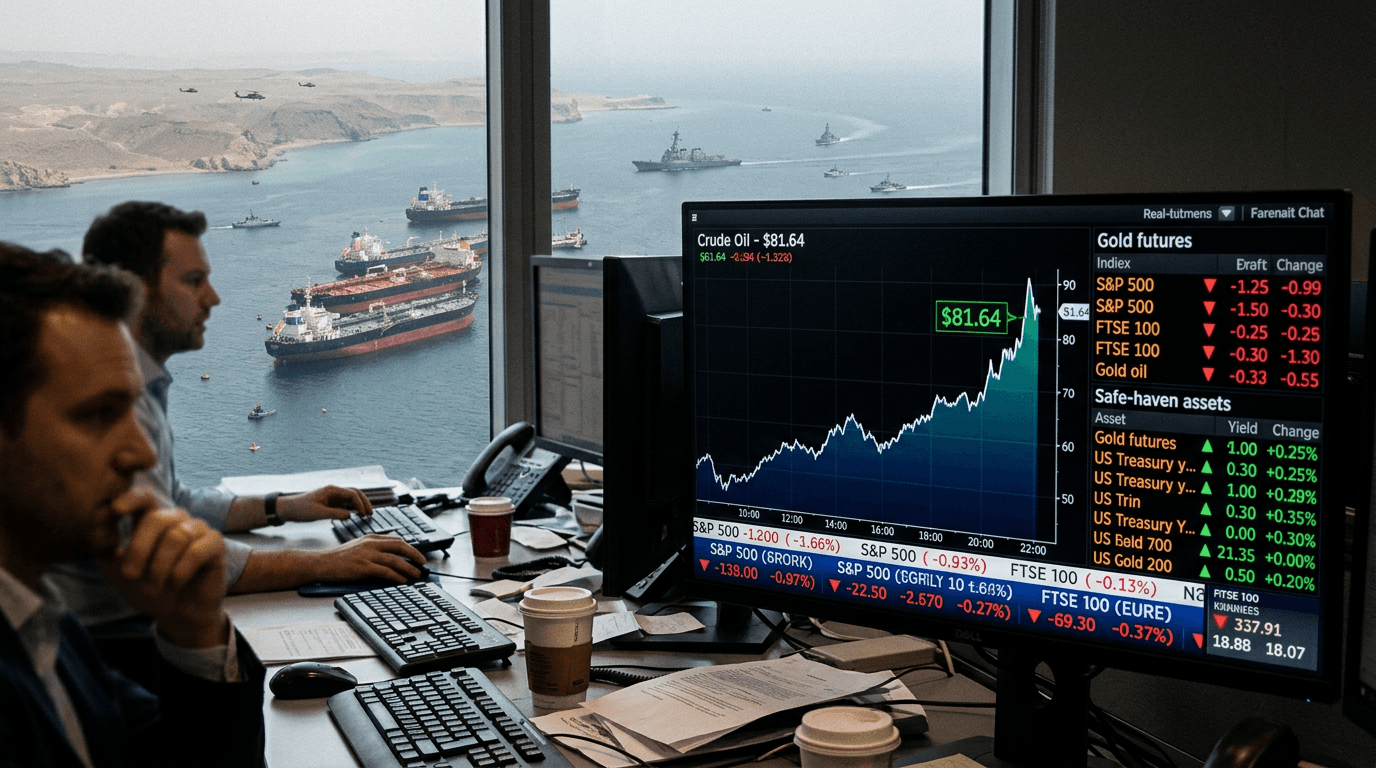
Crude oil prices have skyrocketed 9% to $81.64 per barrel for West Texas Intermediate, with Brent crude climbing to $85.85, marking the highest levels since summer 2024.[1] This dramatic surge reflects a genuine supply shock stemming from escalating military tensions between the United States and Iran, and the shockwaves are rippling far beyond energy markets. While oil traders are celebrating the windfall, equities investors are facing a tougher reality: the same geopolitical crisis driving oil higher is now pressuring US stocks lower as investors flee to safety and grapple with resurgent inflation fears.
The Supply Shock Reshaping Energy Markets
The core driver of this oil surge is straightforward but severe: active military conflict is directly disrupting critical energy infrastructure and vital shipping routes in the Middle East. US airstrikes on Iran combined with Iranian retaliation have escalated beyond traditional military engagement into economic warfare over energy resources. The most consequential development is Iran's effective closure of the Strait of Hormuz, a critical chokepoint responsible for approximately 20% of global oil supply.[1] Iranian strikes on tankers in regional waters have forced ports to shut down, creating genuine supply constraints that cannot be easily dismissed.
Analysts estimate that military actions have removed approximately 10 to 11 million barrels per day from the global market, representing roughly 10% of daily global oil supply in a system that typically trades around 100 million barrels daily.[1] This is not a minor disruption. The International Energy Agency has characterized this as the largest supply disruption in the history of the global oil market. Physical crude markets are showing severe stress signals, with Asian refiners now paying record premiums for alternative supplies. Norwegian Johan Sverdrup crude, for example, is trading at a record premium of $11.80 per barrel over Brent as buyers desperately seek stable supply sources.[1] Persian Gulf oil producers have cut production by approximately 6% as local storage reaches capacity, further tightening global supply and amplifying price pressures.
Equities Under Pressure As Investors Flee To Safety
The paradox of this market environment is that oil strength is creating stock weakness. As crude prices climb and geopolitical uncertainty intensifies, investors are rotating into traditional safe-haven assets while dumping equities. This safe-haven flow dynamic has become the dominant driver of equity market direction in recent trading sessions.
The mechanism is clear: higher energy prices create multiple headwinds for equities. First, elevated oil costs increase operational expenses for corporations across nearly every sector of the economy. Airlines, transportation companies, manufacturers, and retailers all face margin compression as energy input costs rise. Second, the inflation implications of higher oil prices dampen investor appetite for growth stocks, which perform poorly in inflationary environments. Third, geopolitical risk itself creates uncertainty that discourages equity investment in favor of defensive positioning.
The result has been a marked divergence between energy equities, which are surging on higher oil prices, and the broader market, which is declining as investors price in multiple headwinds. This bifurcation reflects the market's acknowledgment that while energy companies benefit from higher prices, the broader economy faces real costs from this supply shock.
Inflation Resurgence And Fed Policy Implications
Eight weeks into the conflict, the consequences have become undeniable. Gas prices have jumped above $4 per gallon, straining consumers and pushing inflation to its highest level in nearly two years.[3] Mark Zandi, chief economist at Moody's Analytics, summarized the challenge bluntly: there is no going back on oil prices, at least not any time in the near future. Even if the war ends tomorrow, Americans are likely to feel the financial sting for months.
This inflation resurgence is reshaping Federal Reserve expectations. Markets had been pricing in potential interest rate cuts later in 2026, but the oil shock has eliminated this possibility. Higher energy prices feed through to consumer price indices, forcing the Fed to maintain elevated rates for longer than previously expected. Treasury yields are climbing as the market reprices inflation and Fed policy, creating additional headwinds for equity valuations that depend on discounting future earnings at lower rates.
The Path Forward For Traders
Goldman Sachs warns that if the conflict continues and the Strait of Hormuz remains closed through June, crude oil could spike to $200 per barrel, with US gasoline prices reaching $3.50 per gallon and inflation becoming a persistent problem.[1] Some analysts are predicting oil could reach $100 per barrel if the conflict persists, putting additional strain on economies already facing stagflation risks. The immediate focus remains on whether diplomatic channels can resolve US-Iran tensions before the supply disruption becomes more severe.
For traders and investors, this environment demands careful risk management. Expect continued volatility in oil futures and continued defensive positioning in equities until geopolitical tensions ease. The assumption that Middle East tensions were compartmentalized has been definitively proven wrong. Geopolitical risk premiums are now a permanent fixture of market pricing. Position sizing and stress-testing portfolios for further escalation are no longer optional considerations—they are essential elements of prudent portfolio management in this new market reality.