
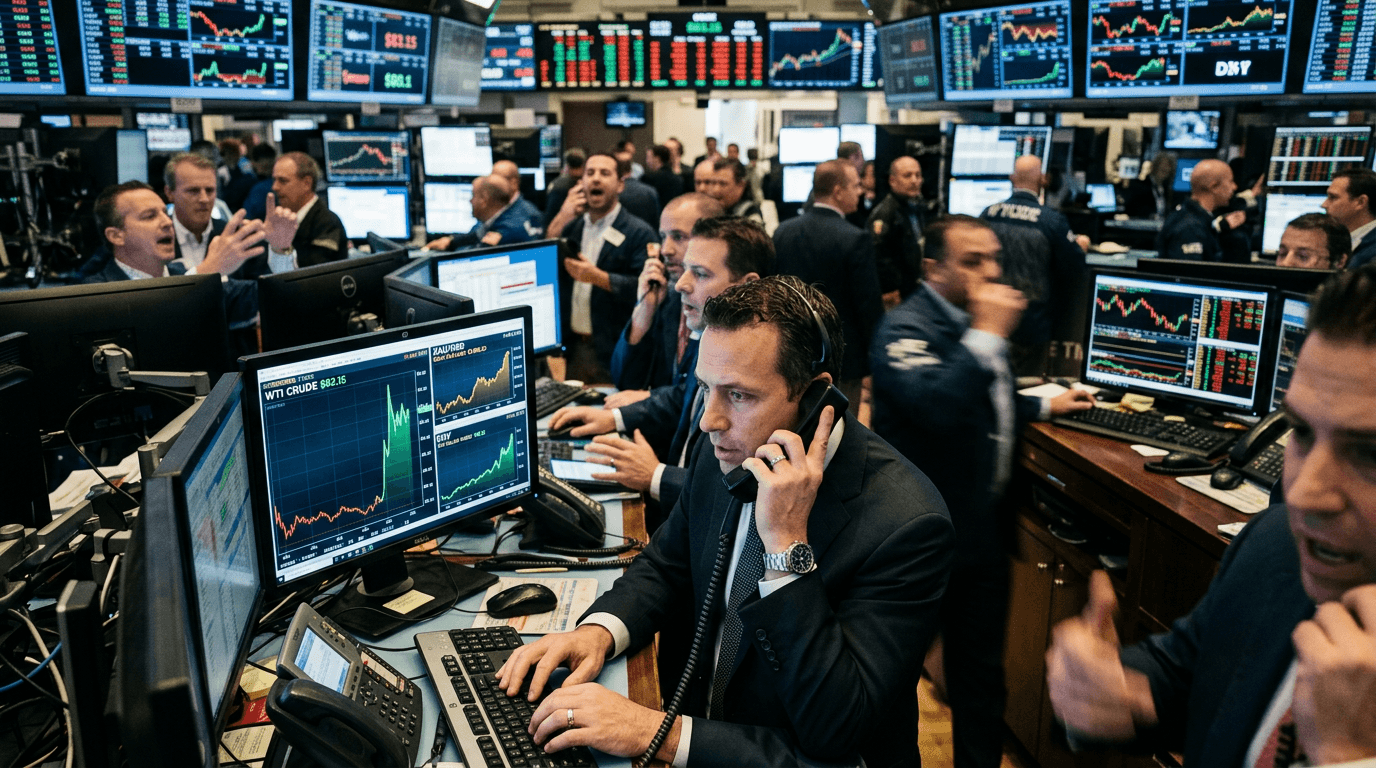
A renewed flare-up in tensions between the United States and Iran has jolted energy markets, sending crude prices sharply higher and rippling across global assets. U.S. benchmark crude briefly traded in the low-$80s per barrel, with Brent moving into the mid-$80s, as traders rushed to reprice geopolitical risk in a region that still anchors a large share of global oil supply. The immediate result: higher energy stocks, firmer inflation expectations, weaker global equities, and a classic risk-off move into the U.S. dollar and gold futures.
Market Reaction: Oil, Equities And Inflation Expectations
When crude oil jumps on conflict headlines, the market is not only reacting to today’s supply, but to tomorrow’s risk. The U.S.–Iran confrontation raises the probability of disruptions in key shipping routes and production facilities, especially around the Persian Gulf and Strait of Hormuz, through which a significant share of global seaborne oil flows. Even without an actual physical disruption, the possibility alone is enough to add a risk premium to prices.
Higher oil prices feed directly into expectations for headline inflation, since energy costs are embedded in transportation, manufacturing, and many consumer goods.[1] That is why you often see inflation breakevens and oil moving in the same direction on days like this. In equity markets, the effect is uneven: energy and defense names tend to benefit from higher oil and heightened geopolitical risk, while more rate-sensitive or energy-intensive sectors, such as airlines, industrials, and consumer discretionary, typically underperform.
Why Geopolitics Hits Energy So Hard
The Middle East remains one of the central pillars of global oil production and export. Any rise in the probability of military confrontation, sanctions, or disruption of shipping lanes forces traders to reassess supply risk. U.S.–Iran tensions have historically triggered bouts of volatility in oil, even when the fundamental demand picture has not changed materially.[4]
In practice, traders incorporate this through a higher “geopolitical risk premium.” That premium shows up in both the spot price and, often, in the shape of the futures curve. In a severe scare, near-term contracts can spike more than longer-dated ones, signaling concern about immediate supply. Less dramatic episodes still push the whole curve higher, especially if markets think conflict could become a drawn-out standoff rather than a short-lived shock.
For macro traders, it is crucial to separate two components of any oil move: the cyclical demand story (growth, industry activity, global trade) and the risk premium (war, sanctions, accidents, political instability). U.S.–Iran headlines overwhelmingly fall into the second category, which can fade quickly if de-escalation signals emerge—or intensify sharply if conflict escalates further.
Risk-off Flows Into Usd And Gold
The same headlines that drive oil higher often trigger a broader risk-off reaction: investors reduce exposure to risky assets and rotate into perceived safe havens. In this latest episode, the U.S. dollar strengthened against a basket of currencies as global equities came under pressure. The logic is straightforward: in times of uncertainty, USD assets benefit from deep liquidity, the dollar’s reserve currency status, and U.S. Treasuries’ role as global benchmarks.
Gold tends to benefit in parallel. Safe-haven demand for precious metals typically increases during geopolitical crises, particularly when there is concern that conflict could widen or drag on. Unlike the dollar, gold carries no sovereign risk and is not tied to any central bank, making it a hedge not just against volatility in risk assets, but also against geopolitical and currency risk. Rising oil prices can reinforce the gold bid if markets interpret them as inflationary, since gold is often used as a store of value when real purchasing power is in question.
It is worth noting that these risk-off flows are not always linear or permanent. If the conflict stabilizes or signs of diplomacy emerge, the dollar and gold can give back gains while oil retraces. Traders need to think in probabilities and scenarios, not certainties.
What This Means For Traders And Investors
For active traders, days like this are a reminder that geopolitics can override short-term technical setups. A clean chart pattern in equities, FX, or commodities can fail quickly when a headline reprices risk across the macro complex. That is why risk management—position sizing, stop levels, and scenario planning—matters as much as trade selection.
Key cross-asset relationships to watch include: - Crude oil vs. inflation expectations: persistent oil strength keeps pressure on central banks if it feeds through to consumer prices. - Oil vs. cyclical equities: energy sector outperformance versus global indices can signal that the move is being interpreted as a supply shock rather than a demand story. - USD and gold vs. high-beta FX (AUD, EM currencies): widening spreads here confirm a genuine risk-off move rather than a narrow, sector-specific reaction.
Longer-term investors should distinguish between temporary risk premia and structural shifts. A short, sharp spike in oil on geopolitical news may not change the multi-year outlook for inflation or growth if it reverses quickly. However, repeated flare-ups or outright conflict that keeps oil elevated for months can weigh on global growth, compress margins, and eventually alter central bank trajectories.[1]
Navigating Volatility In A Simulated Environment
For traders learning to navigate macro markets, a simulated trading environment can be a powerful way to stress-test strategies against these kinds of geopolitical shocks. Conflict-driven moves compress weeks of price action into hours, exposing weaknesses in leverage, diversification, and emotional discipline.
Practically, traders can use such episodes to: - Test how their strategies perform under sudden volatility spikes in oil, FX, and indices. - Experiment with hedging approaches, such as offsetting equity exposure with commodities or safe-haven assets. - Evaluate whether their risk rules (max daily loss, position size limits) are robust to gap risk and headline-driven reversals.
By replaying or modeling similar past events—prior U.S.–Iran flare-ups, other Middle East tensions, or supply shock scares—traders can build a library of scenarios. The goal is not to predict the next headline, but to ensure your process is resilient when the unexpected hits.
Key Takeaways For The Days Ahead
Several practical points emerge from the market’s reaction to the renewed U.S.–Iran conflict:
First, monitor whether oil remains anchored in the $80s or pushes higher. A sustained move higher increases the odds that inflation concerns re-enter the conversation, especially if other commodity prices follow.
Second, watch cross-asset confirmation. If oil is elevated but the dollar and gold start to fade, the market may be shifting from acute fear to a more measured assessment of the conflict. If all three remain strong while equities remain under pressure, risk-off sentiment is still firmly in place.
Third, stay alert to policy and rhetoric. Statements from U.S., Iranian, or regional officials, as well as any commentary from major central banks on energy prices and inflation, can quickly shift the narrative from temporary shock to policy-relevant risk.
Ultimately, episodes like this underscore that markets are not driven solely by economic data and earnings. Geopolitics can rapidly reshape the pricing of risk, forcing traders and investors to adapt on the fly. Those who understand the linkages—oil and inflation, USD and global risk appetite, gold and geopolitical uncertainty—are better positioned to interpret the moves rather than simply react to them.