
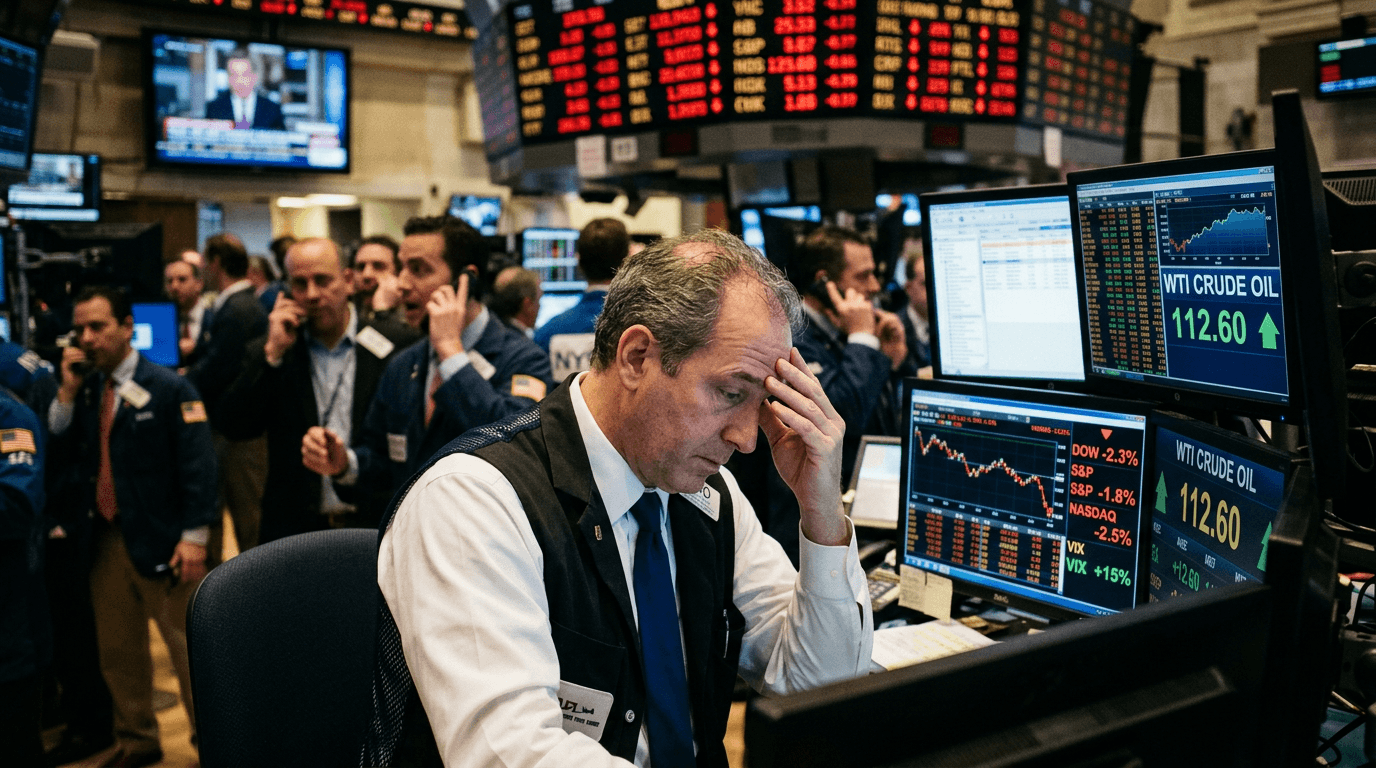
Geopolitical Tensions Drive Financial Market Turmoil: Oil Surges, Equities Plunge
As the geopolitical tensions between the US, Israel, and Iran intensify, global financial markets are feeling the heat. This escalating conflict has pushed crude oil prices to their highest since 2022, while equities face a sharp selloff. Investors find themselves navigating a volatile landscape where rising energy costs, fears of recession, and shifting Federal Reserve expectations create an unpredictable mix. The simultaneous drop in major equity indices and the spike in crude prices reflect a broader market recalibration that transcends the realm of energy trading.
Crude Oil Soars on Supply Disruption Worries
The most significant market movement comes from crude oil, which has surged past $112 per barrel. Concerns over potential military escalations disrupting the Strait of Hormuz—a vital global energy passage—have fueled this rise. With the strait effectively closed, major Gulf producers, including the UAE, Kuwait, and Iraq, have slashed oil output due to storage constraints and tankers stuck in port. Brent crude oil saw a dramatic 29 percent spike in Monday’s Asia session, briefly touching USD 120 a barrel before stabilizing.
For traders and investors, the critical insight is that this rally isn’t solely about actual supply disruptions. Morgan Stanley’s analysis suggests that geopolitical risk premiums—around $7 to $9 per barrel—are a significant component of current prices, serving as an insurance against possible disruptions. This implies that once geopolitical clarity returns, these premiums could vanish quickly.
Equity Markets Deepen in Selloff
US stock indices have succumbed to the pressure, with the S&P 500 shedding 1.67 percent to 6,368 points, the Dow Jones Industrial Average dropping 1.73 percent to 45,166, and the Nasdaq 100 falling 1.93 percent to 23,132 in recent sessions. These drops edge all three major indices toward correction territory, marked by around a 10 percent decline from recent peaks. The CBOE Volatility Index jumped 13.16 percent to 31.04 points, its highest in nearly a year, mirroring the pervasive market anxiety.
This stark downturn contrasts with the bullish sentiment that dominated Wall Street during the initial Trump administration months, fueled by robust corporate profits and investments in innovative technologies like AI. The eruption of Middle East tensions has derailed the market's path, introducing uncertainty that even solid earnings growth struggles to mitigate. European markets also felt the strain, with the Stoxx Europe 600 down 1.5 percent, highlighting the global nature of this risk-off sentiment.
Shifting Federal Reserve Policy Expectations
The nexus of rising energy prices and inflation expectations has dramatically reshaped market perceptions of the Federal Reserve’s path. Just two months ago, markets anticipated two interest rate cuts from the Fed in 2026, but ongoing conflict and surging energy prices have shifted this outlook. Now, market participants anticipate a higher-for-longer hawkish stance from the Fed, with the CME FedWatch Tool indicating heightened inflation concerns linked to increased energy costs.
The University of Michigan’s inflation expectations for March significantly exceeded analyst forecasts, underscoring the growing anxiety over price stability. While some strategists noted that improving technical and sentiment indicators suggest the S&P 500 may be forming a bottom after recent weakness, the inflation narrative could quickly change if oil prices remain high or climb further.
Gold Shines Amid Market Turmoil
Amidst the chaos, gold has emerged as a safe-haven asset despite facing headwinds from a hawkish Fed environment. Gold futures rose 2.66 percent to $4,492 per ounce as investors sought refuge from geopolitical uncertainty. Notably, gold prices have retreated approximately 8 percent from their all-time highs, presenting what many investors view as attractive entry points at a discount.
Strategists observed that positioning and sentiment are becoming more constructive, with institutional flows potentially offering incremental support. Systematic investors who previously reduced equity exposure are poised to re-enter the market, particularly favoring cyclical and growth segments where valuations have reset, and earnings remain strong. This suggests that once geopolitical clarity emerges, markets could rebound quickly.
Investor Takeaways
The current market environment is characterized by a classic risk-off dynamic, where energy concerns dominate traditional valuation metrics. Historical data from Deutsche Bank indicates that stock markets have fallen an average of just 4 percent across 30 major geopolitical events since 1939, suggesting that even significant international crises are typically absorbed by equity markets within a reasonable timeframe. However, the duration and escalation path of the current conflict remain unclear.
Investors navigating these waters will likely encounter continued volatility in the near term, driven by the interplay of strong earnings growth and renewed geopolitical uncertainty. The critical question is whether the recent market decline is an overreaction to temporary risks or a genuine risk repricing that will endure. Energy markets will remain sensitive to any indications of supply disruptions, while gold may continue to serve as a hedge for risk-averse portfolios. Until clearer signals emerge regarding both the Middle Eastern situation and the Federal Reserve’s actual policy path, expect markets to remain headline-driven, with volatility closely linked to geopolitical developments.
---
NEWSIMPACTSCORE: 8