
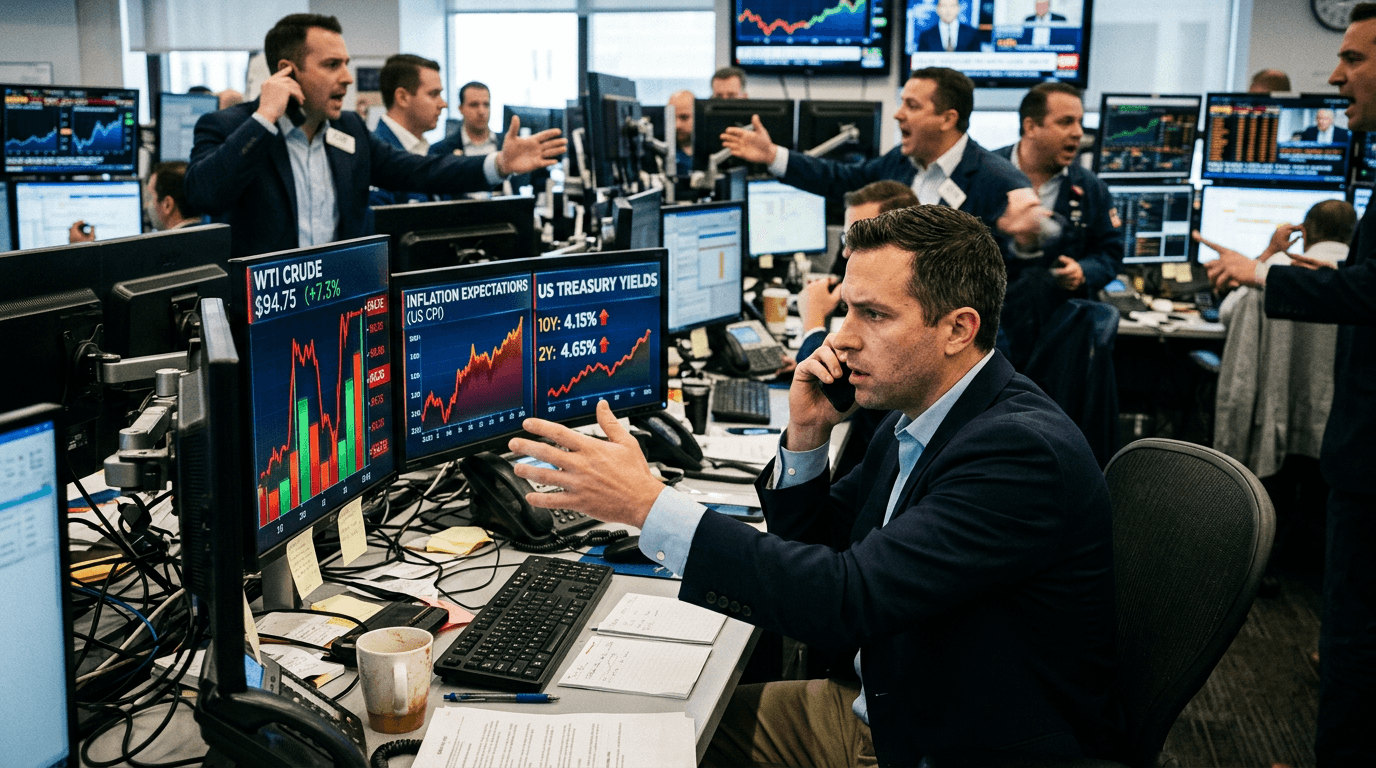
Oil markets are back in the spotlight as prices whipsaw following a dramatic 9% single‑day surge driven by rising Middle East tensions and fears over supply disruptions.[1][6] West Texas Intermediate (WTI) briefly pushed above $81 per barrel while Brent crude climbed toward $86, before pulling back just as quickly, underscoring how sensitive energy markets have become to geopolitical headlines.[1][6] For traders and investors, this is not just an oil story—it is a macro story with implications for inflation, interest rates, and cross‑asset positioning.
WHAT’S DRIVING THE LATEST OIL SWINGS
The latest bout of volatility has its roots in escalating tensions between the United States and Iran, layered on top of an already unstable regional backdrop.[1][6] Markets are highly alert to any threat involving the Strait of Hormuz and surrounding export routes, given that a sizable share of global crude flows through these chokepoints.[3] When traders perceive even a modest probability of disruption, risk premiums in oil futures can expand rapidly, fueling outsized moves in a short period.
Recent trading sessions have seen price action that resembles earlier episodes in which Middle East conflict pushed Brent and WTI sharply higher on fears of supply interruption.[2][8] Volatility indicators such as the CBOE Crude Oil Volatility Index (OVX) have spiked to levels last seen in earlier phases of regional conflict, reflecting rising demand for options protection and uncertainty around the near‑term price path.[5] In practical terms, this means intraday swings of several dollars per barrel have become common, especially around major news events or official statements from involved governments.
At the same time, structural forces are complicating the picture. On the supply side, OPEC+ continues to weigh production decisions and potential extensions of existing cuts, which could either cushion prices or amplify the impact of geopolitical shocks depending on how policy evolves.[2][5] On the demand side, concerns about global growth and the health of key consuming economies inject a countervailing force: weaker demand could neutralize some of the upside pressure from geopolitical risk.[2][3] The result is a “tug‑of‑war” market where sharp rallies can be followed by equally sharp reversals.
Why Volatile Oil Matters For Inflation And Rate Expectations
Oil’s importance goes far beyond the energy sector because crude prices feed directly into gasoline, diesel, jet fuel, and a wide array of transport and production costs. A sustained increase in oil prices tends to lift headline inflation and can also filter into core measures over time if higher energy costs persist.[3] Research cited by the IMF suggests that a 10% rise in oil prices typically translates into roughly a 0.4 percentage point increase in global inflation and a 0.15 percentage point drag on economic growth, underlining the macro relevance of these moves.[3]
The recent 9% jump in oil prices has already tempered expectations for near‑term cuts from the Federal Reserve, as markets reassess the inflation outlook and the risk of renewed cost‑push pressures.[1][6] Higher energy prices can slow the disinflation process central banks are trying to achieve, encouraging policymakers to keep rates elevated for longer to contain inflation expectations. This repricing is visible in interest‑rate futures and overnight index swaps, where the probability and timing of cuts shift as energy shocks alter macro assumptions.[1][3]
Bond markets respond as well. Rising oil prices and inflation concerns tend to push nominal yields higher while also affecting breakeven inflation rates implied by inflation‑linked instruments such as TIPS.[1][6] In episodes of sharp energy rallies, investors often demand greater compensation for inflation risk, widening breakevens even if real yields remain more stable. For multi‑asset traders, this underscores why monitoring oil is essential for understanding moves in fixed income and the broader macro narrative.
CROSS‑ASSET RIPPLE EFFECTS: EQUITIES, FX, AND COMMODITIES
Equity markets feel oil volatility through sector rotation and earnings expectations. Higher crude prices typically benefit energy producers and related service companies, while weighing on fuel‑intensive industries such as airlines, logistics, and parts of manufacturing.[4][5] During recent spikes, energy indices and oil‑heavy ETFs have often outperformed broader benchmarks, even when the overall market has traded sideways or lower.[5][8] For portfolio managers, this can create opportunities—but also challenges—in balancing sector exposure against macro risk.
Commodity‑linked currencies are another important transmission channel. Currencies such as the Canadian dollar (CAD) and Norwegian krone (NOK), whose economies are closely tied to energy exports, often strengthen during sustained oil rallies and weaken when prices slide.[1][6] However, in highly volatile environments, these relationships can become more complex as broader risk‑off flows and interest‑rate expectations interact with the commodity story. Traders who lean on simple correlations without accounting for regime shifts may find that historical patterns break down in stressed markets.
Other commodities can move in sympathy as well. Natural gas, refined products, and even metals sometimes trade higher when oil surges, reflecting shared drivers like geopolitical risk and inflation hedging demand.[1][2][9] Volatility in one major commodity can spill into others via cross‑market arbitrage, portfolio rebalancing, and changes in speculative positioning, reinforcing the idea that oil is a key node in the broader complex rather than an isolated asset.
How Traders Can Navigate Heightened Oil Volatility
For active traders, the current environment demands disciplined risk management and a clear framework for handling news‑driven markets. One practical step is to integrate volatility measures such as OVX into trade planning, using them to adjust position sizes, stop‑loss levels, and holding periods as the regime shifts.[5] Elevated implied volatility suggests that options strategies—like buying calls or puts to define risk, or structured spreads to manage cost—may be more appropriate than large unhedged futures positions.
Scenario analysis is another powerful tool. Building simple frameworks around key geopolitical paths—such as escalation, de‑escalation, or prolonged stalemate—can help traders anticipate how oil, yields, and inflation expectations might respond under each outcome.[2][3][6] From there, simulated trading environments allow participants to test strategies without capital at risk, experiment with different hedging techniques, and quantify how portfolios could behave under sudden price shocks.
Finally, traders should remember that oil is both a macro and micro story. Combining technical analysis of key price levels with fundamental understanding of supply, demand, and policy dynamics tends to yield a more robust view than relying on either in isolation. In volatile markets, the ability to pivot quickly when the news flow changes—without abandoning a coherent risk framework—is often what separates sustainable strategies from impulsive reactions.
Key Takeaways For Simulated And Live Market Participants
First, geopolitical risk in the Middle East has reasserted itself as a major driver of oil prices, turning crude into a highly headline‑sensitive asset with rapid intraday swings.[1][2][6] Second, energy shocks are not confined to the oil chart; they ripple through inflation expectations, central bank policy views, bond yields, and commodity‑linked currencies.[1][3][6] Third, heightened volatility can be a source of opportunity as well as risk, particularly for traders who use options, volatility indicators, and scenario analysis to structure exposure thoughtfully.[5]
For participants practicing in simulated environments, this is an ideal backdrop to refine playbooks for managing macro shocks: test how portfolios respond to sharp oil moves, explore hedging combinations across assets, and study how markets reprice inflation and rates when energy becomes a central narrative. For those trading live markets, the same principles apply—with the added need to size positions prudently and respect the speed at which conditions can change when geopolitics and commodities intersect.