
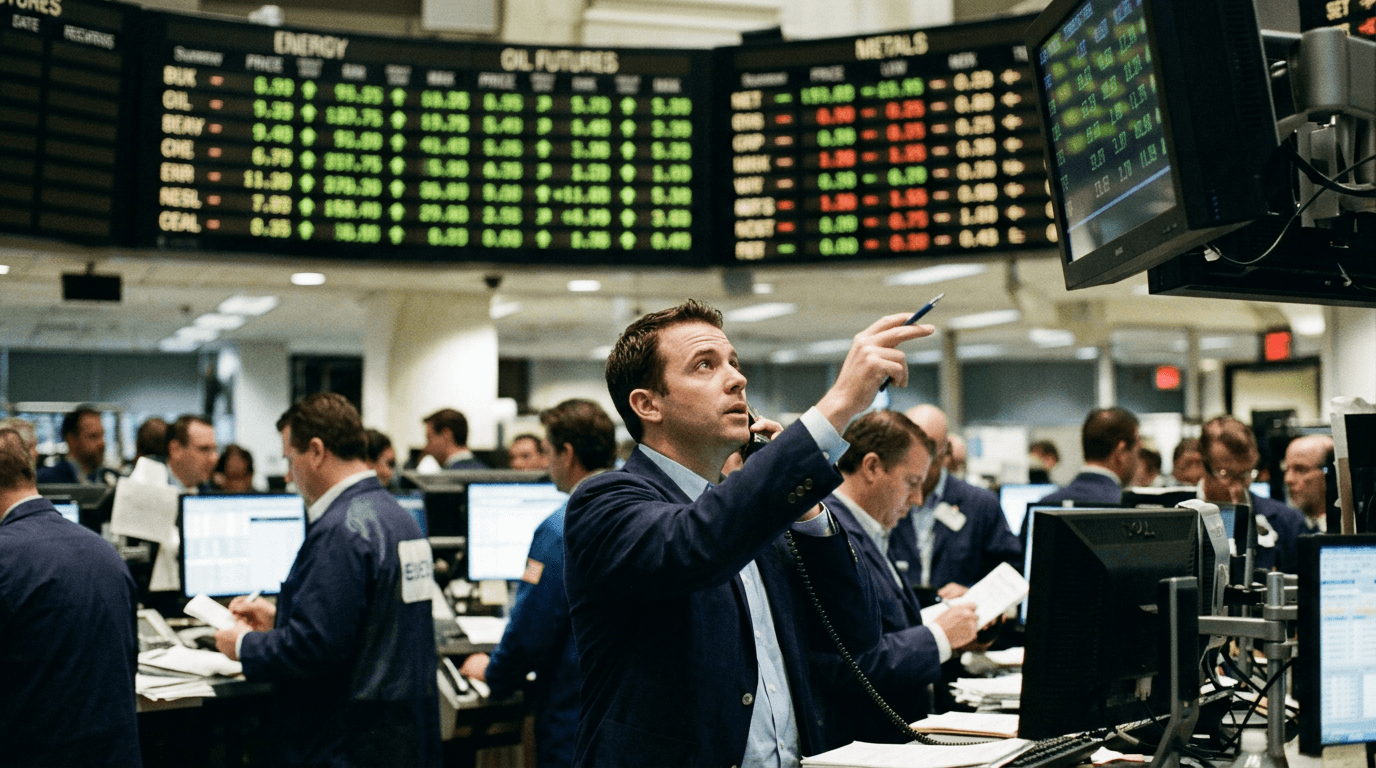
Oil and metals futures are moving in different directions as traders struggle to reconcile persistent geopolitical supply risks with a muted global growth outlook.[3][9][11] Brent crude futures are modestly higher, while benchmark copper contracts are little changed, highlighting how energy markets remain sensitive to disruptions even as industrial metals reflect softer manufacturing demand.[3][13][15] For traders and investors, this divergence is a live case study in how macroeconomic expectations filter through different parts of the commodity complex and into currencies and sector equities.[9][11][12]
Oil Prices Lifted By Supply Risk, Not Booming Demand
Brent crude prices are hovering in a range broadly consistent with an average spot price near the low-to-mid 80s per barrel, supported in part by geopolitical disruptions in key producing regions.[3][9][13] The IMF projects that energy commodity prices could rise around 19 percent in 2026, with oil prices specifically expected to increase by more than 20 percent due to production and transportation disruptions in the Middle East, pushing the average petroleum spot index toward about $82 per barrel.[9] This kind of forecast underscores that current support for oil is more about potential supply tightness than a surge in end-demand from a booming global economy.[9][11]
At the same time, other major outlooks highlight that, over a multi‑year horizon, oil remains vulnerable to structurally weaker demand as growth slows and energy transitions progress.[10][11][12] The World Bank expects overall commodity prices to decline by about 7 percent in 2025 and again in 2026, citing subdued global activity and ample oil supply.[11][14] A separate assessment notes that energy prices could fall by roughly 17 percent in 2025 to their lowest level in five years, reflecting decelerating global oil demand, weaker growth expectations, and the rising adoption of electric vehicles.[12] Taken together, the near‑term pricing buoyancy from supply risks sits in tension with medium‑term forecasts pointing to softer demand and potentially lower equilibrium prices.[9][11][12]
For futures traders, that mix of cyclical and structural forces means oil contracts can be highly sensitive to incoming news on production outages, geopolitical flare‑ups, and OPEC+ policy, even when macro data point to only modest global growth.[9][11] It also encourages more nuanced trade ideas, such as relative‑value strategies between different crude benchmarks, calendar spreads across maturities, or hedging approaches that distinguish short‑term event risk from longer‑term demand trends.[3][6][9]
Metals Stall As Manufacturing And Investment Cool
In contrast to oil, key industrial metals such as copper are showing more muted price action, with front‑month copper futures effectively flat on the day and little changed in percentage terms.[3][6][15] Copper is traditionally viewed as a bellwether for global manufacturing and construction, so its lack of upside momentum aligns with forecasts for only moderate global growth over the next couple of years.[3][5][11] Recent projections suggest world output could hover around 3.3 percent in 2025 and 2026, below the long‑run average of roughly 3.7 percent, implying a slower pace of capital investment and demand for metal‑intensive goods.[5]
Broader commodity outlooks also point to a multi‑year period of generally softer prices, driven by subdued industrial activity, elevated trade tensions, and policy uncertainty.[10][11][14] The World Bank expects aggregate commodity prices to fall by about 12 percent in some years and continue to decline thereafter, with industrial metals facing headwinds from tepid global growth and past capacity expansions.[10][11][14] For metals futures, this environment often produces choppy, range‑bound trading rather than strong, sustained uptrends—especially when there is no clear catalyst from Chinese stimulus or a synchronized global capex boom.[10][11]
For traders, the key implication is that metals may respond more to incremental macro data—such as manufacturing PMIs, industrial production figures, and Chinese housing or infrastructure updates—than to the geopolitical stories that dominate oil.[10][11][14] This can favor mean‑reversion strategies and data‑driven short‑term setups in copper, aluminum, or zinc, rather than purely directional long‑term bets absent a clear macro inflection.[3][6][15]
Why Commodity-sensitive Currencies And Sectors Are In Focus
The current split between stronger oil and subdued metals is feeding directly into commodity‑linked currencies and sector performance in equities.[3][9][11] Historically, exporters of energy and raw materials tend to see their currencies move with terms of trade; when energy prices outperform, oil‑heavy economies often gain relative to manufacturing‑heavy metal exporters.[9][11] At the same time, equity investors are increasingly differentiating between energy producers that benefit from higher crude prices and materials or industrial names more tied to metals demand and manufacturing health.[3][10][11]
Macro forecasters emphasize that the overall commodity complex is still shaped by a cautious global growth backdrop and expectations of subdued demand.[5][10][11] That backdrop encourages investors to favor companies with strong balance sheets and efficient cost structures in resource sectors, rather than broad, indiscriminate exposure.[10][11][14] For currency traders, it increases the importance of tracking both commodity price moves and the evolving growth mix across regions, since differences in exposure to oil versus metals can create relative value opportunities in FX pairs.[9][11][12]
What Mixed Futures Mean For Traders Using Simulated Finance
A mixed commodity tape with oil modestly higher and metals largely flat is an ideal environment for traders to refine playbooks in a simulated setting before committing real capital.[3][6][15] It provides a live testing ground for ideas such as trading spreads between energy and metals indices, building macro‑themed baskets that go long energy producers and short metals‑exposed names, or experimenting with hedging commodity‑sensitive currency exposures against futures positions.[3][9][11]
Simulated Finance (SimFi) platforms allow traders to explore how different asset classes interact when global growth is merely adequate rather than booming, and when supply‑side shocks dominate one part of the complex but not others.[9][11][12] By running scenarios where oil prices spike on geopolitical news while metals remain sluggish, traders can observe how portfolio P&L behaves, how margin usage evolves, and where diversification does or does not work as expected.[3][9][11] This kind of environment is particularly suited to stress‑testing risk management rules, such as maximum exposure per theme, stop‑loss disciplines, and correlation assumptions between commodities, FX, and equities.[10][11][14]
Key Takeaways For The Weeks Ahead
Several practical points emerge from the current divergence between oil and metals futures:
- Expect oil to remain headline‑sensitive, as supply disruptions and geopolitical events clash with medium‑term forecasts for weaker demand.[9][11][12]
- Treat industrial metals as a high‑beta expression of the manufacturing and investment cycle, closely tied to global and especially emerging‑market growth data.[5][10][11]
- Watch commodity‑linked currencies and sector indices for confirmation or contradiction of the futures message, especially where economies are heavily skewed toward either energy or metals exports.[9][11]
- Use simulated trading to rehearse cross‑asset strategies—such as long‑energy/short‑metals baskets or currency‑commodity hedges—before deploying them in live markets.[3][9][11]
In a world of cautious global growth, the commodity complex is unlikely to move in a straight line, and different segments will react differently to macro news and shocks.[5][10][11] Traders who understand why oil and metals can decouple—and who practice managing those dynamics in a risk‑controlled, simulated environment—will be better prepared when opportunities and volatility arise across futures, FX, and sector equities.[3][9][11]