
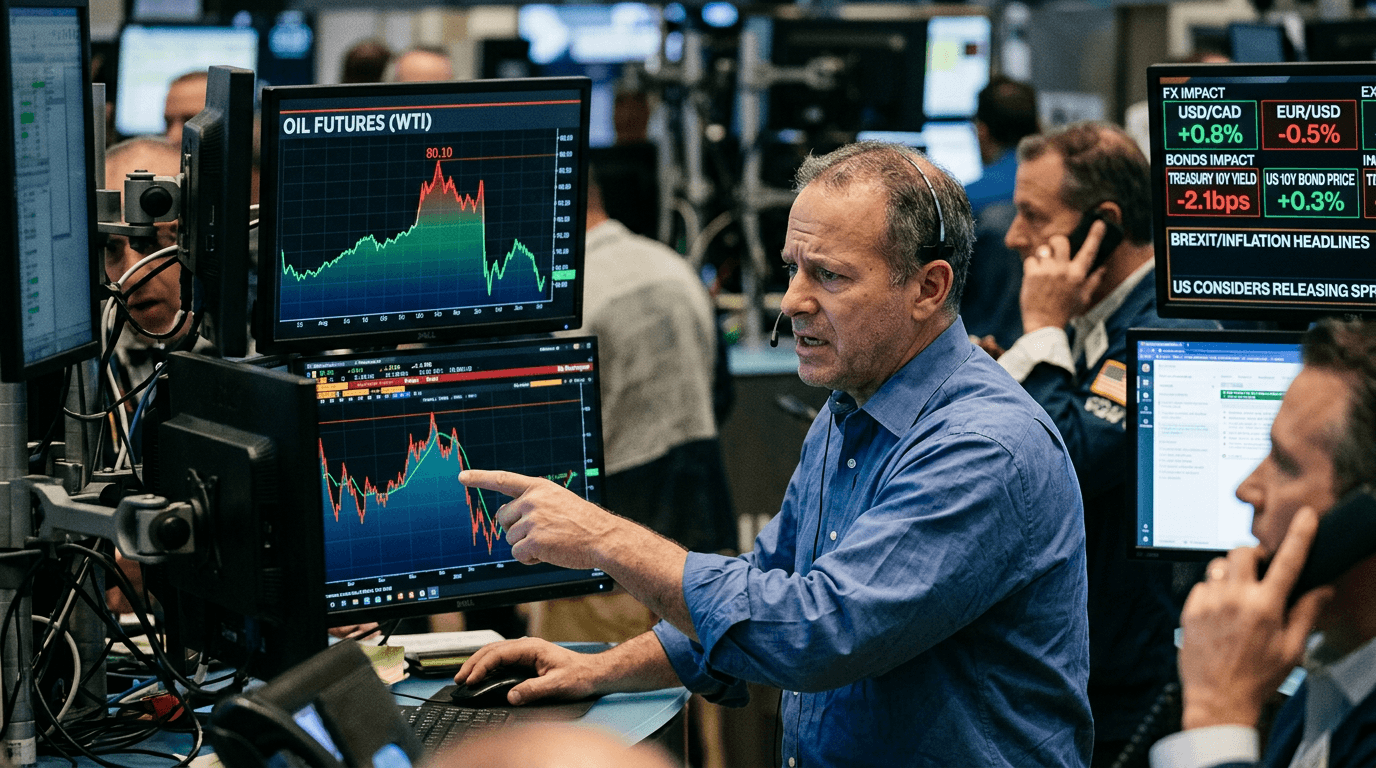
Oil futures briefly surged above $80 per barrel, with Brent topping $84, as fresh conflict involving Iran reignited fears of supply disruption and inflation before prices pulled back on talk of potential US intervention in the futures market and greater Indian access to discounted Russian crude. The episode offered a real‑time lesson in how geopolitics, policy signaling, and macro expectations collide to move energy, currency, and bond markets in fast, sometimes violent swings.
GEOPOLITICAL RISK AND THE IRAN “WAR PREMIUM”
Crude markets routinely build a “risk premium” when tensions flare around key producing regions, and Iran is near the center of one of the world’s most strategically important energy corridors.[2] When traders see even a small probability that flows through the broader Gulf or the Strait of Hormuz might be disrupted, they rapidly re‑price futures to reflect tighter potential supply.[4]
History shows how quickly this can happen. In earlier phases of the Iran conflict, Brent and US benchmark crude have jumped to multi‑month highs as markets reassessed the odds of shipping disruptions and production outages.[2] Those moves are often front‑loaded in the nearest‑dated futures, where hedgers and speculators respond within seconds to headlines.
The latest push through $80 is another expression of that dynamic: a geopolitical shock layered onto an already tight global supply‑demand balance, with inventories not overly abundant and OPEC+ policy still constraining barrels.[2] In that environment, even modest escalation chatter can send traders scrambling to secure exposure or hedge risk in front‑month contracts.
Why The Spike Faded: Policy Signals And Supply Substitution
Just as important as the initial surge was how quickly it retraced once reports surfaced that Washington might intervene in the futures market and facilitate more Indian purchases of Russian crude. Policy signaling can change the calculus on both the demand and supply side even before any concrete measures are implemented.
Hints of US intervention in oil futures can be interpreted in several ways: tougher oversight on speculative positioning, closer scrutiny of potential manipulation, or coordinated communication aimed at dampening volatility. Past episodes where presidential statements abruptly shifted the outlook for Iran talks have triggered sharp reversals in oil prices and raised questions about timing and information flows.[5][6] Traders know that political jawboning alone can wipe out a fear‑driven rally.
At the same time, talk of India ramping up imports of Russian barrels at a discount implies additional alternative supply reaching global markets. That can offset the perceived risk that Middle East barrels become harder to source, softening the risk premium embedded in prices. Even if flows do not immediately change, the expectation of more flexible sourcing can cool panic buying.
The result was classic geopolitical whiplash: front‑month contracts spiked on conflict risk, then slipped as policy and trade‑flow narratives shifted, leaving intraday charts littered with sharp reversals and stop‑outs.
Ripple Effects Across Fx, Inflation And Bonds
Oil does not move in isolation. The jump above $80 instantly fed into inflation expectations, particularly in economies still struggling to bring price growth back toward target.[2] Higher crude translates into pricier gasoline and diesel, which historically have pushed headline inflation higher and squeezed real household incomes.[1][4]
In currency markets, commodity‑linked FX such as CAD and NOK often catch a bid when energy prices rise, while import‑dependent economies’ currencies can come under pressure as traders brace for deteriorating trade balances and higher local fuel costs.[2] At the same time, “inflation‑sensitive” currencies and emerging‑market FX may see added volatility as investors reconsider rate paths and risk premia.
Bond markets feel the impact through breakeven inflation and real yields. A sudden oil spike can nudge breakevens higher as investors demand compensation for potential energy‑driven price pressure, pushing nominal yields up even if growth expectations are unchanged. If the move is seen as a threat to growth via weaker consumers and tighter financial conditions, curves can twist, with short‑dated yields reacting to inflation fears and longer maturities reflecting growth angst.
When the spike faded on talk of US intervention and alternative supply, those cross‑asset moves partially unwound. That back‑and‑forth illustrates how a single commodity headline can propagate through macro assets in minutes, only to reverse when the narrative pivots.
Lessons For Active And Simulated Traders
For active traders—and those practicing in SimFi environments—the episode offers several valuable takeaways.
First, map the transmission channels. Understanding how an Iran‑related supply scare flows from crude futures into FX, inflation expectations, and bond yields helps you build coherent trade ideas instead of isolated bets.[2] If you only trade oil, you are missing opportunities—and risks—created elsewhere in the macro complex.
Second, watch the futures curve, not just the spot price. A spike concentrated in front‑month contracts with pronounced backwardation signals heightened near‑term tightness and risk premia.[2] If the curve steepens at the front then flattens as prices pull back, that tells you the market is pricing a short‑lived shock, not a structural shift. That can guide whether you focus on short‑dated exposure, calendar spreads, or longer‑term hedges.
Third, distinguish between fear‑driven moves and fundamental trends. Previous Iran war scares have seen oil leap toward or above triple‑digit levels before retracing once physical flows proved more resilient than feared.[2] Building scenarios—“headline spike with no real disruption” versus “multi‑month supply outage”—helps you decide whether to fade panic or ride a structural re‑pricing.
Finally, practice execution and risk management in simulated environments before taking real‑money risk. Geopolitical moves often feature fast gaps, wide bid‑ask spreads, and slippage. Using SimFi platforms to rehearse entries, exits, and position sizing under stress conditions can make you more disciplined when volatility erupts for real, whether in crude, commodity FX, or inflation‑linked bonds.
Practical Takeaways For The Next Oil Shock
Episodes like the $80 spike are unlikely to be the last as geopolitical and policy risks continue to intersect with tight energy balances. A few practical principles can help you prepare:
Stay news‑aware but avoid chasing every headline. Build a framework for assessing which developments genuinely alter supply and demand versus those that only shift sentiment.
Track policy communication closely. Statements about intervention, sanctions, or alternative supply routes can reverse moves as quickly as conflict news creates them.[5][6]
Use cross‑asset signals. If oil jumps but inflation breakevens and commodity FX barely move, the market may be treating the move as noise. If all channels align, the shock is more credible.
Above all, treat geopolitically driven volatility as an opportunity to learn how macro narratives translate into prices. Whether you trade live or in simulation, understanding the mechanics behind an $80 oil spike and its rapid unwind is a powerful edge in today’s headline‑driven markets.[2]