
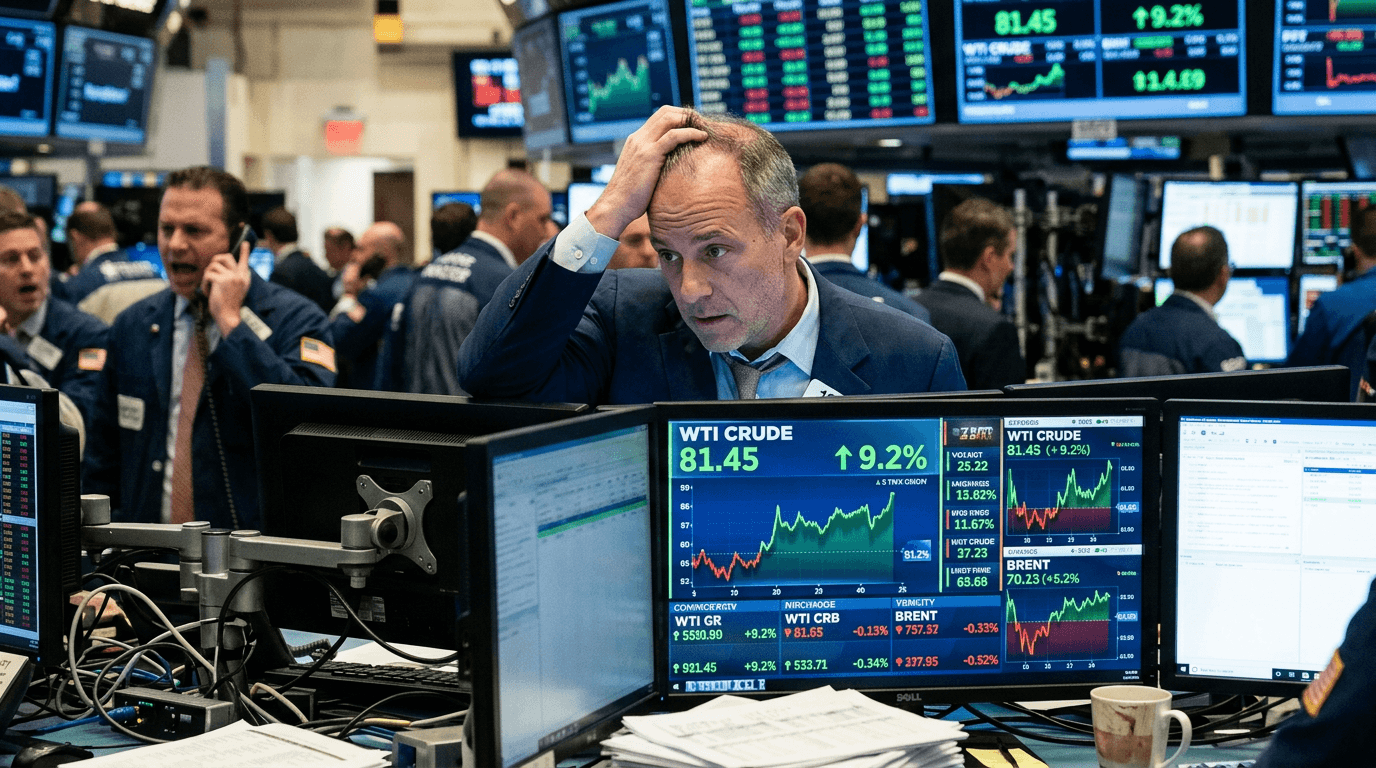
Oil’s latest surge is not just a story about higher fuel bills; it is a full‑scale macro shock rippling through futures, currencies, inflation expectations, and equity markets. With U.S. crude jumping roughly 9% to above $81 and Brent climbing toward $86 as conflict with Iran intensifies, traders are once again reminded that geopolitics can reprice entire asset classes in a matter of hours. Understanding how and why this move is happening is essential if you trade energy, indices, FX, or macro themes in a simulated or live environment.
WHAT’S BEHIND THE 9% OIL SPIKE?
The immediate catalyst is the escalation of conflict involving Iran and its neighbors, which raises the risk of disruption to oil flows from one of the most strategically important regions for global energy supply. When tensions flare in the Middle East, the market does not wait for actual barrels to go offline; it rapidly prices in a “risk premium” for potential supply disruptions.
Even without concrete production cuts, the fear that shipping lanes or critical infrastructure could be targeted is enough to push futures sharply higher. In this case, WTI breaking above $81 and Brent toward $86 reflects traders paying up for insurance against the worst‑case scenarios: disruptions to exports, sanctions tightening, or broader regional escalation.
This kind of move is often exacerbated by positioning. If speculative traders were short crude or underweight energy going into the headlines, they can be forced to cover quickly, adding fuel to the rally. Trend followers, volatility‑targeting funds, and options hedging flows can further amplify the initial move once key technical levels are breached.
Key takeaways: - Geopolitical risk in key producing regions tends to reprice oil quickly, often before fundamentals visibly change. - A 9% intraday or short‑window move signals not just noise, but a meaningful risk‑premium adjustment. - Positioning and forced hedging can turn a fundamental shock into a sharp, momentum‑driven spike.
Why Oil And Inflation Worries Move Together
Oil is embedded in almost every part of the modern economy: transportation, manufacturing, agriculture, shipping, and petrochemicals. When crude spikes, markets immediately reassess the inflation outlook, and that reassessment shows up in inflation‑linked instruments like breakeven rates.
Breakevens are the spread between nominal and inflation‑protected government bond yields; when they rise, it indicates the market is pricing in higher inflation over the coming years. A sharp oil rally raises expectations for higher headline inflation, especially through fuel, transport, and energy‑intensive goods. If the move is large and persistent, it can spill into core inflation as companies pass higher input costs on to consumers.
For central banks, this complicates the path for rate cuts. Even if growth is slowing, a renewed spike in energy prices can make policymakers more cautious about easing too quickly. Markets know this, so higher oil can translate into expectations of “higher for longer” interest rates, or at least fewer and later cuts.
Key takeaways: - Oil shocks feed quickly into headline inflation and longer‑term inflation expectations. - Rising breakevens alongside oil suggest markets are repricing the future inflation path, not just reacting to a one‑off data point. - Central bank reaction functions can shift, changing the macro backdrop for bonds, equities, and FX.
CROSS‑ASSET REACTION: FUTURES, FX, AND EQUITIES
The 9% jump in crude and the move in Brent have triggered a classic cross‑asset reaction.
Energy futures are the most obvious winners: crude oil and refined products futures are bid higher as traders price in tighter supply or higher risk premiums. Energy equity sectors, such as integrated oil majors and exploration and production names, often catch a bid as higher prices can expand profit margins, especially if they are not hedged too aggressively.
Inflation‑sensitive assets are also responding. Inflation breakevens have moved higher, reflecting the market’s reassessment of inflation risk. That can pressure nominal bond prices if investors demand more compensation for inflation, especially at the front and belly of the curve.
In FX, commodity‑linked currencies such as the Canadian dollar, Norwegian krone, and, to a lesser degree, the Australian dollar tend to find support as higher oil prices improve terms of trade for exporting economies. Conversely, oil‑importing countries may see pressure on their currencies due to deteriorating trade balances and higher imported inflation.
Risk‑sensitive equity index futures, especially in sectors like airlines, logistics, autos, and consumer discretionary, feel the heat. Higher fuel and input costs can compress margins and weigh on consumer spending power, leading to lower expected earnings and multiple compression in some cyclical sectors. Broad indices may see a tug‑of‑war: energy and materials up, rate‑sensitive growth and consumer names down.
Key takeaways: - Energy futures and energy equities typically benefit from a sharp oil spike. - Commodity‑linked FX tends to strengthen, while import‑dependent markets face headwinds. - Index futures may weaken as higher energy and inflation expectations challenge earnings and valuation assumptions.
Implications For Traders And Simulated Strategies
For traders, a move of this magnitude is both a risk and an opportunity. In a SimFi environment, it is an ideal live‑fire exercise for testing how your strategies behave under geopolitical and macro stress.
First, volatility and correlations change. Equities, bonds, FX, and commodities can all move more sharply and sometimes in different directions than in low‑vol regimes. A system calibrated to calm conditions may overshoot risk limits, hit stops too easily, or underperform when spreads widen and liquidity thins. This is a good time to review position sizing rules, intraday risk limits, and the sensitivity of your P&L to large gaps in key markets.
Second, macro narratives can dominate technical setups. Levels, patterns, and trend indicators still matter, but they are more likely to be overridden by headlines, policy commentary, and surprise events. Traders should be cautious about over‑relying on technical signals in isolation and consider scenario analysis: What if crude breaks above the next resistance? What if there is a de‑escalation headline and oil gaps lower?
Third, timing and instrument choice become critical. Instead of chasing headline moves, many experienced traders look for: - Pullbacks to key levels in crude futures or energy equities to join the trend with defined risk. - Relative value opportunities, such as long energy vs. short sectors hurt by higher oil. - FX pairs where the oil story aligns with broader macro trends, not just a one‑day spike.
Finally, this is a reminder to watch the macro chain reaction: oil → inflation expectations → central bank expectations → yields → equity and FX valuations. The more you understand that chain, the better you can anticipate second‑ and third‑order effects rather than reacting purely to price changes in a single asset.
Key takeaways: - Stress‑test your strategies for sudden volatility and shifting correlations. - Combine technicals with macro and headline awareness in high‑geopolitics regimes. - Focus on well‑defined risk, instrument choice, and the broader macro transmission from oil to rates, FX, and equities.
Conclusion
A 9% spike in oil on the back of Middle East conflict is not an isolated commodity story; it is a macro shock that touches inflation expectations, central bank policy paths, currency markets, and global equity valuations. For active traders, whether in a simulated or live environment, this is a chance to study how geopolitical risk flows through the system and to refine strategies that can navigate—not just survive—these sudden regime shifts. The traders who treat moves like this as a learning laboratory, rather than just a headline to trade around, are the ones building durable edges for the next shock.