
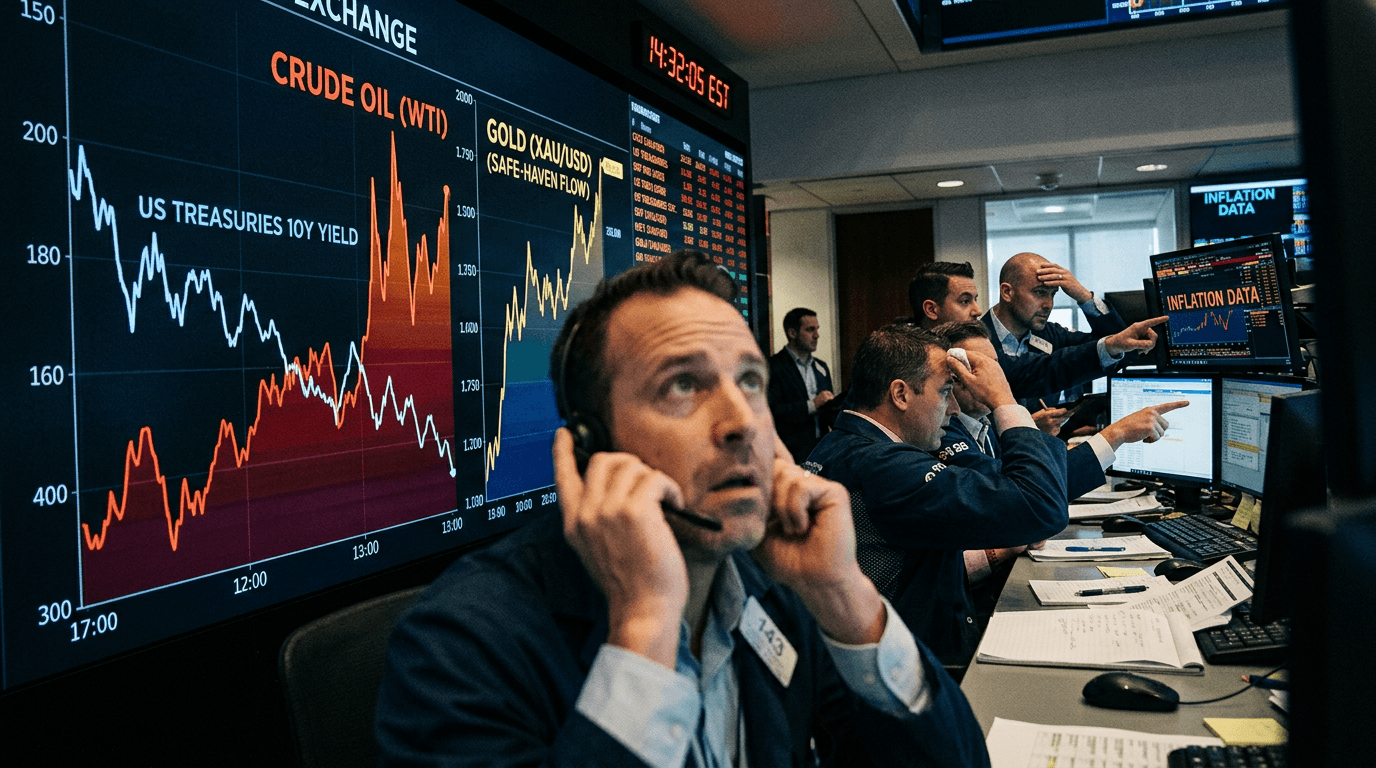
Oil’s latest surge—spiking as much as 9% with WTI briefly above $81 and Brent near $86—has put the US‑Iran conflict back at the center of market psychology. The move is not just about supply fears; it is rekindling concerns about inflation, reshaping expectations for interest rates, and reviving demand for safe‑haven assets while putting pressure on risk‑sensitive parts of the market like growth and tech stocks.[1][8]
Market Reaction: Oil Spikes On Geopolitical Risk
Geopolitical shocks in the Middle East have historically been among the most powerful drivers of abrupt oil moves, and the latest escalation between the US and Iran is no exception.[1][7] Any perceived threat to production facilities or key shipping chokepoints, such as the Strait of Hormuz, prompts traders to price in a “risk premium” for crude, even before actual barrels are taken off the market.[4][7]
In this episode, crude rallied sharply intraday, with intraday gains up to 9% as traders reassessed the probability of supply disruptions and retaliation scenarios. That rally has spilled over into related markets: energy equities have outperformed, commodity‑linked currencies like the Canadian dollar and Norwegian krone have found support, while major equity indices have wobbled under the weight of higher expected input costs and higher discount rates.[8]
History shows that when conflict risk appears persistent—as markets increasingly fear in the Iran theater—oil volatility can stay elevated for weeks or months, not just days.[4][7] That keeps energy traders focused not only on spot prices but also on the shape of the futures curve, time spreads, and implied volatility, all of which can offer clues about whether the move is seen as a short‑lived spike or the start of a more enduring regime shift.
Why Oil Shocks Matter For Inflation And Central Banks
Higher oil prices feed into inflation through several channels: direct fuel costs, transportation, and the energy embedded in manufacturing, agriculture, and services.[2][7] A sustained rise in crude tends to lift gasoline and diesel prices, which quickly show up in headline inflation prints and in consumer inflation expectations. That is why central banks pay close attention when oil spikes.
Scenario analysis from the Federal Reserve Bank of Dallas on an Iran‑related supply shock suggests that a closure of the Strait of Hormuz lasting between one and three quarters could add roughly 0.2 to 1.8 percentage points to US headline PCE inflation, depending on duration and severity.[2] While the current situation has not reached that extreme, markets are forward‑looking and are beginning to re‑price the risk that inflation could re‑accelerate or stay above target for longer than previously expected.[2][8]
This matters directly for rate‑sensitive assets. If central banks fear that a fresh energy shock will unanchor inflation expectations, they may pause or delay rate cuts that markets had been pricing in.[8] That pushes bond yields higher than they would otherwise be, compresses equity valuations, and tends to hit long‑duration growth stocks, speculative tech names, and leveraged sectors hardest. In other words, an oil spike can be both an inflation story and, indirectly, a monetary‑policy story.
SAFE‑HAVEN FLOWS AND CROSS‑ASSET WINNERS AND LOSERS
Episodes of geopolitical stress often trigger a classic “risk‑off” reaction: investors sell equities and high‑yield credit and rotate into safe‑haven assets perceived as more resilient in a crisis.[1][5] In the current oil‑driven move, several dynamics are in play simultaneously:
- Safe‑haven demand: US Treasuries, the US dollar, and, to a degree, gold typically attract inflows when geopolitical and macro uncertainty rise.[1][5][6] Although gold’s behavior can be nuanced—sometimes pressured by rising real yields even as risk sentiment worsens—conflict‑driven energy shocks historically support at least some safe‑haven bid for the metal.[1][3]
- Commodity currencies: Exporters of oil and other raw materials, such as Canada and Norway, can benefit from higher terms of trade, supporting their currencies against those of net importers.[8] However, if risk aversion becomes extreme, the global dash for dollars can overwhelm commodity support, so traders need to watch whether FX moves are being driven more by oil fundamentals or by broad risk sentiment.
- Rate‑sensitive equities: Higher real yields and higher expected inflation tend to compress valuations for long‑duration assets, including growth stocks and sectors like tech, consumer discretionary, and real estate. These segments often underperform when markets suddenly price in a “higher for longer” interest‑rate path sparked by an energy shock.[5][8]
- Emerging markets: Many emerging economies are large net energy importers and can see both inflation and trade balances deteriorate when oil spikes, putting pressure on their currencies and sovereign bonds. Others, especially in the Middle East and parts of Latin America, may benefit from improved export revenues, highlighting the need for country‑specific analysis rather than treating EM as a single bloc.[7][8]
Scenarios Traders Should Be Watching
For traders and investors, the most important question is not just how high oil has gone, but which path it takes next. Broadly, current pricing reflects a tug‑of‑war between three scenarios:
- Quick de‑escalation: Diplomatic efforts succeed in containing the US‑Iran confrontation, the risk premium in oil fades, and crude retraces a large portion of its recent spike. In this case, inflation fears may subside, central banks could stick closer to their previous easing trajectories, and risk assets might rebound, though with lingering volatility.[4][8]
- Prolonged tension without major disruption: The conflict remains elevated, but actual supply losses are limited and shipping lanes remain mostly open. Oil trades with a persistent risk premium and high volatility, but without exploding higher. Inflation stays under upward pressure, potentially delaying rate cuts, while markets oscillate between risk‑on and risk‑off as headlines shift.[2][4][7]
- Severe disruption: A direct hit to infrastructure or a meaningful closure of key routes such as the Strait of Hormuz pushes benchmark crude well beyond recent highs and keeps it there.[2][4][7] This is the scenario that models suggest could meaningfully lift inflation and raise the risk of stagflation—slowing growth combined with high prices—echoing aspects of the 1970s energy crisis.[2][7] In that environment, safe‑havens and select energy and commodity names are likely to outperform, while most global equities and high‑yield credit struggle.
Key Takeaways For Active And Simulated Traders
For both live and simulated traders, an oil shock of this magnitude is a live stress test of strategy design and risk management. Several practical points stand out:
- Volatility is an opportunity and a risk: Elevated intraday swings in crude, equity indices, and FX can offer rich trading opportunities, but they also increase the probability of slippage, gaps, and stop‑outs. Position sizing, wider but rational stop‑loss placement, and disciplined risk per trade become critical.
- Cross‑asset thinking adds an edge: This is not just an “oil chart” story. Monitoring correlations between crude, yields, inflation expectations, FX pairs, and sector indices can help identify more robust trade ideas—for example, pairing a long in an oil major with a hedge in a rate‑sensitive equity index.
- Scenario planning beats prediction: Rather than trying to guess the exact geopolitical outcome, it is more robust to map out several plausible paths—de‑escalation, prolonged tension, or severe disruption—and define in advance how your portfolio or trading strategy would respond in each case. This reduces emotional decision‑making when headlines hit.
- Use simulated environments to rehearse: High‑impact macro events are ideal candidates for testing playbooks in simulated trading setups that mirror real‑market conditions. Running “what‑if” drills around oil at different price levels, yield curves under various inflation paths, and FX moves under risk‑off conditions can help refine strategies before risking capital.
In short, an oil spike driven by US‑Iran tensions is not a single‑asset story. It is a macro shock that reverberates through inflation expectations, central‑bank policy paths, currency markets, and the relative performance of sectors and regions. Traders who approach it with a structured, cross‑asset, and risk‑aware framework will be better positioned to navigate whatever comes next.