
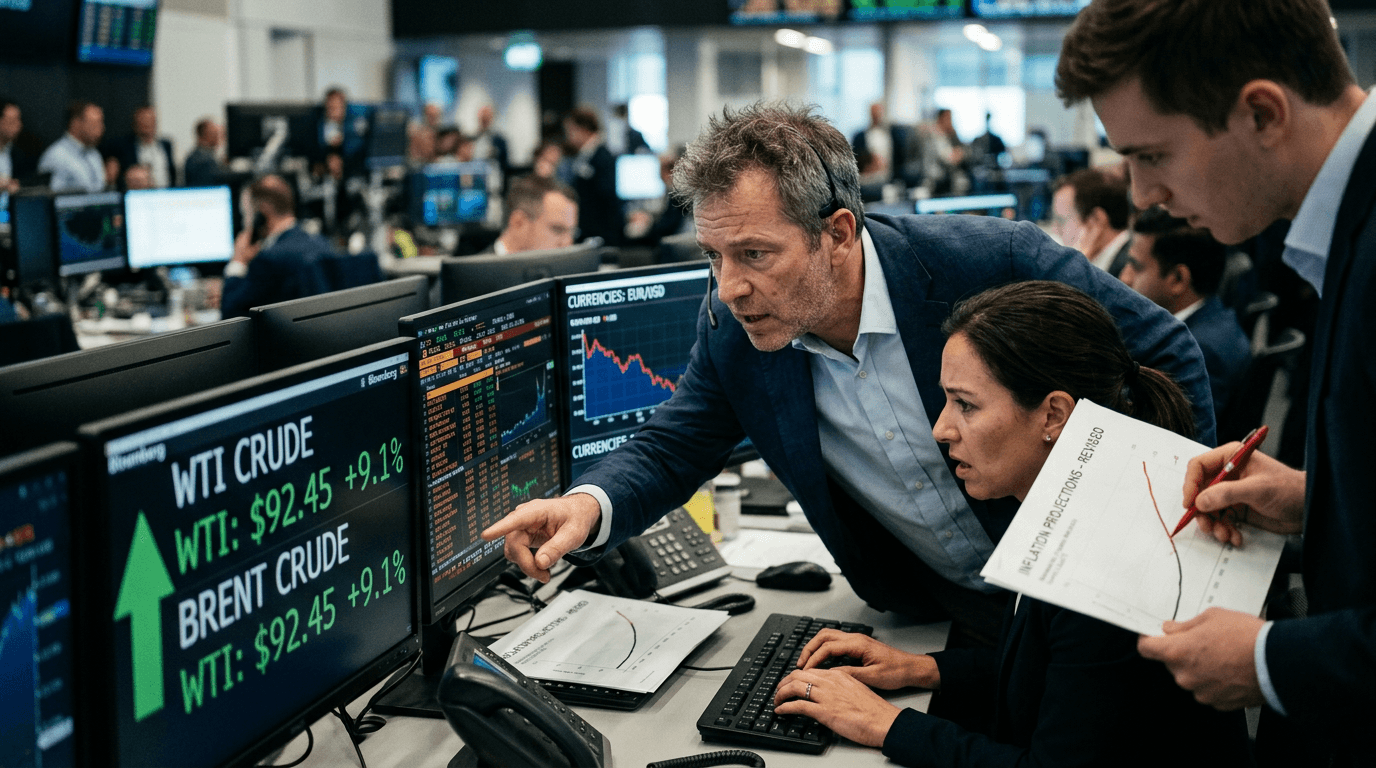
Oil markets have snapped back into focus after a sharp 9% spike that pushed prices to their highest levels since the summer of 2024. U.S. crude has surged to roughly $81.64 per barrel, with international benchmark Brent near $85.85, as renewed U.S.-Iran hostilities and heightened tensions around the Strait of Hormuz reignite fears over global supply.[3][8] For traders and investors, this is more than a headline move: it is a textbook example of how geopolitical shocks can ripple across inflation expectations, interest-rate pricing, currencies, and risk assets in a matter of hours.
GEOPOLITICS BACK IN THE DRIVER’S SEAT
The latest leg higher in oil is directly tied to an escalation in the U.S.-Iran conflict, centered on military strikes and threats involving critical infrastructure and shipping routes in the Gulf.[3][5] The Strait of Hormuz, through which a significant share of global crude exports pass, has repeatedly been at the heart of recent tensions, with previous closures and disruptions driving sharp price spikes.[1][7] When markets sense that transit through this chokepoint is at risk, they quickly price in the possibility of supply outages, insurance costs rising, and logistical bottlenecks for tankers.
Earlier flare-ups in the conflict have already shown how sensitive oil is to military developments. U.S. strikes on Iranian missile sites and Iranian retaliatory actions have pushed Brent and WTI sharply higher on several occasions in 2026 as traders reassessed the odds of a durable peace deal.[5][6] Every new round of hostilities forces the market to revisit the same question: how much of current production and transit is truly at risk, and for how long?
Supply Fears And The Risk Premium In Oil
The current 9% jump is best understood as a rapid expansion of the “geopolitical risk premium” embedded in oil prices. Under normal conditions, prices reflect fundamentals like demand growth, OPEC+ policy, U.S. shale output, and inventory levels. When conflict flares, an extra layer is added to account for potential supply disruptions, even if barrels are still physically flowing.[5][6]
Recent reporting has highlighted that technical talks and tentative deals can quickly relieve some of this premium by promising freer passage through the Strait of Hormuz, leading to sharp pullbacks in Brent when agreements are announced.[3][7] But analysts continue to warn that the physical reality lags behind the headlines: mines must be cleared, backlogs of tankers resolved, and production restored before flows normalize.[7] In the meantime, prices can remain elevated as traders demand compensation for uncertainty.
For active traders, the key takeaway is that the risk premium is inherently fragile and event-driven. A single headline about collapsed talks or renewed strikes, as seen when negotiations were cut off earlier in the conflict, can reverse days of gradual declines and send prices back to multi-month highs.[4][5] Managing exposure around these binary events requires careful scenario analysis and strict risk controls.
Inflation, Central Banks And Macro Markets
Oil at its highest levels since 2024 is not just an energy story—it is a macro story. Higher crude typically feeds into gasoline and diesel costs with a lag, pushing up transport and shipping expenses and, ultimately, the prices consumers pay at the pump.[6][10] Earlier in the U.S.-Iran war, AAA data showed national fuel prices climbing sharply, contributing to a more than 50% rise in consumer energy costs since the conflict began.[5][6]
Economists have repeatedly warned that such oil shocks can create “second-round” effects on inflation, as businesses pass higher input costs through to customers and workers demand wage adjustments.[5] Research from Oxford Economics, for example, has highlighted that elevated energy prices raise the odds that inflation remains sticky for several years, complicating central banks’ efforts to return it to target.[5]
That matters directly for rate-cut expectations. If investors start to see oil-induced inflation as persistent rather than temporary, they will price fewer or slower cuts from major central banks, pushing yields higher and pressuring rate-sensitive assets.[5][6] Markets have already shown this pattern in recent episodes: when oil jumps on war headlines, bond traders reprice the path of policy, and equities often wobble as the cost of capital rises.[2][4]
Winners, Losers And Currency Moves
Oil’s surge tends to divide the global economy into winners and losers. Net importers—especially in Asia and Europe—face higher energy bills, weaker trade balances, and added pressure on growth.[5][6] Past spikes during this conflict have coincided with softer equity performance in energy-sensitive importing economies, even as some regional indices still managed gains on broader risk appetite.[5][6]
On the other side, commodity-linked currencies and exporters often benefit. When crude moves higher on supply fears, currencies of oil-producing nations typically see support, as their terms of trade improve and fiscal revenues rise. By contrast, currencies of heavy importers may weaken as markets anticipate wider current-account deficits and potential policy responses to inflation.
This dynamic has been visible throughout the U.S.-Iran war, with energy-driven swings influencing global equity indices and FX pairs as much as traditional macro data.[2][4][7] For traders, it reinforces the need to think in cross-asset terms: an oil headline is simultaneously a story about FX, rates, and equities.
How Traders Can Navigate This Spike
For traders using simulated environments and modern SimFi platforms, oil’s 9% jump offers a live case study in geopolitical risk and macro contagion. Because the drivers are event-based, not purely cyclical, traditional trend-following alone may be insufficient. Instead, traders should combine three approaches:
First, scenario mapping: outline possible paths for the conflict—from escalation and further strikes to renewed negotiations and partial de-escalation—and estimate how each scenario could affect oil prices, curves, related equities, and FX pairs.[3][5] This helps frame positions and avoid being surprised by plausible outcomes.
Second, volatility management: geopolitical shocks tend to expand intraday ranges and gap risk. Traders should calibrate position size, leverage, and stop-loss levels to the prevailing volatility, rather than to quieter regimes. The swings seen when talks briefly collapsed and when tentative deals were later announced illustrate how quickly markets can reverse.[4][7]
Third, cross-asset thinking: use oil not in isolation, but as a signal feeding into broader macro views. Rising crude can support energy equities and commodity currencies while pressuring airlines, shipping, and energy-import-heavy indices.[2][4][5] Simulated trading is an ideal environment to test multi-leg strategies—such as long oil/short energy-sensitive equity baskets—without capital at risk.
Ultimately, the latest spike shows that even after years of energy transition debates and shifting demand narratives, traditional geopolitical chokepoints still wield enormous market power. For traders and investors, understanding how events in the Gulf translate into prices on screens remains an essential skill in navigating today’s interconnected markets.