
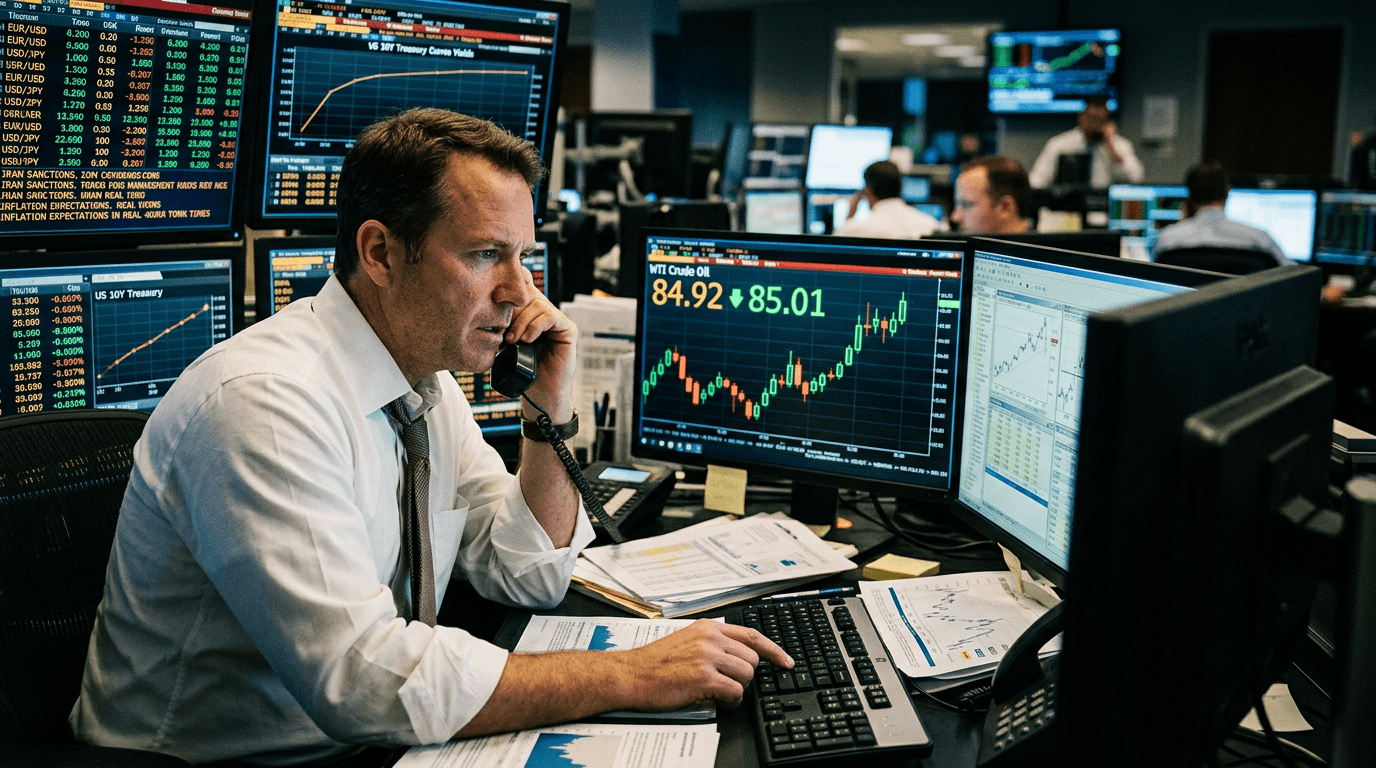
WTI crude is hovering around the $85 mark as markets count down to a new wave of US sanctions on Iran, a moment traders are already calling an “economic D‑Day.”[11][14] This combination of elevated prices and looming policy shock is amplifying volatility across the energy complex and feeding directly into expectations for inflation, growth, and central bank policy, with knock‑on effects that reach FX, rates, and equity risk sentiment.[7][13]
OIL AT $85: WHY THIS LEVEL MATTERS
In recent sessions, WTI futures have traded in the mid‑$80s, consolidating gains after a sharp run‑up driven by geopolitical tension and supply fears.[2][3][11] On the latest data, WTI was changing hands close to $85 as profit‑taking emerged ahead detailed sanction announcements, underscoring how sensitive the benchmark is to policy headlines.[14] This price zone is important because it sits above many breakeven levels for US shale and non‑OPEC producers, yet still below the triple‑digit extremes seen earlier in the Iran conflict, keeping the debate open on whether demand destruction or supply disruption will dominate the next leg.[9][15]
For macro traders, the $80–$90 corridor acts like a pressure gauge: high enough to threaten renewed energy‑driven inflation, but not yet so extreme that a global growth scare becomes the central narrative. At $85, input costs for transport, manufacturing, and agriculture are already being repriced, and options markets are reflecting increased tail‑risk hedging in case sanctions push crude toward the $100–$120 range highlighted by some analysts as a plausible scenario under continued Middle East strain.[9]
Iran Sanctions And The Supply Shock Narrative
The “economic D‑Day” framing reflects more than just one sanctions announcement. US policy toward Iran has oscillated between temporary waivers on crude exports and sudden reversals that tighten the screws on Tehran’s energy lifeline.[4][6][8] Recent moves include threats of sanctions on countries that continue trading with Iran, as well as talk of an indefinite naval blockade that would further constrain flows from the region and raise the risk of accidental escalation.[7][13]
These measures hit a market already dealing with strained logistics. Previous disruptions around the Strait of Hormuz and nearby chokepoints have at times removed an estimated 4.5–5 million barrels per day from available global supply, roughly 5% of output, even before full sanctions bite.[15] At the same time, Iran has been forced to sell crude at double‑digit discounts to benchmarks, and tighter enforcement could reduce even those discounted barrels, exacerbating the deficit.[10] Markets therefore see the sanctions “deadline” as a binary moment: either waivers and enforcement remain flexible, keeping barrels flowing at a discount, or a harder line crystallizes into a genuine supply shock.
The volatility around recent policy headlines illustrates how quickly futures curves can reprice these scenarios. WTI has repeatedly spiked above prior ranges on days when sanctions rhetoric intensifies or rules are tightened, then faded as waivers or partial relief are announced.[1][5][7] This pattern keeps implied volatility elevated and encourages traders to run shorter positioning horizons, reducing liquidity at precisely the time policymakers want orderly markets.
From Energy To Inflation, Fx And Rates
Energy prices are a direct input into headline CPI, and oil at or above $85 raises the odds that disinflation progress stalls or reverses in key economies. Even if core inflation remains relatively well‑behaved, a new wave of fuel and transport cost increases can lift inflation expectations, forcing central banks to reassess how quickly they can pivot toward easier policy. Market‑based gauges like breakeven inflation rates and inflation swaps typically track sustained moves in oil and refined products, especially when those moves are clearly policy‑driven rather than purely cyclical.
For FX markets, higher crude with sanction risk tends to support the currencies of net exporters while weighing on large importers that face deteriorating terms of trade. Petrocurrencies can gain as budget and current‑account positions improve, while energy‑sensitive EMs may see pressure on FX and local‑currency bond markets as investors price higher subsidy costs and weaker growth. The US dollar often behaves as a “safe‑haven” in periods of geopolitical oil shocks, even when the US itself faces higher energy prices, because global investors rotate into dollar assets amid broader risk aversion.
Rates markets connect these themes. If sanctions‑driven oil strength pushes up inflation expectations, long‑term yields may rise even as growth fears build, flattening or inverting curves depending on how aggressively traders expect central banks to respond. Elevated crude on the eve of sanctions makes it harder for policymakers to justify rate cuts and increases the premium investors demand for holding longer‑dated bonds in an uncertain macro regime.
Implications For Traders And Simulated Finance Participants
For discretionary and systematic traders alike, the Iran sanctions “D‑Day” is a classic macro event with multi‑asset implications. Crude futures, energy equities, tanker stocks, high‑yield credit in energy‑heavy indices, EM FX, and global rates are all part of the same narrative, and correlations can shift quickly as new information hits the tape.[7][13][9] Positioning across these instruments is already more cautious, with many desks preferring options structures over outright directional bets to manage gap risk around announcement timing.
In a SimFi environment, such as a simulated trading platform, this episode offers a high‑value testbed for strategy development. Participants can model different sanctions paths—strict enforcement, partial waivers, or diplomatic de‑escalation—and observe how WTI, breakeven inflation, USD crosses, and yield curves react under each scenario. Running these simulations without real capital at risk allows traders to stress‑test portfolio construction, hedging logic, and event‑driven playbooks before deploying in live markets.
PRACTICAL PLAYBOOK: HOW TO NAVIGATE ECONOMIC D‑DAY
Traders looking to navigate this period—whether in live or simulated markets—can focus on a few practical pillars:
1) Clarify the scenarios. Map out at least three distinct policy paths: aggressive sanctions with tight enforcement, sanctions with broad waivers, and a surprise softening tied to diplomatic progress. Each path should have explicit assumptions for lost supply, price targets for WTI and Brent, and expected volatility ranges.
2) Link energy to macro variables. For each oil scenario, specify implications for inflation expectations, central bank reaction functions, and FX and rates behavior. This forces a discipline of thinking in cross‑asset terms rather than treating crude as an isolated trade.
3) Use options and relative value. Around binary policy events, options spreads, calendar structures, and relative‑value trades between oil benchmarks or between energy equities and the underlying commodity can be more resilient than naked directional positions. Elevated implied volatility means option pricing itself is an informative signal of market fear.
4) Stress‑test liquidity and gaps. In simulations, incorporate slippage, wider bid‑ask spreads, and overnight gaps around announcement windows. In live markets, sizing and risk limits should assume that sanctions headlines can move oil and correlated assets several percent in minutes, as recent episodes have shown.[1][7][13]
Conclusion
WTI flirting with $85 on the eve of new Iran sanctions is more than an energy story; it is a macro inflection point that could reshape inflation trajectories, FX flows, and rates curves in the months ahead.[11][14] By treating the sanctions “economic D‑Day” as a structured set of scenarios rather than a single binary mystery, traders and SimFi participants can turn heightened volatility into a learning opportunity and, ultimately, a source of edge. The key is to connect the barrels in the ground to the prices on the screen—and to the policy decisions that will determine which path the global economy takes next.