
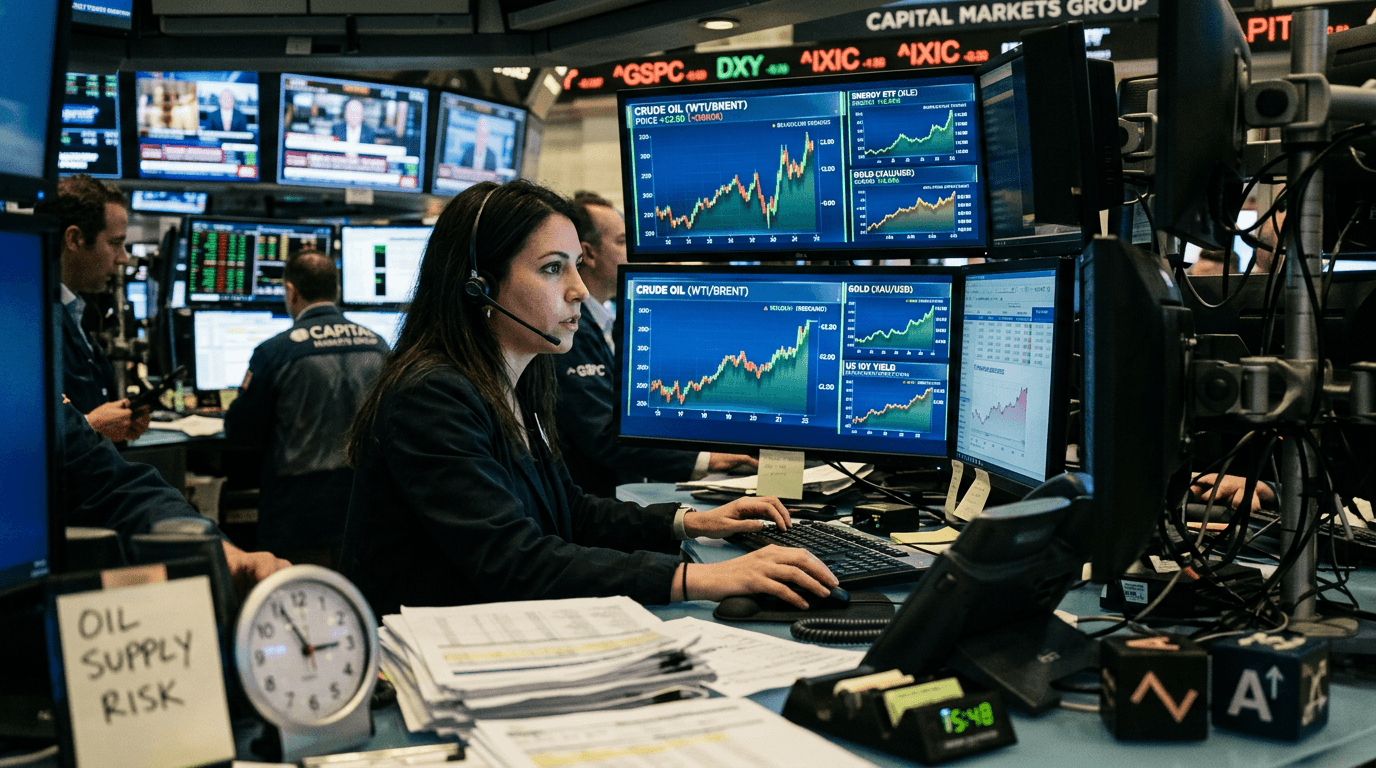
Oil has bounced back sharply as the Middle East war involving US and Iranian forces widens, reminding markets how quickly geopolitics can reprice energy risk and ripple through every major asset class.[5][3] As West Texas Intermediate (WTI) crude climbs back from recent lows, traders are seeing a familiar pattern: energy-linked assets are rallying, safe-haven demand is firm, and inflation expectations are being reassessed in real time.[5][10][12] For anyone trading live or in a simulated environment, understanding this chain reaction is essential to navigating the current landscape.
Why Oil Is Rebounding
The catalyst for the rebound is straightforward: the conflict in the Middle East is threatening key supply routes and production, injecting a new geopolitical risk premium into crude.[3][5][8] Reports of US and Iranian forces exchanging fire and Israeli operations expanding in the region have complicated peace negotiations and triggered what some analysts describe as the largest oil supply disruption in history.[5][3]
Physical flows are at the heart of the story. Iran’s decision to suspend shipping through the Strait of Hormuz—a corridor that carries roughly 20% of global oil and liquefied natural gas—has focused traders’ attention on worst-case scenarios where exports are heavily constrained for an extended period.[3][14] Fears around other regional producers and export facilities have only reinforced the sense that supply risk is now structural rather than transient.[3][10]
The price action reflects this shift. Brent and WTI have logged some of their strongest monthly gains in years, with moves in the double digits as markets rapidly reprice disruption risk.[10][5] The World Bank now projects energy prices to rise around 24% this year, driven largely by the shock to commodity markets from the Middle East war, and expects oil to average significantly higher than last year’s levels.[12] Even when prices pull back on ceasefire headlines or diplomatic overtures, the pattern has been one of buying the dip as traders reassess how durable any peace prospects really are.[6][7]
Market Reaction: Energy And Safe Havens
The immediate beneficiaries of higher crude prices have been energy-linked assets: oil futures, integrated oil majors, refiners, and select commodity currencies.[5][18] Downstream products like diesel and gasoline have also climbed, reflecting concerns about tighter supply and higher input costs for transportation and logistics.[5] In equity markets, energy and defense stocks have cushioned broader index declines, while travel and airline names have lagged on the prospect of higher fuel costs and disrupted regional demand.[18]
At the same time, the geopolitical backdrop has reinforced demand for traditional safe-haven assets. When headlines point to escalation rather than de-escalation, investors typically pivot into US Treasuries, gold, and defensive currencies, even as oil spikes.[1] Bond markets have shown periods of risk-off behavior in prior flare-ups, with yields retreating as investors seek safety and hedge against tail risks.[1] This flight to quality can coexist with higher energy prices, creating a complex macro mix where risk assets are pulled in opposite directions by earnings prospects and geopolitical anxiety.
For FX traders, this environment is especially nuanced. Higher oil tends to support currencies of major exporters while pressuring import-heavy economies, but safe-haven flows into the US dollar or Swiss franc can offset these traditional patterns.[12] That makes it dangerous to rely solely on historical correlations; in conflict-driven markets, positioning, sentiment, and policy expectations matter as much as fundamentals.
Inflation, Central Banks, And Rate Expectations
The rebound in oil prices is not just an energy story—it is an inflation story. Higher crude feeds directly into headline consumer price indices through fuel, transport, and production costs, and indirectly into core inflation via supply-chain and wage pass-throughs.[12] With energy prices projected to surge and remain elevated, central banks face renewed questions about whether inflation will stay above target for longer than previously anticipated.[12]
Market-based measures of rate expectations have already shown sensitivity to oil’s moves. When crude spikes, traders reassess how quickly policymakers can pivot to rate cuts without losing credibility on inflation.[10][12] If inflation risks look persistent rather than temporary, yield curves may re-steepen and long-term rates can rise as investors demand compensation for future price pressures.[12] Conversely, any sign that higher energy costs are eroding growth—through weaker consumption or tighter corporate margins—can push markets to price in slower trajectories for policy normalization.
For traders in both live and simulated environments, this is a prime example of how a single macro shock—oil—cascades into broader asset pricing. A move in one commodity can alter the expected path of interest rates, shift FX valuations, and change sector leadership in equities, often within days or even hours.
What Traders Should Watch Next
In an environment where news flow drives intraday volatility, a clear framework is critical. Short-term traders should focus on three clusters of information:
1) Geopolitical developments Ceasefire talks, troop movements, and announcements about military operations around key shipping lanes such as the Strait of Hormuz and the Red Sea are immediate catalysts for crude and related risk assets.[3][13][17] Unexpected escalations can trigger sharp, gap-style moves, while credible de-escalation signals can lead to fast reversals.[6][15]
2) Policy and coordination Market reaction to the conflict has already prompted coordinated responses such as historic releases of strategic oil reserves, with the International Energy Agency announcing plans to inject hundreds of millions of barrels into the market to dampen price spikes.[3] Traders should track statements from major producers, OPEC+ policy meetings, and any new supply commitments or sanctions that can shift the balance between scarcity and relief.
3) Data and positioning Inventory reports, demand indicators, and speculative positioning in futures provide clues about whether the current rally is driven more by fundamentals or fear.[2][4] When data confirms tightening supply and robust demand, price strength is more likely to be durable. When positioning looks crowded, even a modestly positive headline can trigger a sharp shakeout.
Implications For Simulated Traders And Practical Takeaways
For traders using SimFi platforms, this episode is an invaluable real-time case study in cross-asset dynamics. It offers the chance to test strategies in a risk-free environment while conditions are genuinely complex: oil is moving on geopolitics, inflation expectations are in flux, and safe-haven flows are interacting with sector rotation and FX volatility.[10][12][18]
A few practical takeaways stand out
- Build scenarios, not forecasts Rather than betting on a single outcome, design scenarios around escalation, partial de-escalation, and full ceasefire, and map out how each would affect oil, energy equities, safe havens, and rate expectations.[3][6][15]
- Respect correlation shifts In stress environments, historical correlations can break down. Simulated trading allows you to observe when typical relationships—such as oil and the dollar, or equities and bonds—temporarily invert.[1][12]
- Focus on risk management Large intraday moves around news can quickly invalidate tight stops or overly leveraged positions. Use simulations to practice scaling exposure, widening or tightening risk limits, and diversifying across asset classes rather than concentrating solely in crude.
Oil’s rebound on the back of Middle East conflict is a reminder that global markets remain highly sensitive to geopolitical shocks, especially when they strike critical energy hubs.[3][5][12] For traders, the goal is not to predict every headline but to understand how these shocks propagate through prices and to build robust frameworks that can adapt as the story evolves.