
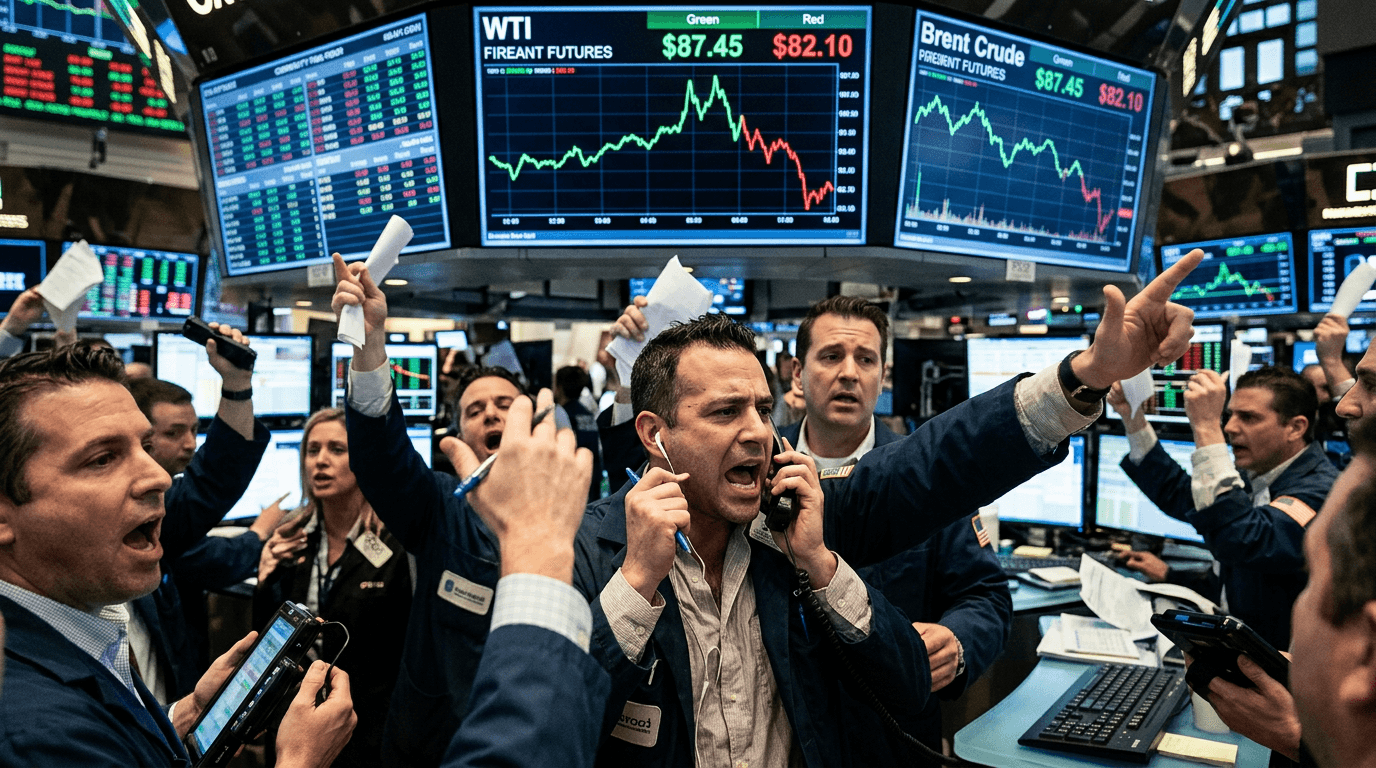
Oil traders were reminded again how quickly geopolitical risk can reprice crude when West Texas Intermediate (WTI) and Brent futures spiked on fresh U.S.–Iran war fears, only to retreat within hours on headlines hinting at peace talks and ceasefire extensions.[3][4][5] In a narrow window, energy markets swung from pricing supply disruption and inflation shock to discounting a more orderly path back to normal Middle East flows.[6][8]
Market Snapshot: From War Premium To Peace Discount
Each flare-up in the U.S.–Iran conflict has produced a familiar pattern: aggressive buying on initial headlines, followed by a sharp pullback as investors reassess how much disruption is truly likely.[3][4][6] Recent sessions saw intraday moves of more than 6%, with WTI surging into the mid-$70s and Brent pushing toward $80 as traders reacted to renewed strikes, threats to shipping, and talk of an extended war.[3][7]
Earlier in the conflict, U.S. crude futures jumped 7.5% while Brent climbed 6.2%, briefly trading above $82, after U.S. and Israeli strikes on Iran raised the risk of broader regional escalation.[4] On another day, WTI rallied 4.9% to around $73.89 and Brent 5.2% to about $78.02, both off intraday peaks above 6%, after U.S. strikes and a breakdown in a fragile truce.[3]
At the extreme, oil prices have posted some of their biggest moves in decades: futures were up as much as 29% intraday at one point, before closing nearer a 7% gain as talk of strategic reserve releases and coordinated G7 action cooled the panic bid.[6] Weekly gains above 30% in WTI and near 28% in Brent underscored just how powerful the war premium can become when investors fear sustained disruption in the Strait of Hormuz and regional production.[11]
Why War Risks Hit Crude Prices So Fast
The speed of these spikes is rooted in the structure of the global oil market. The Strait of Hormuz is one of the world’s most critical energy chokepoints, carrying a large share of seaborne crude exports from the Gulf.[11][12] When headlines suggest attacks on commercial vessels, a naval blockade, or prolonged hostilities, traders immediately model scenarios where physical volumes could be interrupted or rerouted.[3][7][11]
Futures markets translate those scenarios into prices via a geopolitical risk premium: an additional amount traders are willing to pay above what fundamentals alone would imply.[8][10] That premium tends to rise sharply when:
- Military activity escalates or ceasefires break down.[3][4][11]
- Shipping lanes like Hormuz are threatened or closed.[11][12]
- Major producers signal capacity constraints or cut output.[6]
Analysts have repeatedly warned that markets may be underpricing the tail risk of a prolonged conflict, even as Brent has tested four-year highs above $120–$125 and WTI has moved into triple-digit territory in some episodes.[1][9][10][11] In other words, even rapid spikes may still assume that war will end quickly and infrastructure will be largely preserved.[8][10]
Headlines That Deflate The War Premium
Just as quickly as the war premium can be built, it can be compressed when news flow shifts toward de-escalation. In recent months, key turning points have included reports that Washington and Tehran would pause hostilities, allow commercial vessels to transit the Strait of Hormuz more freely, and resume negotiations on ending the conflict.[5][12]
Following such announcements, both WTI and Brent have pulled back from their highs as traders recalibrate the probability of extended supply outages.[5][9][12] Brent, for example, surged to around $126 per barrel before retreating toward the low $110s once investors saw signs of diplomatic engagement and potential military restraint.[9] Similarly, when U.S. officials talked up technical talks and memoranda of understanding around the shipping corridor, futures gave back part of their recent gains.[5][12]
Policy responses also matter. Even without a formal peace deal, hints that the U.S. and G7 could tap strategic petroleum reserves, ease certain shipping regulations, or coordinate emergency supply measures have helped cool the most aggressive upside scenarios.[6][10] These signals don’t remove the risk of disruption, but they reassure markets that policymakers won’t remain passive in the face of runaway energy prices and inflation.
The Ripple Effect: Fx, Bonds, And Inflation Expectations
Oil is a global macro asset, so its war‑peace swings ripple far beyond energy futures. When WTI and Brent spike on conflict headlines, traders quickly reprice:
- Commodity‑linked currencies such as the Canadian dollar, Norwegian krone, and some emerging‑market FX, which tend to strengthen with higher oil revenues but can weaken on risk‑off sentiment.[6][7]
- Inflation expectations, especially in economies heavily dependent on imported fuel, pushing up breakeven rates and altering the path implied for central bank policy.[6]
- Equity sector performance, where energy producers and refiners often rally while transportation, airlines, and consumer‑discretionary names come under pressure.[4][10]
Conversely, when peace‑talk headlines hit, that complex unwinds. The inflation shock narrative softens, rate‑hike expectations can stabilize, and some of the defensive flows into energy and commodity‑linked FX reverse as investors rotate back toward growth assets.[6][8] These cross‑asset swings are often compressed into hours, not days, making event‑driven positioning both opportunistic and risky.
Trading Geopolitical Shocks In Simulated Markets
For active traders, this kind of environment is both attractive and dangerous. Volatility can create short‑term opportunities in oil futures, options, FX, and equity indices, but the path of prices hinges on political decisions and military developments that are impossible to model with precision.[4][6][8]
This is where simulated finance (SimFi) platforms are particularly valuable. In a risk‑free environment, traders can:
- Build and test playbooks for war‑driven oil spikes and peace‑driven reversals, including entry, exit, and position‑sizing rules.
- Practice trading around event windows, such as scheduled briefings, press conferences, or expected ceasefire announcements, without exposing real capital.[6][9][10]
- Explore cross‑asset strategies that link crude futures to FX pairs, inflation‑linked bonds, or sector indices, observing how correlations change as the conflict narrative evolves.[6][7]
By running these scenarios repeatedly, traders can refine discipline—such as respecting stop‑loss levels when headlines contradict positions, or avoiding over‑leveraging when volatility regimes shift suddenly. SimFi effectively turns a high‑risk live environment into a learning laboratory where mistakes are informative rather than costly.
Key Takeaways For Active Traders
Several lessons emerge from the latest WTI and Brent whipsaw:
First, geopolitical risk premiums can be built and destroyed in very short intervals, making static fundamental views insufficient in conflict periods.[6][8][9] Event awareness and scenario planning become essential.
Second, not all headlines are equal. Strikes and threats to strategic chokepoints deserve more attention than rhetoric alone, while credible reports of ceasefires, transit reopenings, or coordinated policy responses often mark turning points.[5][10][12]
Third, cross‑asset impacts matter. Oil is central to inflation, FX, and sector performance; trading crude in isolation misses opportunities and risks that arise elsewhere in the macro complex.[4][6][7]
Finally, complex environments reward preparation. Using simulated markets to rehearse war‑and‑peace scenarios, refine risk management, and test diversified strategies can help traders navigate real‑world volatility more calmly and systematically when it matters most.