
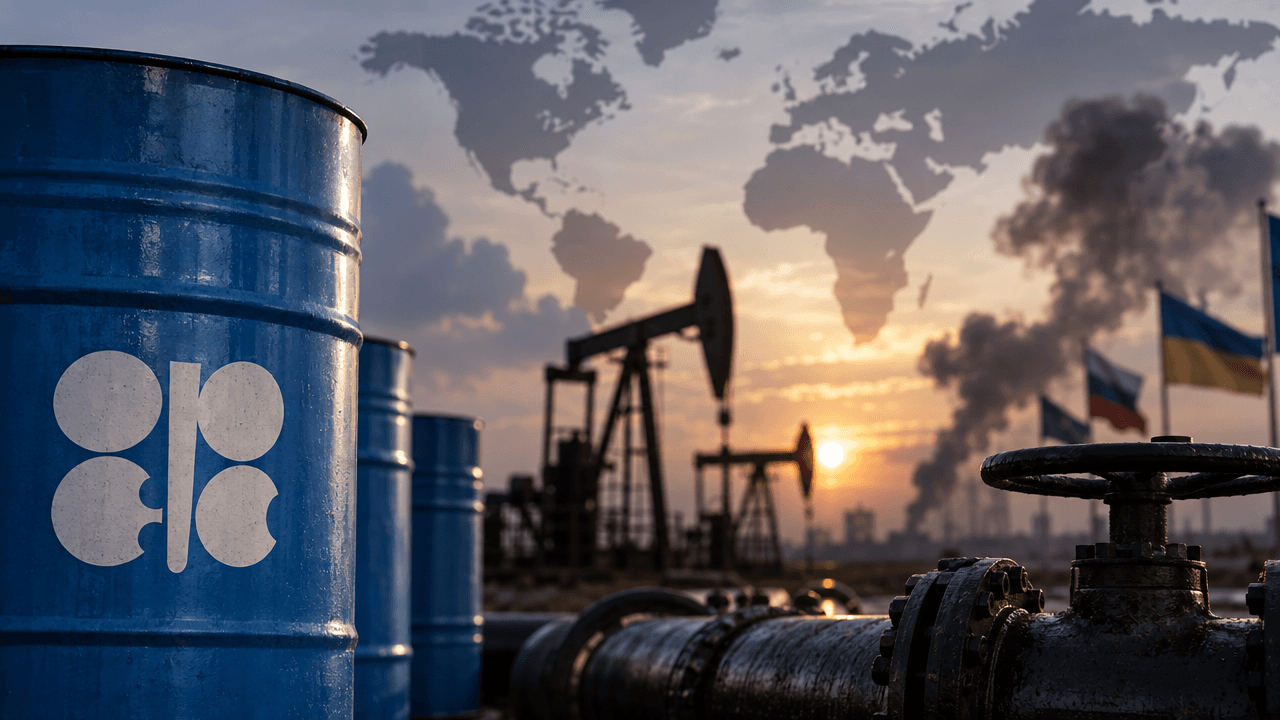
OPEC+ is expected to keep its December production targets unchanged, signaling that the alliance will pause further adjustments to its output policy until next year. The decision is broadly in line with market expectations, but its effect on oil prices may be less straightforward than the headline suggests. Since several members are already producing below their assigned targets, unchanged quotas do not necessarily mean unchanged physical supply. [1]
For traders, the key issue is not only what OPEC+ says it plans to produce, but how much crude is actually reaching the market. With geopolitical tensions disrupting supply routes and increasing uncertainty around exports, the balance between official targets, real-world production and risk premiums will remain central to oil-market pricing.
WHAT THE OPEC+ DECISION MEANS
The agreement involves seven major producers: Saudi Arabia, Russia, Iraq, Kuwait, Kazakhstan, Algeria and Oman. Their December requirements are expected to remain at the levels established for November, which were based on September production requirements. Reported November targets include approximately 10.478 million barrels per day for Saudi Arabia, 9.949 million for Russia and 4.431 million for Iraq. [2]
This is best understood as a policy pause rather than a major new supply decision. OPEC+ is maintaining the existing framework while attention turns toward negotiations over production quotas for 2027. The group also continues to carry an additional layer of cuts totaling roughly 2 million barrels per day for most members through the end of 2026. [4]
Keeping targets unchanged gives producers and consumers greater short-term visibility. It also avoids introducing a fresh policy surprise at a time when markets are already dealing with geopolitical uncertainty, disrupted exports and sharp fluctuations in crude prices.
Why The Immediate Supply Impact May Be Limited
Production targets are not the same as production volumes. A quota can indicate how much a country is permitted or expected to produce, but actual output depends on infrastructure, transportation access, export capacity, domestic demand and security conditions.
Recent reporting indicates that many OPEC+ members are producing below their assigned targets. As a result, leaving the targets unchanged may not create a large increase or decrease in barrels immediately available to global buyers. [7]
This distinction is important for interpreting the market reaction. If producers were already unable to reach their quotas, a decision to preserve those quotas does not automatically add supply. Conversely, if disrupted producers restore operations quickly, actual exports could rise even without a formal target increase.
Gulf producers have reportedly been increasing exports after months of disruption linked to the conflict involving Iran. Additional shipments could help relieve some short-term supply pressure and limit further price gains. However, the scale and reliability of those exports remain more important than the unchanged quota language itself. [9]
Geopolitics May Matter More Than Quotas
The largest near-term oil-price driver may be geopolitical risk rather than the OPEC+ announcement. Oil prices rose more than 2% on Friday, with Brent crude settling at $117.64 per barrel after reaching $118, as traders assessed the possibility of further escalation in the region. [1]
Energy markets often price the risk of future disruption before a physical shortage appears. A threat to production facilities, shipping lanes or export terminals can lift crude prices because buyers demand compensation for uncertainty. If tensions ease, that risk premium can unwind quickly. If disruptions expand, prices may rise even while official production targets remain unchanged.
This creates a market environment where headline supply policy and actual price direction can diverge. A steady OPEC+ decision may appear neutral, but oil can still move sharply in response to diplomatic developments, military activity, insurance costs or changes in shipping through strategically important waterways.
What Traders Should Watch Next
First, monitor actual production and export data rather than relying only on official quotas. The gap between assigned targets and delivered barrels can reveal whether the market is genuinely tightening or simply operating below capacity.
Second, watch the durability of Gulf export increases. If additional exports continue, they could partially offset disrupted supply and reduce pressure on crude prices. If the improvement proves temporary, the market may quickly refocus on shortages and logistical risks.
Third, track the structure of the futures market. A strengthening premium for near-term contracts can indicate immediate supply concerns, while a weaker structure may suggest that traders expect disruptions to fade or supply to recover.
Finally, keep the 2027 quota discussions on the radar. Once OPEC+ begins negotiating next year’s framework, debates over market share, compliance and production capacity could become more significant than the December rollover. The current agreement may therefore represent a temporary holding pattern before a more consequential policy debate.
Practical Takeaways For Simfi Traders
Treat the announcement as a confirmation of expectations, not automatically as a bullish or bearish shock.
Separate production targets from actual output, exports and available inventory.
Use geopolitical headlines as potential volatility catalysts, especially when prices are already elevated.
Avoid assuming that a price jump will continue without confirmation from physical supply data.
Plan for rapid reversals because oil’s risk premium can change quickly when diplomatic or military conditions shift.
Conclusion
OPEC+ is expected to maintain its December production targets, but the decision alone may have a limited immediate effect on physical oil supply. Several members are already producing below quota, while a major layer of cuts remains in place through the end of 2026. [1]
That leaves geopolitics, export recovery and the credibility of supply routes as the most important variables for oil traders. For SimFi participants, the strongest approach is to look beyond the headline: compare targets with real production, monitor the futures curve and manage risk around events that can rapidly reshape market expectations. The December decision provides stability on paper, but the oil market remains highly sensitive to what happens beyond the quota table.