
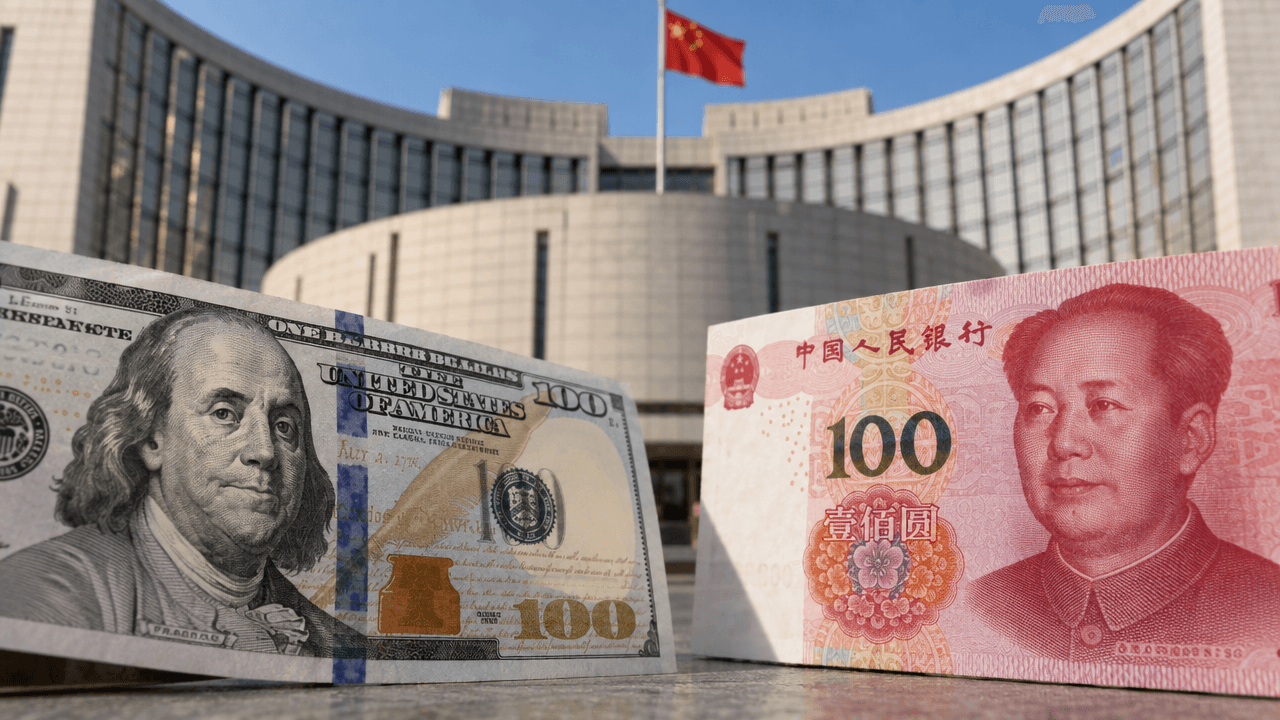
China’s central bank has added a fresh layer of nuance to the yuan story by setting the USD/CNY central parity at 6.7411, noticeably above the market estimate of 6.7177 and slightly above the previous fixing at 6.7399[1][2]. For traders, that difference of a few dozen pips is not noise; it is a deliberate signal about how the People’s Bank of China (PBOC) wants the currency to trade in the days ahead[1][2].
By guiding the midpoint higher than consensus models implied, the PBOC is effectively indicating a willingness to temper the pace of recent yuan strength while still keeping the currency near its firm levels versus the dollar[1][2][14]. In an environment where the yuan has been trading around multi‑year highs against the dollar, such a move suggests policymakers are focused on controlled, orderly price action rather than a one‑way appreciation trend[6][10][13][14].
WHAT HAPPENED IN TODAY’S FIXING
The daily USD/CNY fixing is the anchor of China’s onshore foreign‑exchange regime, set each morning by the PBOC based on quotes from banks, market conditions, and policy considerations[5][7][11]. Spot USD/CNY can then trade within a band of plus or minus roughly 2% around that midpoint, giving the central bank flexibility to lean against market moves while still allowing some two‑way volatility[5][7][11][15]. Today’s fixing at 6.7411 gives traders a reference point that is modestly more dollar‑friendly than forecasts implied, nudging the yuan weaker relative to expectations[1][2].
This contrasts with episodes where authorities have set the fixing significantly stronger than models suggested in order to arrest sharp yuan declines[5][7][9]. In 2023 and 2024, for example, the PBOC issued fixings with the widest recorded gaps versus market estimates, clearly signaling discomfort with the pace of depreciation and a desire to stabilize sentiment[5][7]. Today’s deviation is smaller but still noteworthy, and in the opposite direction: it looks more like an effort to slow further yuan gains, similar to recent instances where the fixing was set weaker than projected to moderate appreciation[12].
WHY THE PBOC’S FIX MATTERS
The fixing is one of the PBOC’s most precise tools for steering currency expectations because it is observed daily and sits at the intersection of policy and price[4][5][7]. When the midpoint aligns closely with market estimates, traders infer that authorities are broadly comfortable with existing trends[4][14]. When the midpoint diverges—either much stronger or much weaker than models—the signal is that policymakers want to lean against those trends[5][7][12]. Over time, this creates a feedback loop where the fixing surprise itself becomes a tradable input.
History shows how powerful this mechanism can be. Stronger‑than‑expected fixings have been used to yank the yuan off multi‑year lows and counter disorderly depreciation episodes, including one record‑setting bias that flagged the central bank’s determination to support the currency[7][9]. Similarly, weaker‑than‑expected fixings have been deployed to slow rapid yuan rallies, keeping export competitiveness in focus and discouraging speculative one‑way bets[4][12]. In both directions, the midpoint acts as a subtle but effective communication channel.
For global investors, the fixing also offers insight into broader policy priorities: balancing growth and financial stability, managing capital flows, and aligning domestic objectives with external pressures[4][5]. A small shift today may reflect concerns about the impact of too‑rapid yuan strength on exporters, as well as a desire to avoid the perception that the currency is being driven solely by speculative flows and dollar weakness[6][10][13].
Impact On Yuan Positioning And Asia Fx
Positioning in the yuan has turned increasingly constructive in recent months as firmer fixings and robust export flows helped push the currency toward its strongest levels since 2022–2023[6][8][10][13]. Episodes where the PBOC repeatedly strengthened the fixing across consecutive sessions were interpreted as a green light for moderate yuan appreciation, supporting broader Asia FX and risk sentiment[6][10][13]. Against that backdrop, today’s higher‑than‑expected USD/CNY midpoint sends a more cautious message to aggressive yuan bulls[1][2].
For speculative accounts, this can trigger a reassessment of long yuan exposure. A fixing surprise that leans toward a weaker yuan, even modestly, may prompt profit‑taking in crowded positions and reduce appetite for adding new longs at current levels[1][2][12]. That, in turn, can spill over into other Asia currencies that have benefitted from the yuan’s strength, encouraging a pause or consolidation in regional FX rallies as traders watch whether this is a one‑off adjustment or the start of a new pattern[6][8][10].
Corporates and real‑money investors take a different angle. Exporters may welcome signals that the central bank is reluctant to let the yuan appreciate unchecked, while importers and offshore borrowers might see this as a reminder to keep hedging programs active[5][12]. In both cases, the fixing serves as an early indicator of how much currency volatility policymakers are willing to tolerate around key macro events.
How Traders Can Respond On Simulated Markets
For participants on simulated finance platforms, the PBOC fixing is a rich source of trading scenarios without the capital risk that comes with live markets. One practical approach is to build a “fixing surprise” framework: compare the daily midpoint to consensus estimates, categorize the surprise by direction and magnitude, and study how USD/CNY trades intraday in each regime[1][2][5]. Over time, this helps reveal whether stronger‑than‑expected or weaker‑than‑expected fixings tend to produce directional moves, mean reversion, or merely volatility spikes.
Another avenue is to structure virtual trades around the 2% band in which spot yuan is allowed to trade[5][7][11][15]. Traders can simulate breakout strategies that seek to exploit moves toward the edges of the band when the fixing surprise is large, versus range‑trading strategies when the midpoint closely matches expectations. Because simulated environments allow repeated iteration, it becomes easier to refine rules for entries, exits