
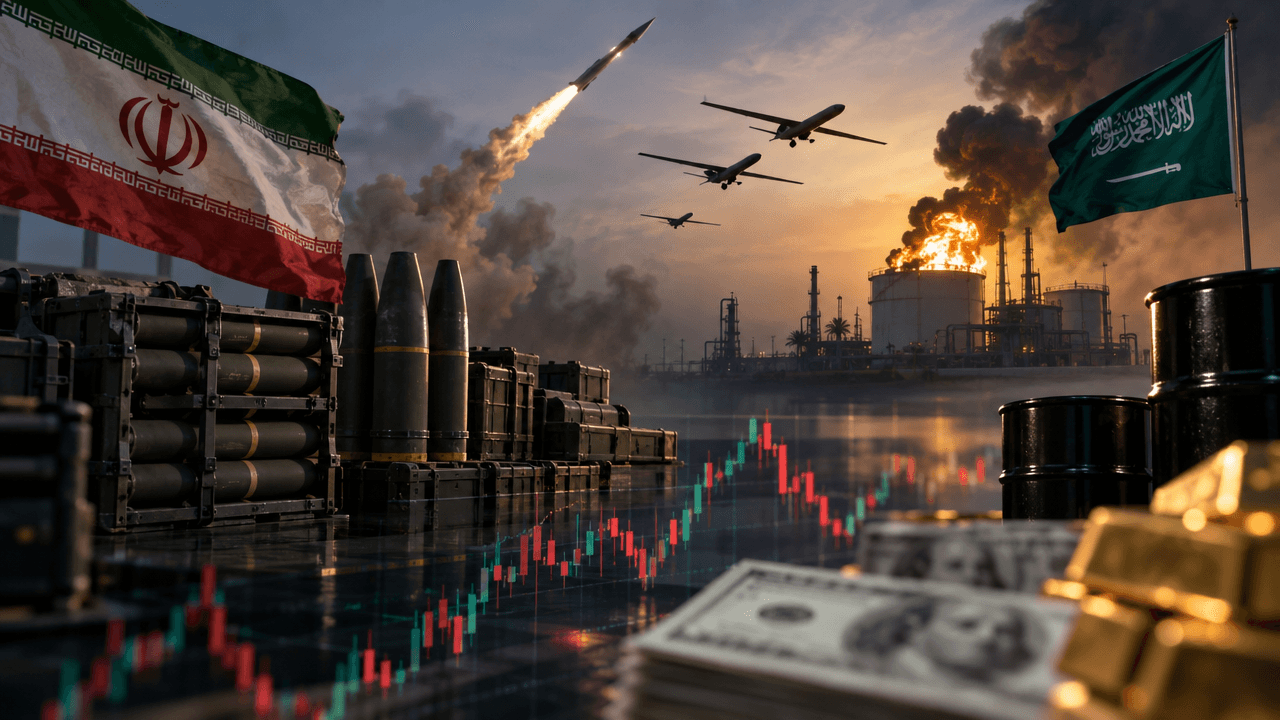
Geopolitical risk is once again front and center for energy and defense markets as the Pentagon confirms Iran’s war munitions shortages and Iran‑aligned Houthi forces intensify attacks on Saudi Arabia. Combined, these developments are pushing traders to re‑price the probability of supply disruptions and military escalation, supporting higher risk premiums in crude oil, defense equities, and related index futures while reinforcing safe‑haven flows in key currencies.
Geopolitical Flashpoints Driving Risk Premium
Recent Houthi attacks have targeted multiple southern Saudi cities, using drones and ballistic missiles against civilian areas, military sites, and energy infrastructure.[2][9][11] These strikes have wounded more than 70 people in some incidents and ignited fires at oil facilities and utilities, underscoring the vulnerability of key energy assets in the region.[7][11][13]
Reporting also highlights temporary halts or disruptions at energy facilities in southern Saudi Arabia after strikes on cities such as Abha, Jazan, Khamis Mushait, and Najran.[2][15] Such interruptions may be short‑lived in operational terms, but they carry outsized psychological impact for markets that remain highly sensitive to any threat around critical production hubs and transport routes.
For traders, these events matter less for the immediate barrels taken offline and more for the probability that further escalation could target larger oil facilities or key chokepoints like the Red Sea and Bab al‑Mandab.[6][13][15] That scenario risk is what drives the “geopolitical premium” layered on top of fundamental supply‑demand pricing.
Energy Markets: Risk Premium Back In The Barrel
Crude futures typically react quickly to credible threats against major producers, and the latest wave of Houthi attacks on Saudi oil infrastructure has reinforced upside support for prices.[1][6][7] Fires at facilities and temporary disruptions remind the market that physical assets are within range of missiles and drones, even if core export capacity remains intact.[7][11][13]
These events tend to show up in the shape of the futures curve. Front‑month contracts may outperform longer‑dated ones as traders price near‑term disruption risk, while calendar spreads can widen as refineries and physical traders hedge supply uncertainty. In periods of sustained tension, markets may move into steeper backwardation as buyers pay more for prompt barrels relative to future delivery.
Petrocurrencies—those of energy‑exporting nations—often benefit from higher oil prices and renewed geopolitical risk, as improved terms of trade and cash‑flow expectations support their FX profiles. At the same time, importing economies face the dual challenge of higher energy costs and greater macro uncertainty, which can weigh on their currencies and boost inflation expectations.
Defense Sector And Munitions Shortages
On the defense side, confirmation that Iran is experiencing war munitions shortages sits alongside reports that the United States is grappling with its own munitions stockpile constraints and production bottlenecks linked to the conflict.[8][10] The Pentagon has urged faster weapons production and accelerated procurement processes to rebuild inventories, signaling sustained demand for missiles, drones, and precision‑guided munitions.[8][10]
For defense‑related equities, this backdrop is supportive on several fronts. Elevated geopolitical tension tends to underpin orders for air defense systems, intelligence and surveillance platforms, and missile interceptors, while munitions shortages highlight structural capacity gaps in the industrial base. Companies positioned in these supply chains—from prime contractors to component manufacturers—may see multi‑year visibility on demand as governments prioritize replenishment and modernization.
Investors also pay attention to budget signaling. When the Pentagon stresses the need to rebuild munitions stockpiles and modernize production, it tends to feed into expectations for higher future defense spending and more stable cash flows for contractors.[8][10] That perceived durability of demand can reduce cyclical risk in the sector, contributing to a higher valuation premium relative to the broader market.
INDEX FUTURES AND FX: CROSS‑ASSET SIGNALS
The combination of energy risk and defense tailwinds often shows up in index futures through sector rotation. Contracts tied to benchmarks with heavy energy and defense weightings can outperform as traders re‑allocate from more cyclical or rate‑sensitive sectors into names perceived as geopolitical beneficiaries.
At the same time, FX markets tend to reflect the broader risk environment. Safe‑haven currencies such as the US dollar, Swiss franc, and Japanese yen typically see increased demand during periods of elevated geopolitical tension, particularly when conflicts involve key energy routes and US military engagement. Stronger petrocurrencies and firmer safe‑havens can occur side by side, reflecting both the commodity shock and the risk‑off mood.
For multi‑asset traders, the key is to read these moves not as isolated reactions, but as a network of signals. If oil prices firm, defense stocks rally, sector‑tilted index futures outperform, and safe‑haven currencies strengthen simultaneously, the market is clearly assigning a meaningful probability to further escalation and supply or security disruptions.
How Simulated Traders Can Navigate The Geopolitical Risk Premium
For SimFi participants and active traders, the current environment offers a practical case study in how geopolitics translates into cross‑asset pricing.
1. Connect events to assets. Map Houthi attacks and munitions shortages to specific instruments: crude futures, energy equities, defense stocks, sector index futures, and key FX pairs. This builds the habit of turning headlines into a structured trading watchlist.
2. Separate fundamental and risk premiums. Identify how much of the move in oil or defense equities appears driven by macro fundamentals versus geopolitical risk. In simulation, experiment with scenarios where tensions either ease or escalate and observe how the premium compresses or expands.
3. Monitor correlations and regime shifts. During heightened geopolitical stress, correlations can change quickly—energy and defense may decouple from broader indices, while safe‑haven FX diverges from normal macro drivers. Track how these relationships evolve as new information emerges.
4. Practice risk management around event risk. Even in a simulated environment, treat geopolitical catalysts as scheduled and unscheduled events that can trigger gaps and volatility. Test position sizing, hedging strategies, and stop‑loss placement in scenarios where headlines break outside normal trading hours.
Ultimately, the current combination of Iran’s munitions constraints and rising Houthi activity against Saudi assets illustrates how modern markets continuously re‑price geopolitical uncertainty. Energy and defense sectors sit at the heart of this adjustment, but the ripple effects extend across indices and FX, offering a rich learning landscape for traders. By systematically linking events to assets, understanding how risk premiums form, and stress‑testing cross‑asset scenarios, SimFi participants can build more robust frameworks for navigating an increasingly complex geopolitical market regime.