
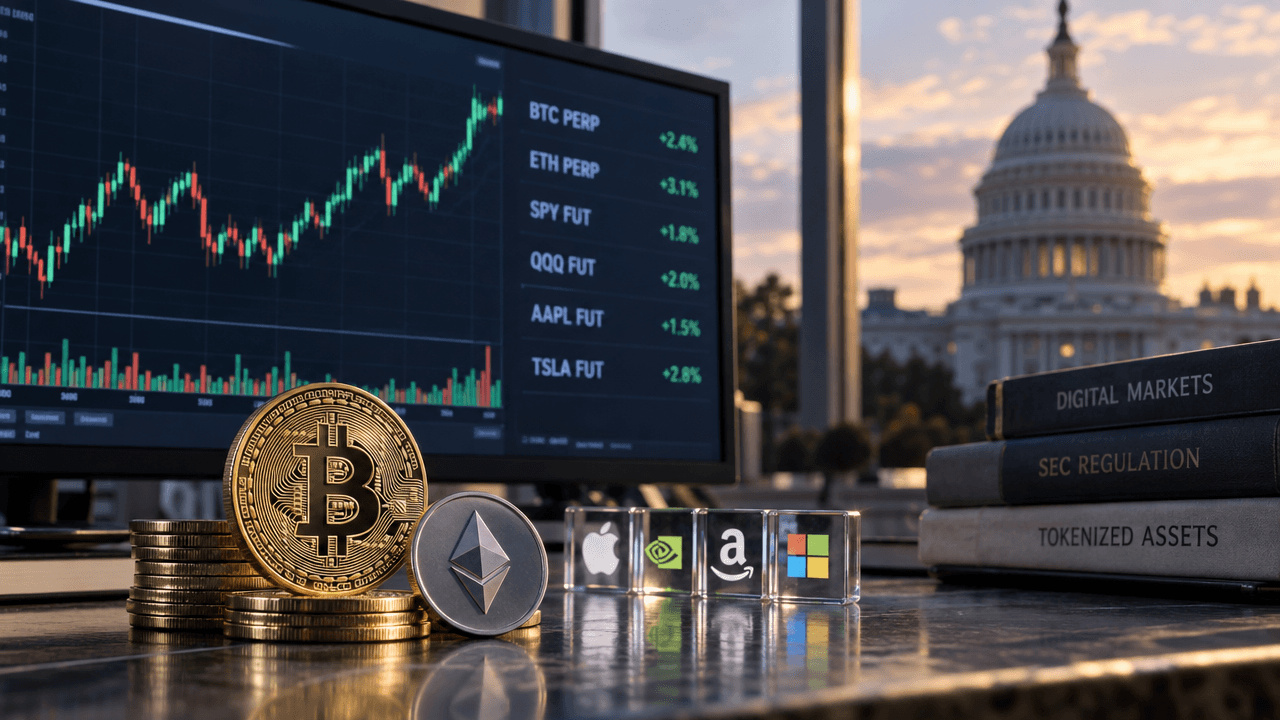
The U.S. crypto and derivatives landscape is entering a new phase, as perpetual futures on individual stocks and ETFs converge with a five-year regulatory pathway for on-chain trading of tokenized U.S. equities.[7][11][15] Together, these developments point to a future where traditional securities, digital assets, and derivatives increasingly share the same infrastructure and design patterns.[2][8][13]
STRUCTURAL SHIFT IN U.S. DIGITAL-ASSET DERIVATIVES
Kalshi and other venues have already brought crypto-style perpetual futures into the regulated U.S. environment for assets such as Bitcoin, Ethereum, gold, and silver, following approvals from the Commodity Futures Trading Commission (CFTC).[3][10][14] The latest step is the reported filing of listing standards for perpetual security futures linked to dozens of individual U.S. stocks and ETFs, effectively extending the “perps” model from crypto into traditional equities.[7][13][14] These contracts are designed to be cash-settled, offer leverage, and provide continuous long and short exposure without transferring ownership of the underlying shares.[7][13] Traders gain price exposure but not voting rights or dividends, aligning the product more closely with synthetic exposure than spot ownership.[7][13]
On centralized crypto exchanges, stock and index perpetuals have already become a major category, with trading volumes in stock-linked perpetual futures reportedly reaching hundreds of billions of dollars per month in 2026.[5][12][13] The move to bring similar structures onshore under U.S. oversight is therefore less about invention and more about migration—importing a proven derivatives format from offshore crypto venues into a U.S.-regulated framework.[7][14] For market participants, this means familiar crypto mechanics like funding rates and 24/7 price discovery could increasingly apply to regulated equity-linked products.[6][7]
How Perpetual Stock And Etf Futures Work
Perpetual futures differ from traditional futures in one critical way: they have no fixed expiry date.[6][7] Instead of settling on a predetermined day, positions can be held indefinitely as long as margin requirements are met, making them well suited to continuous trading environments and short-term speculation.[6][7] To keep contract prices aligned with the underlying stock or ETF, venues use a funding rate mechanism—periodic payments between longs and shorts based on the gap between the perp price and a reference index.[6][7] When the perpetual trades above spot, longs typically pay shorts; when it trades below, shorts pay longs, pulling the perp price back toward the underlying.[6][7]
For stock and ETF perpetuals, margin is usually posted in stablecoins or cash equivalents, and gains or losses are realized through mark-to-market and funding payments rather than physical share delivery.[5][6][13] Because there is no expiration date, traders avoid the need to roll contracts forward, which is common in traditional equity index futures.[6][7] Instead, risk management focuses on leverage, volatility, and funding rate dynamics—elements that should be front and center in any simulated or live trading strategy using these instruments.
Key practical implications for traders include understanding how funding can turn a seemingly profitable directional position into a less attractive trade over time, and how sharp moves in the underlying stock or ETF can trigger rapid liquidations when leverage is high.[6][7] In a SimFi environment, these features can be modeled explicitly, allowing traders to stress-test strategies across different volatility regimes and funding scenarios without capital at risk.
Sec's Five-year Pathway For Tokenized Equities
Parallel to the derivatives innovation, the U.S. Securities and Exchange Commission has granted a temporary, conditional “Innovation Exemption” to a new category of venues that trade tokenized U.S. equities on-chain.[2][11][15] Under this relief, Tokenized Securities Venues can facilitate secondary trading in genuine tokenized National Market System stocks using permissioned automated market makers and liquidity pools, without being treated as full-fledged exchanges under the Exchange Act.[2][4][11] The exemption lasts for five years from publication, giving regulators and industry time to observe real-world behavior and iterate on the framework.[2][11][15]
The order is intentionally narrow and heavily conditioned.[8][9][11] Venues may list only a capped set of Tier 1 symbols, including names from the S&P 500 and Russell 1000 plus certain exchange-traded products, and average daily volume in any symbol cannot exceed a small fraction of consolidated market volume.[8][9] Participants must be verified, and the automated market makers and liquidity pools operate in a permissioned fashion rather than as fully open DeFi protocols.[2][8][9] In effect, the SEC is opening a controlled testbed for on-chain equity trading while limiting systemic risk and preserving the primacy of traditional exchanges.[2][4][11]
From a structural perspective, combining tokenized equities with perpetual futures on stocks and ETFs creates the building blocks of a hybrid market: spot-like exposure in tokenized form, synthetic exposure via perps, and a shared settlement and data layer on public blockchains.[2][7][8] For traders, this opens the door to cross-market strategies such as basis trades between tokenized spot and perpetual futures, or relative-value trades between on-chain liquidity pools and traditional order books—at least in jurisdictions and venues where such activity is permitted.
Implications For Simulated Finance Platforms
Simulated finance platforms like E8 Markets are uniquely positioned to help traders navigate this evolving market structure because they can integrate the mechanics of perpetual stock and ETF futures alongside tokenized equity models without the constraints of live capital, custody, or licensing.[5][6][13] By mirroring features such as funding rates, leverage limits, and on-chain settlement windows in a simulated environment, traders can experiment with strategies that bridge spot, perp, and tokenized markets.[6][7][8]
For example, a SimFi environment can allow users to:
Design and test funding-neutral strategies that aim to profit from microstructure inefficiencies rather than outright direction.
Model how regulatory volume caps and permissioned liquidity pools could affect slippage, spreads, and execution quality in tokenized equities.[2][8][9]
Explore hedging frameworks that pair perpetual stock futures with simulated portfolios of tokenized equities or ETFs, assessing how well these tools offset risk across different market regimes.[6][7][11]
Because the SEC’s pathway is time-limited and highly constrained, the live market may evolve unevenly, with liquidity fragmented across venues and products.[2][8][15] SimFi can help traders prepare for that reality as well, by simulating fragmented order flow and varying levels of depth in different instruments, so users learn to manage execution risk, not just price risk.
What Traders Should Watch Next
For active traders and firms watching these developments, several themes merit close attention.
First, product design: the precise parameters of proposed U.S. perpetual stock and ETF futures—eligible symbols, leverage limits, margin currencies, and funding rate formulas—will shape how useful the contracts are for hedging and alpha generation.[6][7][13] Second, regulatory evolution: the SEC’s innovation exemption is explicitly temporary, and future rulemaking or enforcement could either broaden the pathway for tokenized equities or narrow it depending on observed outcomes.[2][11][15]
Third, liquidity and market data: the viability of any new derivative or tokenized product depends on robust price discovery and sufficient depth.[5][12][13] Traders should monitor how volumes build over time in both on-chain tokenized stocks and regulated perpetual futures, and how these new venues integrate with existing data feeds and risk systems.[5][8][12] Finally, cross-venue arbitrage and basis: as more instruments reference the same underlying stocks and ETFs across spot, tokenized, and derivatives markets, basis relationships will become more complex but also more opportunity-rich for those who understand the mechanics.[6][7][8]
In summary, the convergence of perpetual stock and ETF futures with a controlled pathway for on-chain trading of tokenized U.S. equities marks a meaningful advance in U.S. crypto-market structure, even if volumes and product scope remain limited at first.[2][7][11] Traders who use simulated environments to learn these new mechanics—funding dynamics, tokenized settlement, and cross-market basis—will be better positioned if and when these innovations scale into mainstream market infrastructure.