
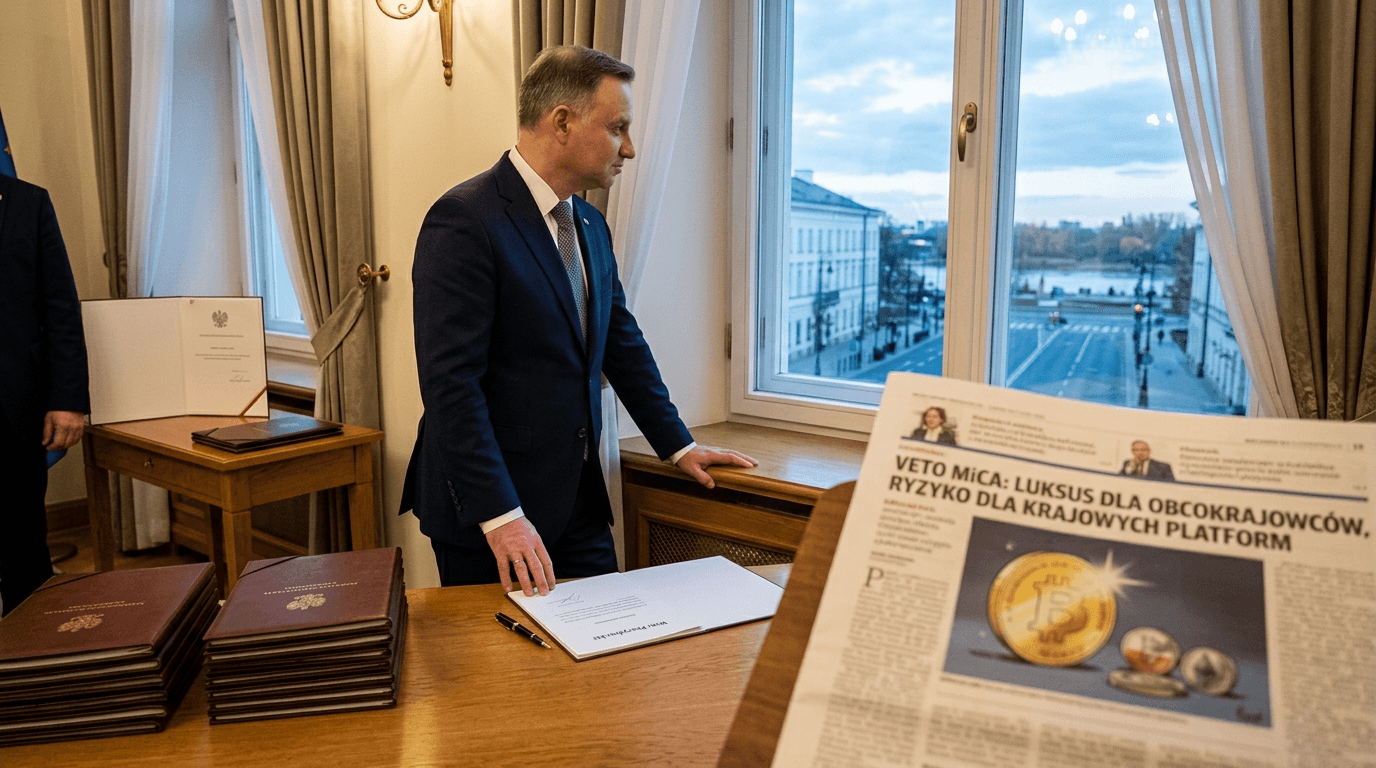
Regulatory risk has jumped back into the spotlight for crypto markets as Poland’s political standoff over digital asset rules stretches into overtime, leaving a licensing gap that favors foreign EU‑authorized firms over domestic players. This widening divide between national politics and EU‑level regulation is becoming a real-world case study in how legal uncertainty can reshape market structure, competitive dynamics, and investor behavior.
Regulatory Limbo In Poland
Poland has spent more than a year trying to pass a law that would regulate its crypto‑assets market and transpose the European Union’s Markets in Crypto‑Assets (MiCA) framework into national legislation.[5][9] President Karol Nawrocki has repeatedly vetoed these bills, arguing that the measures threaten property rights, individual liberties, and the stability of the state.[9][14] Each veto sends the bill back to parliament, which needs a three‑fifths majority to override the president’s decision—a threshold lawmakers recently failed to reach, keeping the veto in place.[10][12] As a result, Poland remains the only EU member state without a functioning national framework to implement MiCA and supervise crypto‑asset service providers (CASPs).[6][12]
The political backdrop is complicated by domestic scandals and concerns around fraud and criminal activity involving major crypto firms, which Nawrocki cites as evidence that the proposed laws do not adequately address core risks.[7][11] In practice, however, the absence of any implemented framework leaves the market in limbo: regulators cannot fully license or oversee domestic platforms, while foreign firms benefit from EU‑level clarity. The tension between security, freedom, and competitiveness is now playing out in real time—and traders need to pay attention.
Understanding The Licensing Gap
At the heart of the current tension is the “licensing gap”: Polish crypto businesses cannot obtain MiCA‑compliant licenses on home soil because the national implementing law has not entered into force.[5][12][13] Without a signed law, Poland has not formally designated a competent supervisory authority or empowered its Financial Supervision Authority (KNF) to issue CASP licenses.[5][13] The KNF has warned that, after the EU transition deadline of July 1, 2026, domestic platforms may lose the ability to secure the licenses required under MiCA.[5][6]
In contrast, crypto firms licensed in other EU jurisdictions will be able to passport their authorization into Poland under MiCA’s single‑market rules.[6][10] That means EU‑authorized exchanges and service providers can serve Polish clients, while locally based firms are stuck in a regulatory vacuum: they cannot obtain new permits at home, nor demonstrate full compliance with EU standards.[6][13] The result is a structural disadvantage for domestic operators and a redistribution of market share toward firms regulated elsewhere in the bloc.
For market participants, this licensing gap is not just a legal nuance—it changes who can compete, who can innovate, and who controls key parts of the crypto value chain in Poland. It also raises a broader question: to what extent can national politics slow, or even reshape, the rollout of harmonized digital asset rules in the EU?
Impact On Global Crypto Markets
While Poland is a single market, its situation reverberates more widely because MiCA is meant to be a flagship example of coordinated crypto regulation across a major economic bloc. With most EU states moving ahead, Poland’s repeated vetoes stand out as a high‑profile deviation from the trend toward harmonization.[6][12] Global exchanges and institutional players planning European strategies must now factor in the risk that some markets will lag behind, creating pockets of regulatory arbitrage and uneven competitive conditions.
For exchanges, the immediate implication is strategic: EU‑licensed platforms may see Poland as an attractive expansion opportunity, given reduced competition from fully regulated domestic rivals.[6][10] DeFi projects, payment service providers, and custodians could also view Poland as a market to approach via EU passporting rather than local setup, at least until national legislation catches up. This shift can change liquidity patterns, as trading volumes migrate to platforms that can operate under clear rules and consumer protections.
For global regulators and policymakers, Poland’s standoff is a warning signal. It shows that even when high‑level frameworks such as MiCA exist, political resistance at the national level can slow implementation and complicate enforcement. This tension adds another layer to the already complex landscape of global crypto regulation, where the United States, Asia, and Europe are all pursuing different approaches to licensing, stablecoins, and market oversight.
What It Means For Traders And Firms
For traders, the most immediate takeaway is that regulatory risk is not abstract—it can directly influence access to platforms, product offerings, and the safety of funds. In Poland, traders are likely to see greater reliance on EU‑authorized foreign exchanges that can passport their licenses, while home‑grown platforms may face constraints or even exit scenarios if they cannot secure compliant authorization.[6][10][13] This asymmetry makes due diligence more important: understanding where a platform is licensed, which regulator supervises it, and how MiCA rules are applied becomes a key part of risk management.
For Polish crypto firms, the veto‑driven delay forces strategic decisions. Some may seek licenses in other EU jurisdictions and operate in Poland via passporting, effectively “offshoring” their regulatory home.[6][12] Others may pivot to niche services, limit their activities, or focus on international markets where licensing is clearer. The cost of uncertainty is real: stalled product development, higher legal expenses, and potential loss of domestic users to foreign competitors.
For global firms considering entry, Poland is now a case study in timing. Entering via an EU license obtained elsewhere may offer a smoother path than waiting for domestic rules to settle. However, firms must also monitor political developments: if parliament eventually assembles the supermajority needed to override a veto or passes a revised bill acceptable to the president, the competitive landscape could shift again.[10][12] Flexibility in operating models—and a robust understanding of EU regulatory mechanics—will be critical.
Practical Takeaways For Simulated And Real Traders
1. Treat regulation as a market variable, not background noise. Political vetoes, licensing gaps, and delayed frameworks like those in Poland can move liquidity, spreads, and access in ways that directly impact trading outcomes.[5][6][10]
2. Prioritize platforms with clear licensing and oversight. Whether trading in live markets or simulated environments, understanding which authority regulates a provider—and under which regime—is essential. MiCA authorization and EU passporting can be material differentiators for investor protection.[5][6][13]
3. Use simulated finance (SimFi) environments to stress‑test regulatory scenarios. A case like Poland’s licensing gap is ideal for modeling: how does market structure change if domestic players are constrained and foreign firms dominate? How might volatility respond to sudden legal clarity or, conversely, to further political gridlock?
4. Monitor deadlines and override thresholds. In Poland, the July 1 MiCA transition deadline and the three‑fifths parliamentary majority needed to overturn a presidential veto are not just political trivia—they are event risks that could trigger rapid shifts in access and sentiment.[5][10][12]
As global crypto regulation evolves, Poland’s extended licensing gap underscores how quickly a national dispute can ripple through markets that otherwise appear harmonized. Traders and firms who integrate regulatory analysis into their decision‑making will be better positioned to navigate these periods of uncertainty—whether they are trading live capital or refining strategies in a simulated environment.