
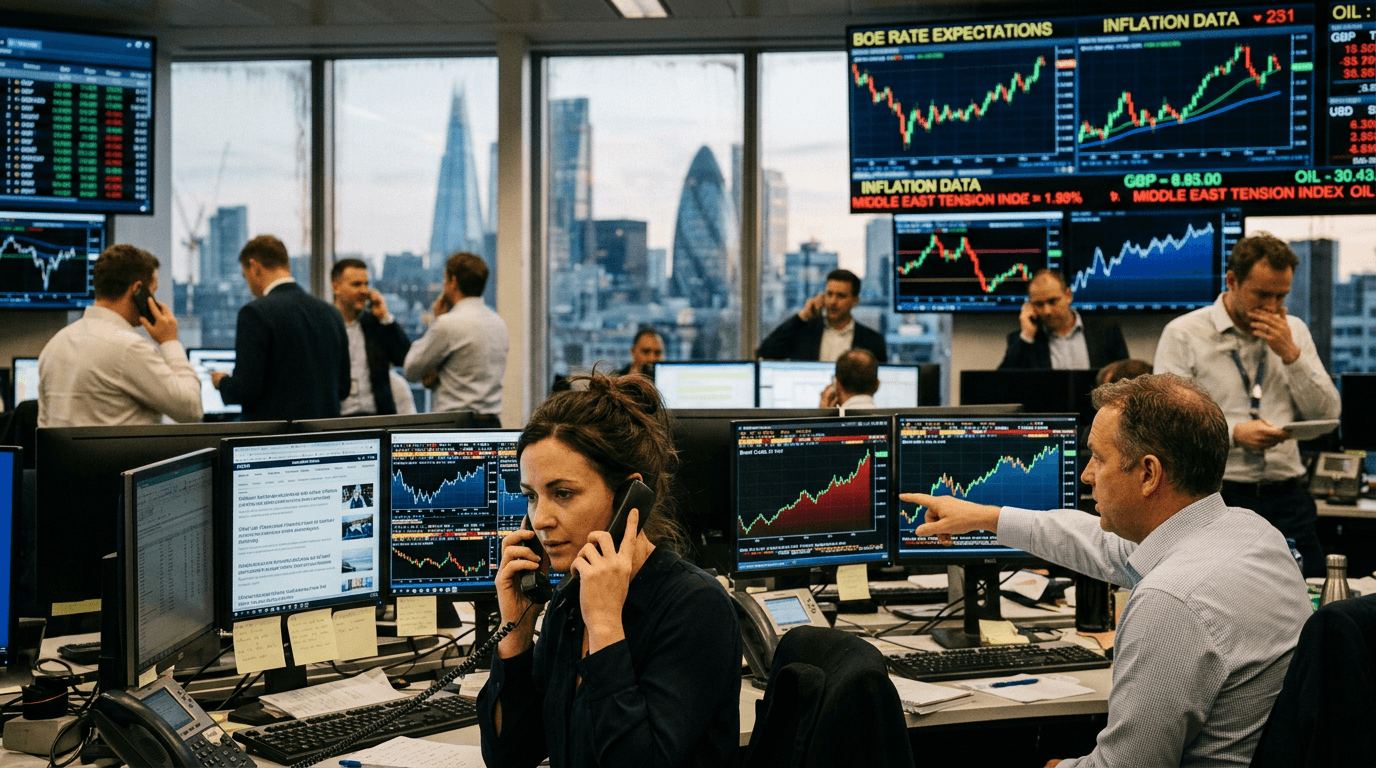
Sterling’s latest firming against the dollar is a subtle move, but it’s happening against a dramatic backdrop: surging oil prices, renewed Gulf tensions, and shifting expectations about central banks. The result is an FX market where traditional safe-haven flows into the dollar are being reshuffled, and GBP/USD traders need to think carefully about how energy, geopolitics, and interest rates intersect.[1][4][13][14]
Global Backdrop: Oil, Gulf Tensions And Safe-haven Flows
Gulf and broader Middle East tensions have flared again, with reports of strikes and disruptions around key shipping routes such as the Strait of Hormuz.[1][4][11][14] These developments have pushed crude higher, with Brent trading above the low-to-mid $70s and some sessions seeing gains of more than 2% as markets price in supply risks.[3][4][14] Higher oil is reviving concerns that global inflation may re-accelerate, especially through fuel and transport costs.[1][4]
Historically, episodes like this have driven investors firmly into the U.S. dollar as the primary safe haven, often pressuring risk-sensitive currencies such as the pound.[3][5][10] We’ve seen that pattern recently when oil spikes above $100–120 a barrel, with sterling dropping sharply as investors seek the perceived security of the dollar and U.S. Treasuries.[3][5][9][10] However, the current move is more nuanced: dollar demand is robust, but the greenback has eased off recent highs, and flow is increasingly differentiated across G10 FX rather than simply “buy USD, sell everything else.”[1][11][13][14]
Key takeaway: geopolitical shocks are still dollar-positive and oil-supportive, but the reaction is no longer one-directional. Traders need to map not only “risk-off” sentiment, but how each currency’s domestic story interacts with those global forces.
Why Sterling Is Holding Up
Despite elevated Gulf tensions and firmer oil, sterling has managed to edge higher against the dollar in recent sessions, with GBP/USD posting modest gains of around 0.03–0.3% depending on the trading window.[2][4][13][14] That resilience is notable given that the UK is a net energy importer and typically suffers when oil prices spike.[5][9]
The key reason: markets still expect the Bank of England (BoE) to keep interest rates relatively high for longer to contain persistent domestic inflation, which is being reinforced by higher energy costs.[4][11][14] Hormuz-related disruptions feed directly into UK inflation expectations, strengthening the case for a prolonged period of restrictive policy.[4][11] By contrast, softer U.S. CPI readings have clipped some of the more aggressive dollar-bullish bets on the Federal Reserve, even as oil and war risk remain elevated.[1][11][15]
In this environment, sterling’s “carry” appeal – the yield advantage or at least competitiveness versus some G10 peers – helps offset its vulnerability to energy shocks.[4][11][13] GBP’s gains are not explosive; cable is still trading within a broad range, with support roughly in the 1.25 area and resistance closer to 1.27 in some recent narratives, or mid-1.33–1.34 in others depending on the reference dates.[3][4][11][13][14] But the pound’s ability to hold firm while the dollar and oil both have safe-haven bids is a clear sign that rate expectations matter just as much as risk sentiment.
Key takeaway: sterling is not “immune” to Gulf tensions, but strong BoE rate expectations and still-elevated UK yields are giving GBP a cushion. For FX traders, the pound is behaving less like a pure risk currency and more like a high-beta, higher-yield G10 unit.
IMPLICATIONS FOR GBP/USD AND BROADER G10 FX
For GBP/USD, the current setup is a tug-of-war between three forces: dollar safe-haven demand, oil-driven inflation risk, and relative central bank expectations. Safe-haven flows and higher oil support the dollar, but softer U.S. data and some profit-taking have prevented the greenback from breaking substantially higher.[1][11][13][15] At the same time, UK-specific inflation pressures are anchoring expectations that the BoE will keep policy tight, allowing sterling to firm modestly even as risk sentiment remains fragile.[4][11][13][14]
Across G10 FX, currencies more closely tied to energy exports (like NOK and CAD) may benefit from higher oil, while energy importers (like JPY, EUR, and GBP) face a more complex mix of inflation risk and growth concerns.[3][5][9] The euro and yen have struggled more than sterling in some recent episodes, indicating that the pound is outperforming other risk-sensitive currencies, not that the dollar is structurally weak.[4][8][13]
This matters for traders in two ways. First, range dynamics in GBP/USD remain important: we are seeing repeated tests of key technical levels rather than clean, trending moves.[3][4][11][14] Second, relative rate expectations – Fed versus BoE versus ECB – are doing more of the heavy lifting than headline risk alone. A softer dollar on the back of inflation data can coexist with elevated Gulf tensions and high oil, and that blend is what has allowed the pound to firm.
Key takeaway: GBP/USD is being driven by cross-currents. Trend-following strategies based solely on risk sentiment may underperform; traders need to incorporate rate differentials and inflation data into their playbook.
Trading Takeaways For Simulated And Live Markets
For traders using simulated environments such as SimFi platforms, this episode is a textbook case study in multi-factor FX analysis.[4] It highlights how quickly narratives can shift from “war shock, buy USD” to a subtler mix of “war shock plus inflation plus central bank divergence.”[1][4][11][13]
In a practice or live setting, several disciplines become crucial:
1) Scenario planning: Map at least three scenarios – further escalation with oil above recent highs, a contained conflict with stable oil, and a de-escalation that drives both oil and safe-haven demand lower. Estimate how each scenario affects Fed and BoE expectations and, in turn, GBP/USD.
2) Correlation awareness: Track rolling correlations between GBP/USD, oil benchmarks, and the dollar index. Correlations can invert when inflation data or central bank communications surprise markets.[1][11]
3) Range and risk management: With cable confined to relatively well-defined ranges, mean-reversion strategies around key support and resistance, combined with tight risk controls, may be more effective than chasing breakouts that fail.[3][4][11][14]
4) Event discipline: Gulf headlines, central bank minutes, and CPI releases are all capable of shifting the narrative in a single session. Mark these events on your calendar and adjust position size and leverage ahead of time.[1][11][13][15]
Key takeaway: treating this environment as a live case study – rather than a one-off news shock – can sharpen skills in macro analysis, risk management, and scenario planning.
What To Watch Next
Looking ahead, the interplay between Gulf tensions, oil prices, and central bank expectations will remain central to GBP/USD and G10 FX trading. Continued military action or new disruptions to key shipping routes could push crude higher and re-intensify dollar safe-haven demand.[1][3][4][14] Conversely, signs of diplomatic progress or stabilizing energy supply would likely cool oil and reduce the urgency of inflation fears, potentially easing pressure on both the Fed and BoE.[1][11]
Foreign exchange traders should also monitor whether softer U.S. inflation prints become a trend rather than a one-off. If the market grows more confident that the Fed can eventually pivot away from a hawkish stance, while the BoE remains locked into fighting stubborn UK price pressures, sterling could continue to outperform even during intermittent bouts of global risk aversion.[4][11][13]
Key takeaway: this is a dynamic story, not a static snapshot. The pound’s recent firmness amid Gulf tensions and shifting dollar demand is an early chapter in a broader narrative about how geopolitics and inflation are reshaping FX behavior in the mid-2020s.
Conclusion: Navigating A Complex Fx Landscape
The headline “Pound firms as oil and Gulf tensions shift dollar demand” captures a nuanced reality: safe-haven flows are still powerful, but they now operate through the lens of inflation risk and central bank divergence.[1][4][11][13][14] For GBP/USD traders, the challenge is to move beyond simple risk-on/risk-off frameworks and integrate energy markets, geopolitics, and rate expectations into a coherent strategy.
In practice, that means respecting the dollar’s defensive role, recognizing sterling’s evolving profile as a higher-yield, inflation-exposed currency, and staying alert to how each new data point or Gulf headline can tip the balance. Whether in simulated environments or live markets, those who adapt to this more complex regime will be better positioned to interpret the next move in cable – and the broader G10 FX landscape it helps to signal.[4][11][13][14]