
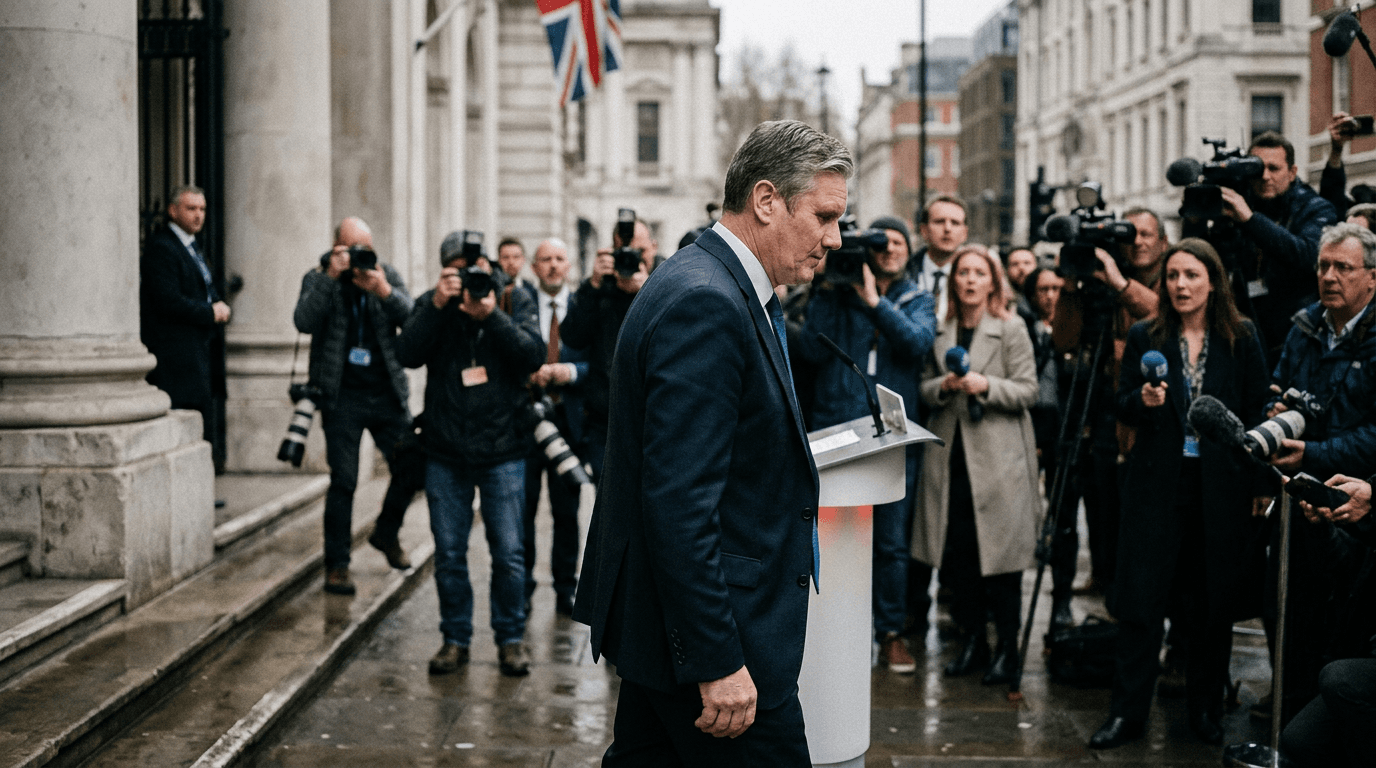
The announcement that Prime Minister Keir Starmer will step down by September has injected a fresh dose of political risk into UK markets, pushing the pound and UK government bonds lower as investors rapidly reassess the country’s policy outlook.[2][5] For traders, this is not just a headline – it’s a real-time example of how political uncertainty can ripple through FX and fixed income markets and reshape opportunity and risk.
Political Shockwave Hits Sterling
Starmer’s decision to resign as both prime minister and Labour leader, while remaining in office until a successor is chosen, effectively starts a leadership race that could deliver the UK its seventh prime minister in a decade.[3][5] Markets dislike uncertainty, and a contested transition at the heart of government is a textbook catalyst for repricing risk.
Sterling reacted first. The pound slipped roughly 0.25–0.30% against the dollar, trading near $1.32 in the hours after the announcement, while holding broadly steady versus the euro.[2] On an average day this is not a crisis-level move, but in a major currency pair like GBP/USD, that kind of shift, driven primarily by politics rather than data, is notable.
UK government bonds also came under pressure. Benchmark 10-year gilt yields ticked up to around 4.85%, reflecting lower bond prices as investors demanded a slightly higher return to hold UK risk amid the leadership uncertainty.[2] The move in gilts was modest in absolute terms, but directionally consistent with a mild rise in perceived political risk.
Equity markets were more contained. UK stock indices saw only limited movement, suggesting that for now, investors see this as a political story rather than a fundamental shock to corporate earnings or the broader economic trajectory.[1] That could change quickly if the incoming leadership team signals major shifts in fiscal or regulatory policy.
How Uk Politics Translates Into Market Pricing
For traders, the key is understanding the mechanism: why should a leadership timetable move GBP and gilts at all?
There are three main channels
1. Policy uncertainty Markets now have to discount a wider range of potential outcomes on tax, spending, and regulation. A leadership contest within Labour opens the door to different economic priorities depending on who wins and which faction gains influence.[1][5] Until that is clearer, investors price in a small “uncertainty premium” on UK assets.
2. Fiscal credibility and gilt risk premia Bond investors care deeply about who will run the Treasury and how credible the medium-term fiscal plan looks. The experience of the 2022 mini-budget showed how quickly gilts can sell off if markets lose confidence in fiscal discipline. Even though this episode is far milder, any hint of looser fiscal policy under new leadership can push gilt yields higher as investors demand compensation for perceived risk.
3. Growth and monetary policy expectations A new prime minister and chancellor could shift the balance between growth-friendly measures and fiscal consolidation. That feeds back into Bank of England expectations: stronger perceived growth and looser fiscal policy might mean higher-for-longer rates, while a more cautious stance might do the opposite. FX markets, in turn, respond to relative interest rate expectations between the UK and its peers.
In this case, the immediate reaction has been measured, suggesting investors see a managed transition rather than a disorderly power struggle.[1][3] But the leadership race will likely inject bursts of volatility as candidates set out their economic platforms.
Scenario Analysis: What Traders Should Watch Next
For market participants – whether in live accounts or simulated environments – the next phase is about scenario planning rather than reacting blindly to each headline.
Key variables to track include
- The leadership field and frontrunner status Andy Burnham currently appears the favorite to succeed Starmer, with backing from key figures and strong popularity within the party.[1][3] Markets will scrutinize his economic stance and his choice of chancellor if he wins.
- The tone on fiscal and investment policy Traders should watch closely for signals on corporate taxation, public investment, green transition spending, and any revisions to existing fiscal rules. Anything that challenges the perception of fiscal prudence can weigh on gilts and, by extension, on sterling.
- Relationship with the Bank of England While the BoE is independent, political pressure and the broader policy mix matter. A leadership team seen as cooperative and predictable is supportive for UK assets; a confrontational or unpredictable stance could add a risk premium.
Based on these moving parts, here are three broad market scenarios to consider:
- Smooth transition, market-friendly signals A clear frontrunner emerges early, with credible, continuity-oriented economic messaging. In this case, the recent dip in GBP and mild gilt weakness may reverse as investors refocus on macro data rather than politics.
- Smooth transition, more expansionary policy If the new leadership promises higher public spending or looser fiscal settings to address growth and public service pressures, gilts could underperform even if politics stabilise. Sterling might struggle versus the dollar but fare better against lower-yielding currencies.
- Fragmented or contentious transition If the leadership race turns messy, with factional battles and mixed economic messages, risk premia on UK assets could rise more meaningfully. That would likely mean a weaker pound, underperforming gilts, and a wider discount on UK risk relative to other developed markets.
Trading And Risk Management Takeaways
For traders, this development is a reminder that political risk is not a “one-day event” but an evolving narrative that can create multiple trading opportunities – and traps.
Key practical takeaways
- Treat this as a volatility regime shift, not a one-off spike GBP pairs and UK rates may see higher headline sensitivity over the coming weeks as the leadership timetable progresses. That can reward short-term traders but punishes overleveraged positions that ignore political calendars.
- Focus on relative value, not just direction Instead of simply asking “Will GBP go up or down?”, consider crosses where UK-specific risk is the main driver – for example GBP versus EUR – and instruments where UK political risk is directly priced, such as gilts versus German bunds.
- Let positioning and data guide conviction Keep an eye on positioning indicators, implied volatility, and upcoming macro data. If markets are already heavily short GBP, for example, even mildly positive leadership news can trigger a sharp squeeze.
- Use simulated environments to test playbooks For newer traders or those refining strategies, a SimFi environment is an ideal place to backtest and live-test reactions to political shocks: how your strategy would have handled this announcement, and how it might perform across the scenarios outlined above.
Conclusion
Keir Starmer’s decision to set a timetable for his resignation has nudged the pound lower and pushed gilt yields modestly higher, reminding markets that UK politics remains a significant – and recurring – source of risk.[2][5] The headline move so far is contained, but the story is just beginning: a leadership race, a new prime minister, and potentially a new economic team will all feed into the pricing of UK assets in the months ahead.
For traders, the edge lies not in predicting every twist of Westminster politics, but in understanding how those twists filter into FX, rates, and risk sentiment – and in having a clear, tested framework to trade and manage risk around them.