
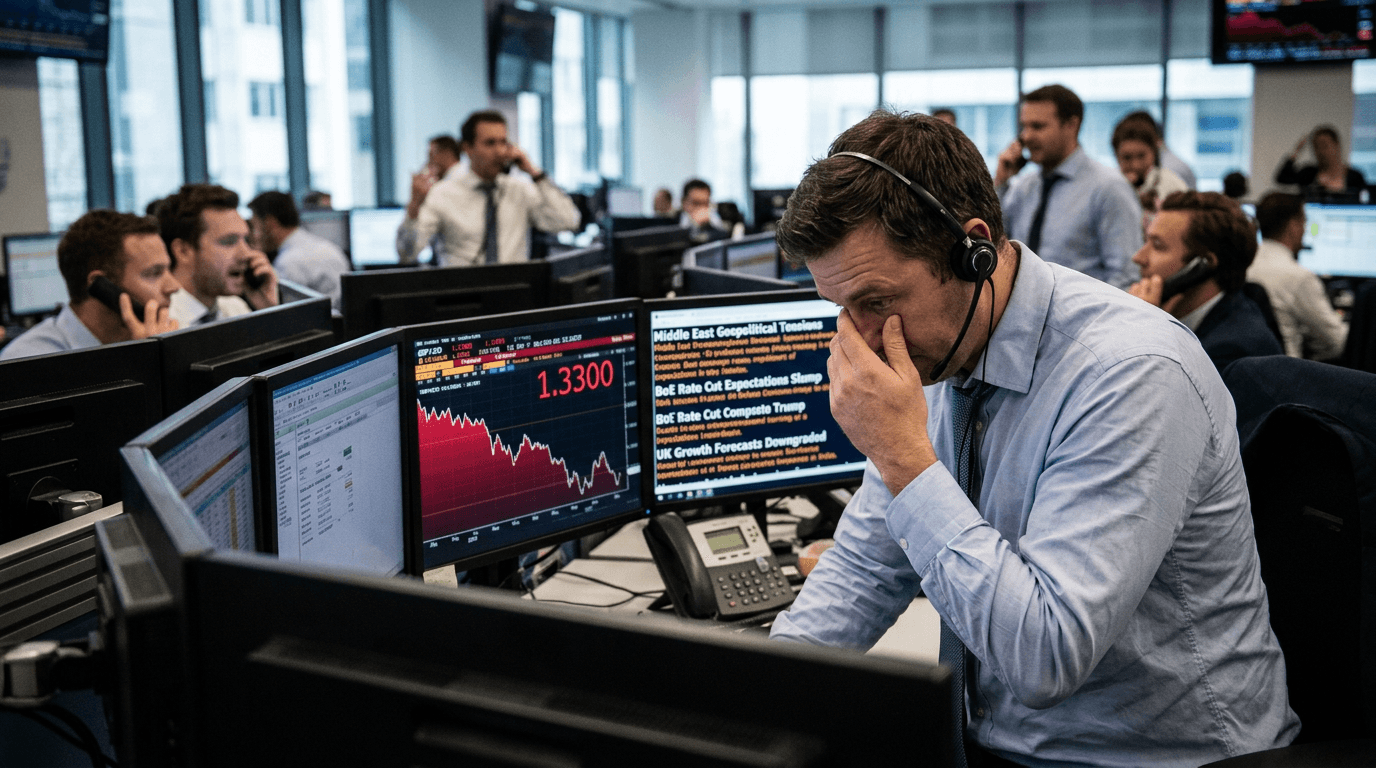
The British Pound has experienced a sharp selloff against major currencies as geopolitical tensions in the Middle East intensify, sending investors fleeing to safer assets and reshaping expectations for monetary policy. GBP/USD has slid to 1.3300, marking its lowest level since December 9, as risk aversion grips global markets and the US Dollar strengthens on safe-haven demand. This currency weakness comes at a particularly challenging time for the UK economy, as domestic growth forecasts have been downgraded and energy price pressures mount from regional instability.
Market Overview: The Pound's Sharp Decline
The Pound Sterling's decline reflects a confluence of external shocks and domestic economic headwinds that are combining to weigh on sterling sentiment. GBP/USD trades at 1.3304, down 0.73% as geopolitical developments drive broader risk-off sentiment across global markets. The US Dollar Index has climbed 0.78% to 99.31, near daily highs, as investors rotate into the perceived safety of the Greenback during uncertain times.
This sell-off represents more than just a routine currency correction. The pound has fallen significantly from its recent highs, moving below clustered moving averages around 1.3500 and breaking through key support levels. The technical breakdown signals that the currency's recent upside momentum has been exhausted, and a more serious corrective phase may be underway. For traders monitoring GBP pairs, this represents a critical juncture where technical support around 1.3290 becomes crucial to prevent further declines toward 1.3100.
Geopolitical Pressures Igniting Flight To Safety
The primary catalyst for sterling weakness stems from escalating Middle East hostilities involving the United States, Israel, and Iran. Recent military strikes have significantly heightened geopolitical risk, with military operations expected to continue for an extended period. The conflict has triggered classic risk-aversion responses, with investors abandoning riskier assets and rotating into traditional safe havens like the US Dollar and gold, which has gained 1.8% during the turmoil.
One particularly significant development involves Iran's Revolutionary Guard threatening to close the Strait of Hormuz, through which approximately 20% of global crude oil production flows. This threat has already prompted some shipping companies to suspend transit through the waterway, creating bottlenecks and adding substantial upside pressure to energy prices. Brent crude initially spiked 13% to above $82 per barrel in early Asian trading before easing, illustrating the volatility that geopolitical shocks create in commodity markets.
These energy price pressures pose a particular challenge for the UK economy, which imports significant energy resources. Rising oil and gas costs typically create inflationary pressures that complicate monetary policy decisions and weigh on consumer purchasing power. The prospect of sustained energy price inflation has begun to reshape how markets perceive both the global economic outlook and the Bank of England's policy path forward.
Shifting Rate Expectations And Economic Headwinds
Perhaps most significantly for pound traders, expectations for Bank of England rate cuts have collapsed amid geopolitical uncertainty and inflationary pressures. Just last Friday, markets had priced in approximately a 75% probability of a BoE rate cut at the March meeting. That expectation has plummeted to just 28% as of Tuesday's session, a dramatic reversal that underscores how quickly geopolitical shocks can reshape policy expectations.
Adding to these pressures, UK Chancellor Rachel Reeves unveiled downgraded economic growth forecasts that further dim the near-term outlook. The Office for Budget Responsibility has reduced its 2026 growth projection to 1.1%, down from the previously estimated 1.4%, signaling meaningful economic weakness before factoring in potential energy price shocks. These softer growth expectations, combined with rising inflation risks from energy costs, place the Bank of England in an extremely difficult position, potentially favoring a more hawkish stance focused on controlling inflation rather than supporting growth through rate cuts.
This policy uncertainty adds another layer of pressure to the pound. With rate cut expectations fading, the attractiveness of sterling-denominated assets diminishes relative to higher-yielding alternatives, particularly the US Dollar, where Federal Reserve officials have indicated the easing cycle remains on track only if inflation moderates. The contrast between potentially higher-for-longer UK rates and a moderating Fed easing cycle creates additional headwinds for GBP/USD.
Technical Outlook And Trading Implications
From a technical perspective, GBP/USD displays a decidedly bearish structure. The pair has broken below key support around 1.3586, and traders should monitor immediate resistance near 1.3400, where broken support and moving average clusters converge. Further resistance emerges at 1.3498 and 1.3550, both aligned with prior reaction highs that are capped by a descending trend line.
To the downside, initial support stands at recent lows around 1.3290, with a break potentially exposing 1.3200 and then 1.3100, levels that mark the origin of the broader rising trend from 1.3035. A daily close back above 1.3550 would be needed to negate the current bearish tone and reopen topside potential toward 1.3700.
Key Takeaways For Traders
The pound's sharp decline reflects genuine economic and geopolitical headwinds rather than temporary market noise. Traders should monitor three key developments: the evolution of Middle East tensions and energy prices, the Bank of England's messaging on rate cuts versus inflation concerns, and whether technical support levels hold. The current environment favors cautious positioning, with risk-aversion likely to persist until geopolitical clarity improves and energy price trajectories stabilize.