
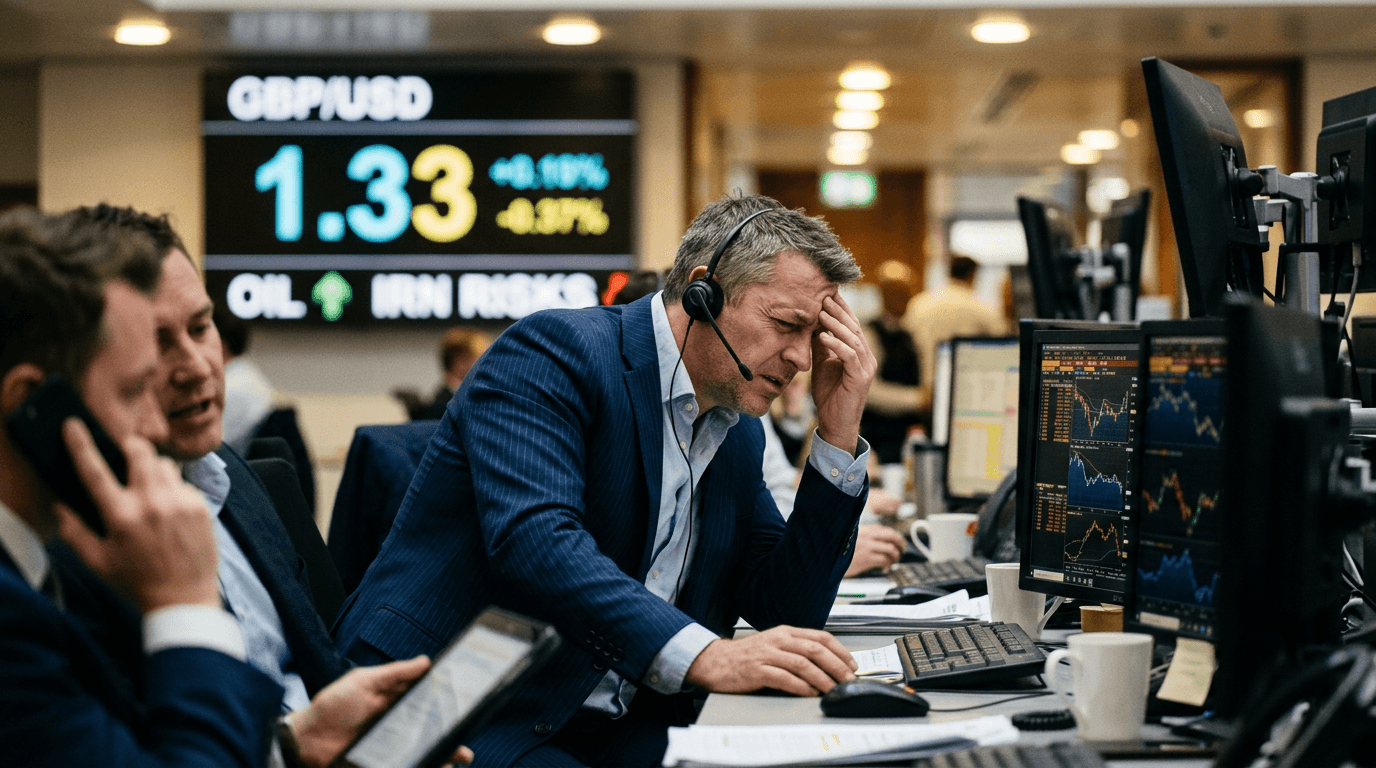
The British pound has slipped back onto the defensive, trading near 1.33 against the US dollar as a combination of heightened Iran-related tensions, elevated oil prices and persistent UK political uncertainty weigh on sentiment. For FX and macro traders, this is more than a single-currency story: sterling’s vulnerability is feeding into volatility in GBP crosses, UK rates markets and equity indices, reshaping expectations around the Bank of England (BoE) and the broader UK risk premium.
WHAT’S DRIVING GBP NEAR 1.33?
Several forces are converging on the pound at the same time.
First, the US dollar has firmed as global investors seek relative safety amid geopolitical stress in the Middle East. When risk appetite deteriorates, capital typically flows into the dollar and US Treasuries, making it harder for currencies like GBP to sustain gains.
Second, oil prices have pushed higher as traders price in the risk of supply disruption and a wider regional conflict involving Iran. The UK is a net energy importer, so sustained higher oil and gas prices tend to worsen its terms of trade, squeeze households and corporates, and complicate the BoE’s inflation fight.
Third, domestic uncertainty remains elevated. Ongoing political instability, shifting fiscal narratives and questions over the medium-term growth outlook all feed into a “risk premium” on UK assets. That premium often shows up first in the FX market, via a weaker pound and more volatile GBP crosses.
As a result, GBP/USD has been gravitating around the 1.33 area instead of pushing higher, even though UK rates are not dramatically lower than US rates. The message from price action is clear: investors need extra compensation to hold sterling in an environment of geopolitical stress and political noise.
Geopolitics, Oil And The Dollar: Why Tensions Hit Sterling
Geopolitical shocks tend to affect currencies through three main channels: risk sentiment, commodity prices and differentiated exposure.
Risk sentiment is the clearest. When tensions rise, investors trim riskier positions and move into perceived safe havens. The US dollar, US Treasuries, the Swiss franc and (to a lesser extent) the Japanese yen often benefit. The pound, while a major currency, is not viewed as a primary safe haven, so it usually sits on the “funding” side of risk-off moves.
Commodity prices are the second channel. Rising oil on the back of Iran-related concerns can boost currencies of energy exporters, such as CAD or NOK, but it is a headwind for net importers like the UK, the euro area and Japan. For the UK, higher oil means:
- Potentially higher headline inflation
- Pressure on consumer spending as fuel and energy bills rise
- Margin compression for energy-intensive businesses
This is a problematic mix for a central bank that is already trying to engineer a soft landing.
The third channel is relative exposure. Investors ask: which economies are most vulnerable if tensions escalate? The euro area and UK, with close trade and financial links and limited energy self-sufficiency, can appear more exposed than the US. That perception alone can widen spreads on European and UK assets and weaken their currencies, even before hard data deteriorates.
For traders, this means GBP is likely to remain highly sensitive to headlines around Iran, oil prices and broader risk appetite. Sudden swings in GBP/USD and GBP/JPY around geopolitical news should not be surprising in this environment.
Uk Political Risk And Bank Of England Expectations
Political uncertainty is the other major drag on sterling. Markets dislike unclear policy trajectories: shifting signals on fiscal plans, questions over the durability of the current government, and noisy debate over growth and regulation all feed into a UK-specific risk premium.
That uncertainty matters because it interacts directly with BoE expectations and the interest-rate differential that underpins FX valuations.
If political instability is seen as inflationary — for example, via looser fiscal policy or weaker confidence in medium-term consolidation — markets may price in higher-for-longer rates or a slower pace of BoE cuts. That could, in theory, support GBP via a wider rate differential versus peers.
However, if instability is viewed as growth-negative — deterring investment, undermining business confidence and raising the risk of future austerity — markets may see an earlier pivot to cuts as the BoE responds to weaker demand. In that scenario, lower expected real yields erode support for the pound.
Right now, the balance of risks leans toward a more cautious BoE, facing:
- Still-sticky services inflation
- A real income squeeze from higher energy
- Soft but not collapsing growth
That leaves the BoE walking a tightrope. Small shifts in market pricing for the next one or two policy meetings can translate into meaningful FX moves when sentiment is fragile.
For traders, tracking BoE commentary, inflation data and UK activity indicators is essential. Surprises on either side — a hawkish pushback against cuts, or a dovish pivot on growth concerns — could jolt GBP away from the 1.33 region.
Market Ripple Effects: Gbp Crosses, Gilts And Equities
Weakness in GBP/USD is only part of the story. Sterling’s vulnerability is rippling across related markets.
GBP crosses: Pairs like EUR/GBP and GBP/JPY have seen increased realized and implied volatility. EUR/GBP tends to rise when UK-specific risk dominates, while GBP/JPY is particularly sensitive to shifts in global risk appetite. For options traders, this is showing up as higher implied vols and richer premiums around key event dates.
UK gilts: Political noise and uncertainty about the BoE path are feeding into the gilt curve. Front-end yields respond to rate expectations, while longer maturities price in term premia and fiscal risk. A weaker pound can make overseas investors more cautious about holding gilts, potentially demanding higher yields as compensation.
Equities: The FTSE 100 often benefits from a weaker pound because many of its components earn revenues abroad and report in sterling. However, for more domestically focused mid- and small-cap indices, sterling weakness tied to political uncertainty and growth worries can be negative. Sector dispersion is high: energy and exporters may outperform, while domestic financials, retailers and cyclicals can lag.
The key takeaway is that GBP weakness near 1.33 is not a standalone FX event; it is a macro regime signal with cross-asset implications.
How Active Traders Can Navigate Gbp Volatility
For active traders, the current environment in sterling offers both opportunity and elevated risk. A few practical considerations:
1. Anchor trades in macro drivers Build GBP views around clear narratives: geopolitical risk and oil, BoE expectations, and UK-specific political headlines. When these drivers align (for example, risk-off, rising oil, and negative UK news), directional GBP trades have stronger backing.
2. Respect key technical zones Levels around 1.33 in GBP/USD, and nearby support and resistance areas, are attracting flows. Watch how price reacts near recent lows and highs: failed breaks and false moves are common when macro uncertainty is high. Use these zones to define risk, not to predict with certainty.
3. Use volatility to your advantage Sterling crosses are seeing higher intraday ranges and richer options pricing. Short-term traders can look for mean-reversion setups after sharp, headline-driven spikes. Options traders may explore defined-risk strategies, such as spreads, to express views on volatility without unlimited downside.
4. Stay data- and event-aware Maintain a calendar of key releases (UK CPI, labour market data, GDP, PMIs) and BoE communication, alongside major geopolitical milestones or summits. Position sizes and leverage should reflect the likelihood of gap risk around these events.
5. Prioritise risk management In an environment where headlines can move GBP by 50–100 pips in minutes, tools like hard stop-losses, scenario planning and diversification across pairs become critical. Consider how correlated your GBP trades are with broader risk sentiment to avoid unintended concentration.
Conclusion
The pound’s slide toward 1.33 against the dollar encapsulates a broader story of geopolitical tension, energy-driven inflation risk and domestic political uncertainty. Rather than a simple reaction to one data point, sterling is reflecting a higher UK risk premium and a more complex backdrop for the BoE.
For traders, this backdrop demands discipline and a macro-aware approach. Understanding how Iran tensions feed into oil and risk appetite, how political noise shapes BoE expectations, and how these forces ripple through GBP crosses, gilts and equities is essential to navigating the current regime. Volatility in sterling may be uncomfortable for passive investors, but for prepared and risk-conscious traders, it is also a fertile environment for opportunity.