
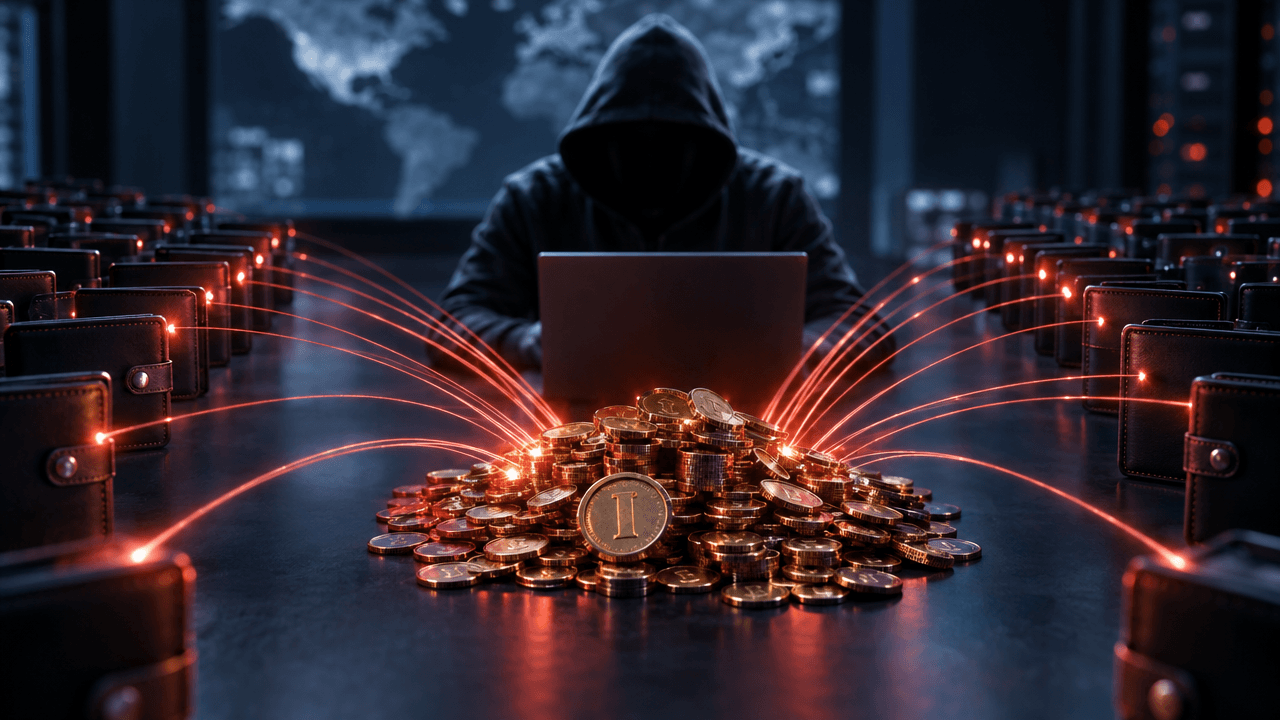
A blockchain can be technically sound at the protocol level and still suffer a serious security failure through the software used to access it. That distinction is central to the Qubic incident, in which an attacker drained approximately 2.94 trillion QU tokens, worth roughly $1.3 million to $1.4 million, from 1,404 wallets before the network was halted. [1][9]
What Happened To Qubic
Qubic halted its Layer-1 network on October 18 after identifying a coordinated attack against wallets with vulnerable recovery seeds. According to Qubic, the theft occurred between 23:42 UTC on October 17 and 01:26 UTC on October 18. Validators, known within the network as Computors, paused the chain at tick 85,371,949 to prevent the stolen assets from being transferred or sold while the incident was investigated. [9][10]
The scale of the attack was significant for a smaller blockchain. More than 1,400 wallets were affected in a short period, indicating that the attacker was likely able to identify vulnerable addresses systematically rather than compromising accounts one at a time.
Reports indicate that approximately 379.04 billion QU reached a MEXC deposit address, where the account was frozen. The remaining stolen funds, estimated at about 2.56 trillion QU, were distributed across eight attacker-controlled Qubic wallets and had reportedly stopped moving. [3]
The immediate halt was designed as a containment measure. However, it also highlighted an important trade-off in blockchain architecture: stopping transactions may help protect users during an emergency, but it demonstrates that the network can exercise centralized discretion over transaction processing.
The Role Of Weak Randomness
The incident was reportedly caused by insufficient randomness during wallet-seed generation, not by a direct failure in Qubic’s transaction-validation protocol. A wallet seed is the foundation from which private keys and addresses are derived. Anyone who reconstructs or predicts that seed can potentially control the assets held in the related wallet.
Randomness must be unpredictable when generating cryptographic secrets. If a wallet relies on a process that produces patterns an attacker can reproduce, even a long seed may provide a false sense of security. Security researchers and reports linked the vulnerability to the use of JavaScript’s Math.random() function, which is not designed for generating cryptographic keys. [4][11]
The affected environments reportedly included wallets created through browsers on iPhones and iPads, Safari on Mac computers before October 18, 2026, and an older version of the Qubic iOS application released before July 2025. [1][7]
Qubic said the issue had been corrected in its updated wallet software. Reports also described a change in web wallet version 4.26.4, replacing Math.random() with crypto.getRandomValues(), a function intended for security-sensitive random-number generation. [11][12]
The lesson applies well beyond Qubic. Wallet security is not determined only by the blockchain’s consensus algorithm. Applications, browser libraries, mobile operating systems, backup procedures and key-generation methods can all create points of failure.
Why The Incident Matters
The Qubic exploit adds to a broader pattern in digital assets: attackers often target the surrounding infrastructure rather than the core blockchain. Exchanges, bridges, smart contracts, front-end applications and wallets have repeatedly become the weakest links in otherwise sophisticated systems.
For users, this means that “self-custody” does not automatically mean “secure custody.” Holding private keys directly removes dependence on an exchange, but it also transfers responsibility for software quality and operational security to the user. A flawed wallet-generation process can expose funds even when the owner has never shared a seed phrase or clicked a malicious link.
The event also raises questions about emergency governance. Qubic’s coordinated halt may have limited additional losses and helped freeze funds connected to the attacker. At the same time, traders and users had no ability to process legitimate transactions while the network was paused. That disruption creates liquidity, settlement and confidence risks, especially for participants using the token in active trading strategies.
For smaller networks, the reputational impact can be greater than the direct dollar value of the theft. A loss of $1.3 million may be modest compared with major cryptocurrency hacks, but draining 1,404 wallets can undermine confidence among users, developers, exchanges and potential ecosystem partners.
Practical Steps For Traders And Users
Qubic users should treat any wallet generated through an affected environment as potentially compromised. Updating the application alone may not be enough if the original seed was created using a weak process. A safer approach is to create a new wallet using confirmed secure software, transfer funds only after the network resumes safely, and avoid reusing the old seed.
Users should also verify wallet software through official channels, review release notes, and be cautious of emergency “recovery” links shared on social media. During a crisis, scammers frequently impersonate project teams and ask users to submit seed phrases or sign suspicious transactions.
Traders using E8 Markets or other SimFi environments can study the incident without putting capital at risk. Build a scenario around a sudden blockchain halt, then consider how open positions, unavailable deposits, frozen withdrawals and sharp liquidity changes would affect risk management. The exercise reinforces an important principle: technical risk can become market risk very quickly.
Before trading a smaller token, evaluate more than price and volume. Review the project’s wallet architecture, software-update process, validator structure, incident-response procedures and exchange support. A network with limited liquidity may be more vulnerable to large price gaps if users rush to exit after a security event.
The Bigger Takeaway
The Qubic halt is a reminder that blockchain security is a complete system, not a single feature. Strong consensus cannot compensate for weak key generation, and decentralization claims do not eliminate the need for careful software engineering and transparent crisis management.
For investors, the practical response is disciplined rather than emotional: identify the source of a vulnerability, determine which wallets or accounts are affected, separate confirmed facts from speculation, and assess liquidity before taking action. For developers, the message is even clearer. Cryptographic randomness should come from purpose-built security tools, receive independent review, and be tested across every supported platform.
Qubic’s recovery will depend not only on returning the network to operation but also on explaining how the flaw passed into production, confirming that vulnerable wallets have been identified, and demonstrating that future wallet-generation processes are secure. The incident may eventually be contained, but its wider lesson will remain: in digital assets, a small implementation decision can create a system-wide security event.