
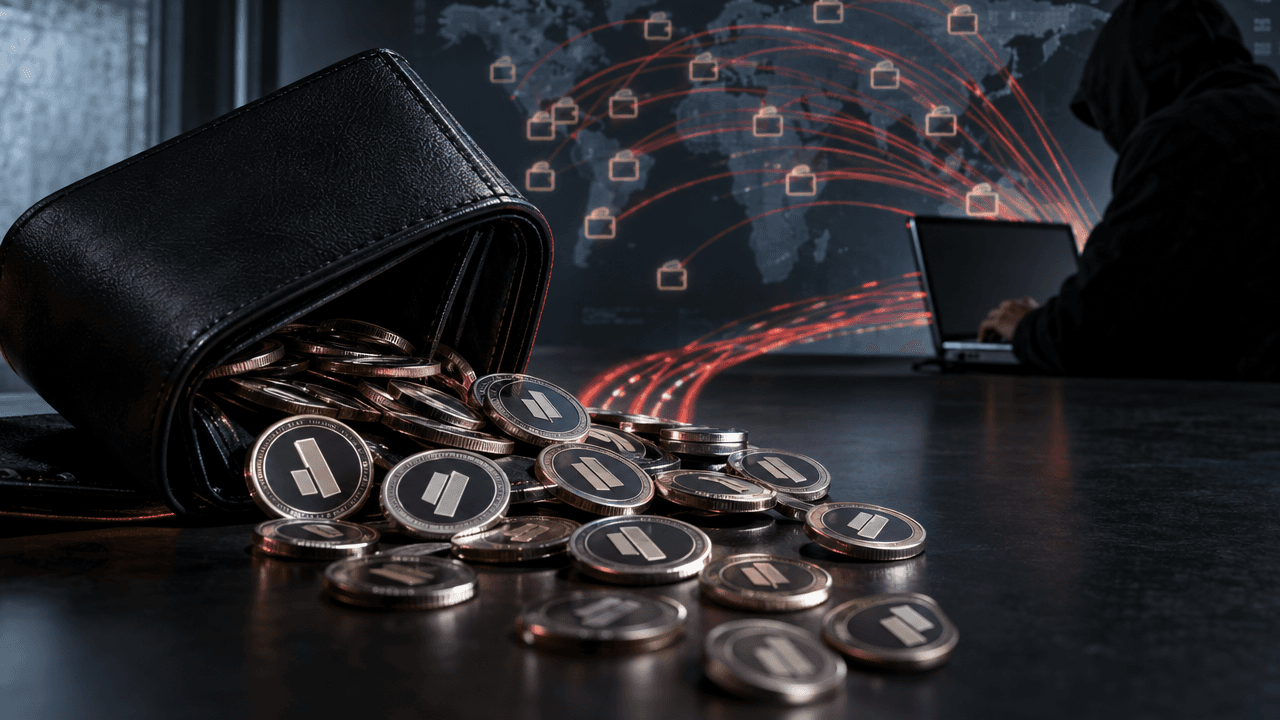
A Qubic blockchain exploit has exposed a familiar but often underestimated weakness in cryptocurrency security: sophisticated networks can still be undermined by basic failures in wallet software. On October 18, an attacker drained approximately 2.94 trillion QU tokens from 1,404 wallets, worth roughly $1.3 million at the time. Qubic validators subsequently halted the network while the team investigated and contained the incident. [2][5]
The attack adds fresh security pressure to smaller crypto assets, where lower liquidity, concentrated ownership, and less mature infrastructure can amplify the effects of a single technical failure. Although Qubic said the problem was not a flaw in its blockchain protocol, the episode demonstrates that the broader digital-asset ecosystem is only as strong as its weakest wallet, application, or development tool.
What Happened On The Qubic Network
According to Qubic’s account, the attacker exploited insufficient randomness in the generation of wallet recovery seeds. A seed is a collection of data used to derive the private keys that control a cryptocurrency wallet. Anyone who can reproduce or predict that seed may be able to reconstruct the wallet’s private keys and authorize transactions without physically accessing the owner’s device or recovery phrase.
The theft took place between 23:42 UTC on October 17 and 01:26 UTC on October 18, a period of approximately 104 minutes. During that window, 1,404 wallets were drained, with the total amount reaching about 2.94 trillion QU. [6][15]
Qubic identified several potentially affected environments. These included seeds generated on an iPhone or iPad through any browser before October 18, 2026, seeds created with Safari on a Mac before the same date, and seeds generated through the Qubic iOS application before July 2025. [2][3]
The network halt was designed to prevent further transactions while the team assessed the affected wallets and the movement of the stolen assets. Qubic reported that 87.1% of the drained funds remained frozen on the network because transactions were no longer processing. [12]
Why Randomness Matters
Cryptocurrency security depends heavily on randomness. Wallets must generate private keys and recovery seeds that are effectively impossible to predict. If software uses a weak or repeatable random-number process, attackers may be able to search through possible outcomes and identify the keys associated with specific wallets.
This risk is particularly serious because users may do everything correctly from a behavioral perspective. They may protect their passwords, avoid phishing links, and store their recovery phrases offline, yet still be exposed if the wallet generated those credentials using inadequate randomness in the first place.
Reports identified the vulnerability as a wallet-generation issue rather than a failure of Qubic’s underlying ledger or consensus mechanism. That distinction matters, but it does not make the consequences less serious for affected users. A secure blockchain cannot protect assets once an attacker has obtained the private keys needed to create valid transactions.
Qubic said the issue was addressed in version 4.26.4. Reporting on the software update indicated that the wallet moved away from JavaScript’s Math.random() function and adopted crypto.getRandomValues(), a method designed for cryptographically secure random-value generation. [9][10]
What Users Should Do Now
Anyone who has created a Qubic wallet in one of the potentially vulnerable environments should treat that wallet as compromised, even if its balance has not yet been drained. The safest response is to create a new wallet using updated software, transfer funds when the network permits transactions, and avoid reusing the old seed.
Users should obtain wallet software only through official Qubic channels and verify that they are using the latest release. Downloading an update from an unverified website or social-media link could introduce a separate malware risk.
It is also important to distinguish between a seed, a private key, a password, and a device. Changing a wallet password may not protect funds if the underlying seed is predictable. Likewise, moving a vulnerable wallet to another phone does not repair the original key-generation problem. The wallet itself must be replaced.
For traders and SimFi participants, the event offers a practical lesson: security analysis should cover custody and infrastructure, not only price charts. Before trading or holding a smaller token, evaluate the project’s wallet software, incident-response procedures, transparency, validator structure, and history of security updates.
Market Impact And Broader Lessons
A $1.3 million theft is modest compared with the largest cryptocurrency exploits, but the market impact should not be judged by dollar value alone. The attack affected more than 1,400 wallets and forced a blockchain halt, raising questions about operational resilience and user confidence. The incident may increase short-term volatility in QU and encourage traders to demand a higher risk premium from smaller digital assets.
The immediate market response can also be distorted by the frozen funds. If most stolen tokens cannot be moved or sold, the selling pressure may be limited temporarily. However, uncertainty around restitution, network reopening, and the long-term status of the affected assets can continue weighing on sentiment.
The most important takeaway is that blockchain security has multiple layers. Consensus rules, smart contracts, wallet software, operating systems, and user practices all contribute to the final security outcome. A protocol may remain technically sound while an application built around it creates a path to large-scale losses.
Conclusion
The Qubic exploit is a reminder that predictable randomness can be just as damaging as a sophisticated smart-contract bug. The affected wallets were compromised because attackers could exploit weaknesses in how their seeds were generated, resulting in the theft of approximately 2.94 trillion QU and a temporary network shutdown. [1][4]
For users, the priority is to abandon potentially vulnerable wallets and use verified, updated software. For traders, the incident reinforces the need to treat technical risk, liquidity, and operational resilience as core parts of market analysis. In SimFi environments, studying events like this can help traders practice evaluating not just whether an asset may rise or fall, but whether the infrastructure supporting it can withstand real-world stress.